
Agility Robotics and Churchill Capital Corp XI said on October 30 that their proposed combination and related financing are expected to deliver approximately $465 million before transaction expenses. For the humanoid-robotics sector, the important distinction is between a funding headline and the cash still to arrive.
In this article
Three components, not one new payment
The companies break down the expected total as follows:
- About $164 million from Churchill XI’s trust account.
- About $201 million from the committed PIPE financing.
- $100 million already received after the transaction was announced.
Alpha Bionic’s calculation: the trust and PIPE components add up to approximately $365 million. Adding the previously received $100 million produces the $465 million headline. Calling the entire amount a new payment at closing would therefore count an earlier inflow as if it were still pending.
This calculation is not a cash-balance estimate. It does not tell us how much of the earlier funding remains, what transaction expenses will be, or how much operating expenditure occurs before completion. Without those figures, a reliable estimate of the company’s funding runway would be speculation.
What the SPAC structure changes
A SPAC is a listed shell company that seeks to combine with an operating business. Its trust account holds funds that may be reduced when shareholders exercise redemption rights. A PIPE is a private investment in public equity: an additional financing component, not customer revenue. The SEC’s investor bulletin explains why investors should examine the transaction documents, redemption rights and potential dilution rather than treating a listing as a quality certificate.
That distinction matters beyond investors. A warehouse operator evaluating a humanoid supplier needs to separate the supplier’s access to capital from the robot’s operating economics. Financing can support development and service capacity; it cannot by itself establish the cost of a successful handling operation.
The listing is still a plan
The companies target a shareholder vote on November 2, closing on November 4 and Nasdaq trading under AGLT on November 5, subject to approval and other closing conditions. These are expected milestones, not completed events.
What industrial buyers should ask next
Our editorial assessment is that the next useful evidence is operational, not another headline funding total. Buyers should ask for availability measured over representative shifts, the frequency of human interventions, integration and maintenance costs, and responsibility for downtime. A demonstration and a sustained production workflow answer different questions.
The same discipline applies to comparing suppliers: use the same workload, shift pattern and support assumptions. Otherwise a low headline robot price can be compared with an all-inclusive service price, producing a misleading result. See our Digit 5 price, costs and safety fact-check for the separate product questions.
The financing announcement makes Agility’s proposed capital structure more concrete. The decisive unanswered question is how much usable capital will remain after completion, and what measurable customer outcomes that capital can finance.
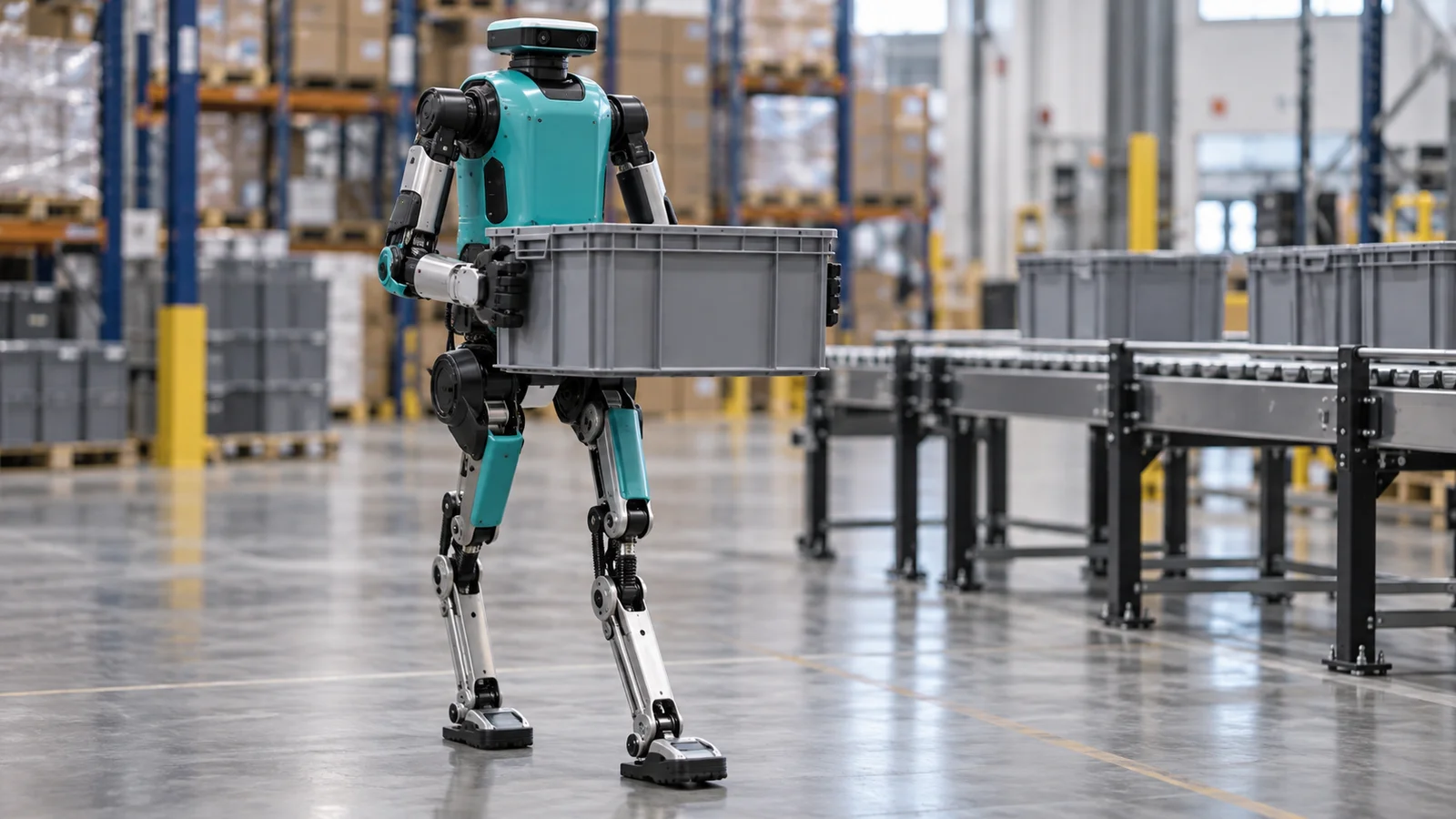
Image: AI-generated symbolic illustration of warehouse robotics; not a photograph of an Agility deployment or an exact Digit 5 product rendering.
Sources
- Agility Robotics and Churchill Capital XI: expected gross capital raise and anticipated closing, October 30, 2026. Primary source for the figures and timetable; company statements, not an independent operating-performance assessment.
- SEC / Investor.gov: What You Need to Know About SPACs, August 21, 2024. Background on the transaction structure and investor risks.