

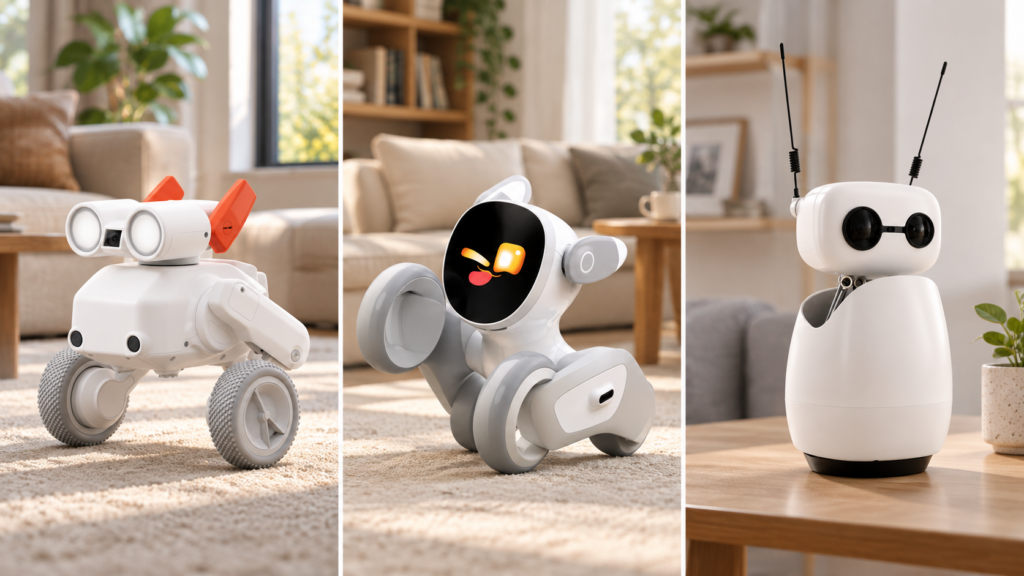
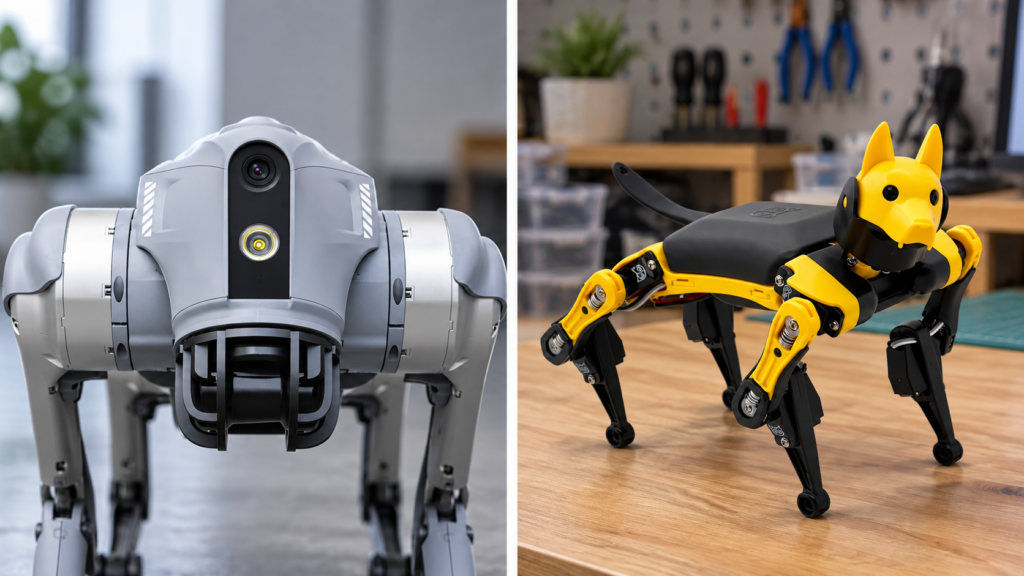
XGO-Duck / Open Duck Mini v2. Original reference-based AI illustration; generated setting, not a hands-on test or a scale-accurate size comparison.
You want a small robot that exists beyond a screen, and Microduck catches your attention. Then the real question arrives: do you actually want a walking duck? Or are you interested in programming, a lively companion, or a camera that follows you? The best Microduck alternatives answer different needs. Choosing solely by the lowest advertised price can mean buying the wrong hobby rather than finding a bargain.
My starting point is simple: choose the activity before choosing the robot. XGO-Duck and Open Duck Mini suit an interest in building and bipedal motion. Bittle X offers another route into experimentation. Beni, Loona and Reachy Mini address different expectations of a companion, while Go2 moves the discussion into a larger budget category. This is an editorial comparison of the linked manufacturer and project information, not a claim that I have personally tested these seven robots.
In this article
Microduck alternatives: prices that actually mean something
The following figures were researched on the linked offer pages on 29 October 2026. Dollar prices remain dollar prices: a currency conversion alone would not establish your local checkout total. Shipping, taxes, import charges and equipment choices can change the final cost. A project’s target parts budget is not a complete robot available at a guaranteed retail price.
| Alternative | Listed price | What it represents |
|---|---|---|
| XGO-Duck | US$352 | Electronics kit; no UNO Q or printed parts; presale |
| Open Duck Mini v2 | Parts target below US$400 | DIY project, not a complete retail offer |
| Open Duck: Tnkr kit | US$600 | Assembly kit; camera and microphone excluded |
| Beni | US$749 / US$899 | Standard / Explore; delivery estimated November 2026 |
| Unitree Go2 | From US$1,600 | Entry version; development access varies by version |
| Petoi Bittle X | From US$319 | V2 construction kit; check variant and availability |
| Loona Premium | US$429 | Displayed dollar offer; check package and region |
| Reachy Mini | US$399 / US$499 | Lite / Wireless kits; different computing arrangements |
Use this as a starting point, not a value ranking. A low entry price may assume that you already own tools, a suitable computer and the knowledge to assemble everything. A more expensive package may save sourcing work without providing more freedom. I would compare the same finished situation: what needs to be on my desk before the first project I actually want to make can begin?
1. XGO-Duck: for people who want to build the duck
If the duck shape and two-legged experimentation are the attraction, XGO-Duck deserves attention. Luwu Dynamics’ project documentation describes a printable design adapted from Microduck. That does not make the two products identically equipped.
I see this as a good direction for somebody who considers assembly part of the pleasure. Routing cables neatly, checking joints and investigating a failed movement are meaningful robotics activities. They are less appealing if the expectation is to open a birthday present and immediately play. Read the complete shopping list and use the assembly instructions for the relevant hardware revision. A photograph of a finished robot does not tell you everything inside the box being sold.
2. Open Duck Mini: more ownership, fewer shortcuts
Open Duck Mini v2 is interesting as an open building project. Its target parts cost and the separately offered kit price are distinguished above. Combining those figures would make DIY appear cheaper without accounting for what the buyer actually receives.
For me, the benefit is understanding decisions. Why is a joint positioned that way? What changes when a component changes? Where does mechanical play arise? These questions can turn assembly into a worthwhile learning experience. They also require time and occasionally more material. Budget for failed prints, spare components and an organised workspace. If you regard those hours as wasted leisure time, the most open design may not be the right purchasing priority for you.
Not sure whether this sort of experimentation is appealing? Our guide to the free browser-based Microduck simulator offers a low-commitment starting point. Simulation cannot reproduce every hardware difficulty, but it can help you explore your interest before ordering a physical platform.
3. Beni: choose it as a camera, not as a learning duck
Mondo presents Beni as an automatically following camera robot with 4K recording. The meaningful question is whether you regularly want moving footage, not whether the machine looks as charming as Microduck.
I would write down three specific filming situations before considering a purchase: perhaps a practice session, a suitable walking route or a low-angle sequence. Then check whether the intended surface, controls and editing process fit those situations. A camera robot helps only if it improves the whole workflow. An impressive advertised speed says little about whether your finished clip is useful. An estimated delivery month must also remain an estimate, not be presented as completed delivery.
4. Unitree Go2: a different scale of decision
Go2 is a larger quadruped rather than a pocket-sized substitute. Unitree also separates access to further development by version. The lowest advertised price should not automatically be paired with the broadest software access.
Here I would first consider space, transport and a clearly defined experimentation area. A more capable machine is not automatically a better first project. Somebody who wants to program a short movement at a desk may not need a larger platform at all. If this particular kind of locomotion is the goal, have the required interface confirmed before buying. A capability somewhere in a product family is not necessarily a feature of the exact version in your order.
5. Petoi Bittle X: coding without insisting on two legs
Bittle X is a small programmable robot dog. Petoi lists Python and block-based programming among its routes into development. That makes it worth considering when learning matters more than choosing a particular animal silhouette.
I would start with something manageable: change a movement sequence, repeat it and observe whether the result stays consistent. This can teach more than playing every supplied trick once. Pay attention to the exact package. A construction kit, an assembled unit and different servo options are not interchangeable descriptions. Check replacement parts and documentation before collecting accessories for a project you have not defined. The cheapest useful starting point is often the one that lets you finish your first idea.
6. Loona: companionship rather than gait research
Loona centres on wheels, expression and interaction. A buyer looking for a lively companion has different requirements from somebody who wants to develop movement control from the ground up.
I would look beyond one particularly charming reaction. How much preparation does an ordinary play session require? Can everyone in the household use the controls comfortably? Which features need an account or a connection? These are questions to check, not allegations of a particular fault. Our article on robot pets and emotional attachment explores why friendly designs can feel so compelling. Enjoyment is a legitimate reason to buy something; it is not evidence that a machine understands people as another person would.
7. Reachy Mini: the desk might be enough
Reachy Mini is a stationary companion. Lite uses an external computer, while Wireless includes computing hardware. Developing interaction does not necessarily require buying a robot that walks around the room.
This may sound less spectacular, yet fit your routine more closely. A fixed position makes it easier to repeat an experiment under similar conditions. I would define a small project: a response to a specific input, a custom expression sequence or a deliberately limited conversation. Check the requirements of that particular application separately. An open ecosystem does not mean every application is free or that every feature operates without an external service. Those are separate questions from the mechanical design.
Which Microduck alternative would I shortlist?
For building, I would start with XGO-Duck and Open Duck Mini. For compact coding exercises, I would compare Bittle X; for stationary interaction, Reachy Mini. Beni belongs in a camera decision, Loona in a companion decision. Go2 becomes relevant once space, budget and development requirements are deliberate choices. The Alpha Bionic robotics directory offers further manufacturers and categories to explore.
Before ordering, make four notes: the first task, the equipment needed, the complete cost and a realistic time allowance. If one remains blank, there is more research to do. None of these seven alternatives wins every category. The right robot is the one you still have a reason to use after the novelty has worn off.
FAQ: Microduck alternatives
Which alternative is closest to a robot duck?
XGO-Duck and Open Duck Mini are the natural building projects to examine for bipedal movement. Compare their individual components and instructions rather than inferring identical capabilities from a similar shape.
Which alternative is cheapest?
Bittle X has a low starting price among the listed product offers. DIY cost targets and incomplete electronics packages should not be ranked as though they were finished devices.
Is Open Duck Mini free?
Access to a project is not ownership of a physical robot. Components, printing material, tools, shipping and your own time remain part of the calculation.
Are the dollar figures local checkout totals?
No. They reproduce the researched offers. Your destination, chosen equipment and the actual complete amount shown by the seller determine the purchase cost.
What if I do not enjoy building?
Focus on the companion or camera activity you want rather than maximum technical openness. Still check setup work, assembly requirements and feature dependencies before ordering.
Are these photographs from a hands-on comparison?
No. They are newly generated AI illustrations based on references of the real models. They do not document shared testing or provide a scale-accurate size comparison.

Author Nico Nuss has worked with mobile computing and automation software since 2001. His many years of experience and strong interest in emerging technologies shape his work on robotics and artificial intelligence.