
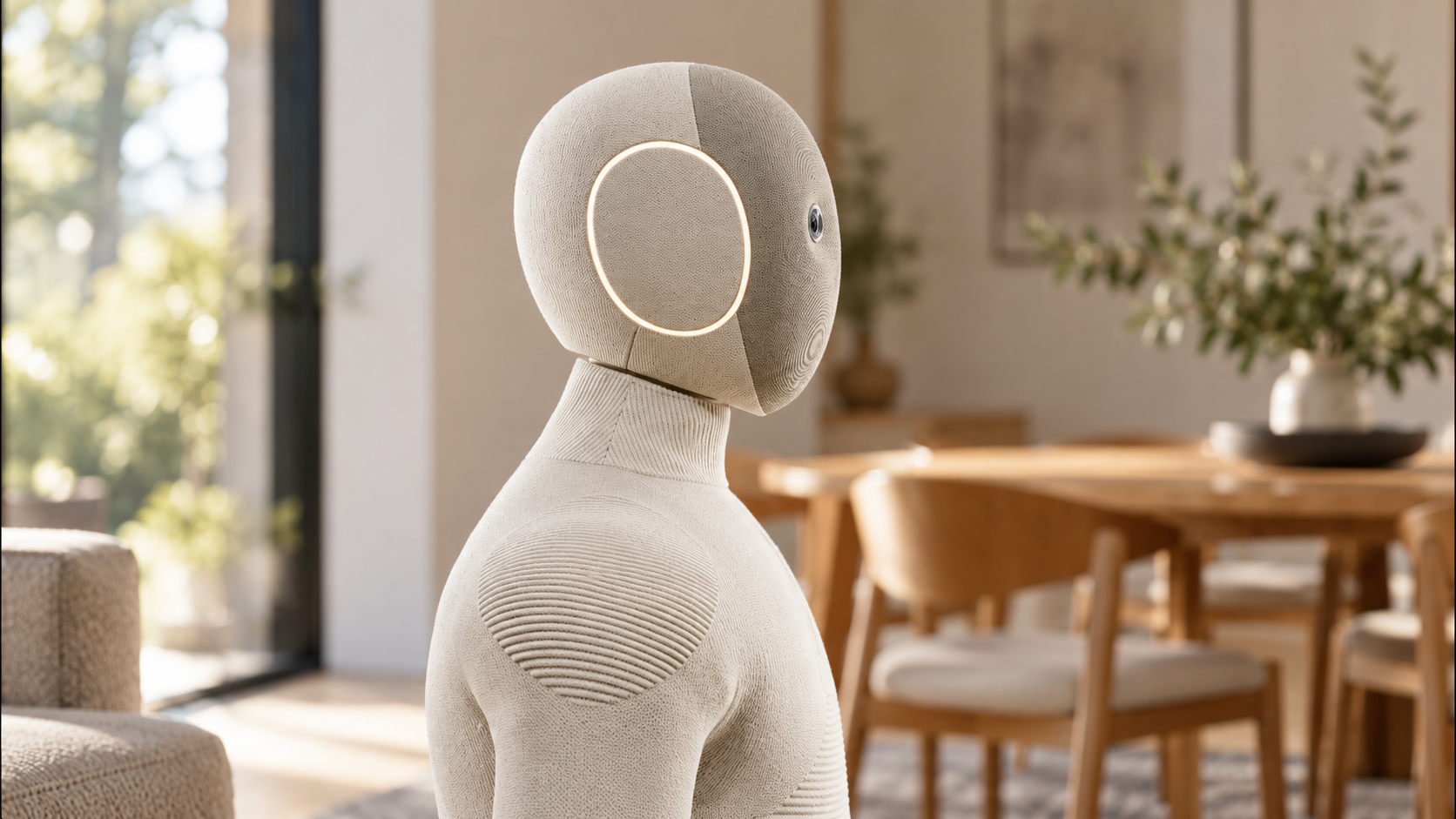
AI illustration of 1X NEO based on an official product reference. The home setting is generated; this is not a photograph of a hands-on test.
1X NEO is designed to help with household work, but a person can assist remotely when the humanoid encounters tasks it has not mastered. That combination of autonomous operation and human support makes Expert Mode central to understanding the product. The important question is not simply whether a towel eventually gets folded. It is who controls the work, how consistently it succeeds, and how much control the people living in the home retain.
This article examines the operating concept using official 1X information. It is not a hands-on review or a purchasing recommendation. We focus on autonomy, practical workflows and expectations that can be checked. Prices and reservations provide context rather than a verdict. For the separate purchasing question, see our guide to buying 1X NEO.
In this article
What Expert Mode actually means
The official NEO product page describes basic autonomy for early owners. For complex tasks that NEO does not know, it describes scheduled Expert Mode: a human expert can remotely supervise the robot’s actions to help complete the work and teach new abilities. The description therefore explicitly allows for tasks that are not fully independent from the beginning.
This is neither automatically a defect nor an insignificant extra. Remote assistance can make a task possible when autonomous control would otherwise stop. However, it changes what the result means. Someone expecting an independent household assistant should evaluate assisted outcomes separately from unassisted outcomes. A successful ending does not reveal the amount of preparation, supervision or intervention needed to reach it.
Three operating situations worth distinguishing
A useful evaluation separates autonomous execution, remote assistance and demonstrations whose operating conditions have not been explained. During autonomous execution, the system controls the action within its intended capabilities. Remote assistance adds human input. A demonstration may involve preparation or selection that viewers cannot infer from the final result. These categories are an editorial evaluation framework, not allegations about the operating mode of any particular recording.
Transitions during a task also matter. A robot might reach an object independently, need help manipulating it, then continue on its own. Calling the entire sequence autonomous would hide that distinction. A practical assessment should record when assistance starts, how long it lasts and whether it is needed again on the next attempt. Completing one step independently is not the same as finishing the complete household job independently.
Why ordinary homes are demanding environments
People rarely notice how much background knowledge goes into simple chores. A towel might be folded, crumpled, damp or trapped beneath other laundry. A drawer might be open, stiff or partially blocked by a chair. A useful machine needs to interpret the particular situation, select a workable action and respond appropriately when contact or movement differs from expectations. Recognizing the object is only one part of the problem.
One informative trial changes a single condition at a time: the same task under different lighting, with another basket or at a slightly different location. This reveals whether an ability extends beyond one prepared arrangement. All trials should remain within manufacturer instructions and intended uses. The purpose is not to expose the robot to deliberately dangerous situations, but to understand the boundaries of normal operation.
What the soft exterior does and does not establish
NEO’s official presentation shows a textile exterior and a design intended for living spaces. 1X describes tendon-like actuation and cushioning around the hardware. The relevant idea is broader than appearance: a machine moving near furniture and people needs manageable contact behavior, appropriate movement and a practical footprint. A capable gripper alone cannot make a complete household assistant comfortable to live with.
Soft covering does not establish universal safety. A moving body can still knock over an object or obstruct a path. Detailed hand engineering likewise does not prove dependable handling of every material. Our Atlas and Optimus robot-hand comparison explains why individual mechanical characteristics need to be evaluated in context. What matters is the completed task and its consequences, not the most impressive component specification.
Remote support inside a home requires clear controls
Before using remote assistance, residents should understand the actual session. How is it requested? What information can the assisting person access? How can residents tell that assistance is active? How do they end it? These are questions to verify, not claims that 1X lacks particular safeguards. The relevant answers are the controls and conditions that apply to the product and service being offered.
A home is often shared. In practical terms, understanding should extend beyond the person who placed the order. Other residents and visitors should be able to recognize when a camera-equipped device is operating and which spaces are intended for use. A clearly limited initial working area may be easier to understand than immediate access throughout the home. Whether such boundaries can be implemented technically must be established rather than assumed.
A week of tasks is more useful than one impressive grasp
A simple task log makes evaluation more meaningful. Record the job, starting conditions, preparation time, total duration and every human intervention. Note whether the result was complete or partial. A machine that correctly puts away eight of ten objects has achieved something different from one that finishes the whole job without help. Without explicit criteria, these outcomes can look misleadingly similar in a short demonstration.
Include the cleanup after the robot finishes. Did someone need to locate a misplaced item, close a drawer or reposition the machine? Those minutes belong in the assessment. The useful question is not how long the robot was active, but how much work actually disappeared from the resident’s schedule. This logging method is Alpha Bionic’s proposal; it does not represent measured NEO success rates.
Completing a supported task is not the same as learning it permanently
Learning new abilities is part of 1X’s stated concept. Nevertheless, an assisted action and a repeatable independent ability remain different outcomes. To assess progress, repeat the activity later and document support again. Repeated results are more informative than a single success. A robot may become useful at a narrow routine without yet being able to generalize that routine to every object or room.
Record what changed between attempts. A software update, different object or rearranged work surface can affect comparability. A useful test sequence is understandable rather than theatrical. Small recurring tasks often provide clearer evidence than an extended sequence of unrelated chores, where a failure is difficult to attribute. Consistency also helps distinguish a genuine improvement from a more favorable starting arrangement.
Putting prices and reservations in context
The ordering page lists $20,000 for Early Access, a $499 monthly subscription offer and a $200 deposit. Those figures do not remove the need to examine the actual service terms. Buyers should establish how assistance, repairs, support and later capabilities are handled within their chosen offer. A US offer also should not be treated as a binding retail offer in every other country.
In its factory report, 1X says reservations filled first-year production capacity of 10,000 NEOs within five days. This is the manufacturer’s account of demand and booked capacity, not evidence of everyday experiences in 10,000 households. For practical use, documented tasks and service arrangements matter more than a large reservation number on its own.
Who might find the concept useful?
An early robotics product may interest people who knowingly accept limited capabilities and can devote time to setup, feedback and experimentation. Someone who needs immediate, dependable assistance requires much more specific performance commitments. Unsupervised care, medical support or dangerous object handling should never be inferred from general marketing. Those uses would require their own appropriate evidence and manufacturer authorization.
NEO matters because it represents a serious attempt to bring humanoid machines into ordinary living spaces. Whether that becomes personal relief depends on small, repeatable routines. Our 1X Technologies company profile provides broader context. The most useful approach is to follow interventions, additional work and understandable progress instead of assuming that a general-purpose ambition already means a flawless all-purpose household service.
FAQ: 1X NEO and Expert Mode
Is NEO always remotely controlled?
That is not how 1X describes it. The company distinguishes basic autonomy from scheduled remote help for unfamiliar tasks. Which activities work without support needs to be established for the actual product and situation.
Can an expert look into my home at any time?
The product description refers to scheduled sessions. That statement alone does not explain every access permission or technical safeguard. Authorization, visibility and the process for ending a session should be understood before use.
Does one assisted attempt make a task permanently autonomous?
No such conclusion follows from a single successful assisted execution. What matters is whether later attempts work without help, first under similar conditions and then with modest changes to the environment.
Do 10,000 reservations prove household reliability?
No. The manufacturer figure concerns booked production capacity. It does not replace delivery evidence or independently documented success rates during ordinary household use.
What should a useful demonstration include?
A complete, predefined task with preparation, interventions and follow-up work made visible. Failed and interrupted attempts should remain part of the record rather than disappearing from the assessment.
What matters most before ordering?
A concrete list of useful unassisted tasks, understandable remote-support conditions and a clear service route. Attractive hardware does not by itself reveal how much work will actually be removed from your day.

Author Nico Nuss has worked with mobile computing and automation software since 2001. His many years of experience and strong interest in emerging technologies shape his work on robotics and artificial intelligence.