
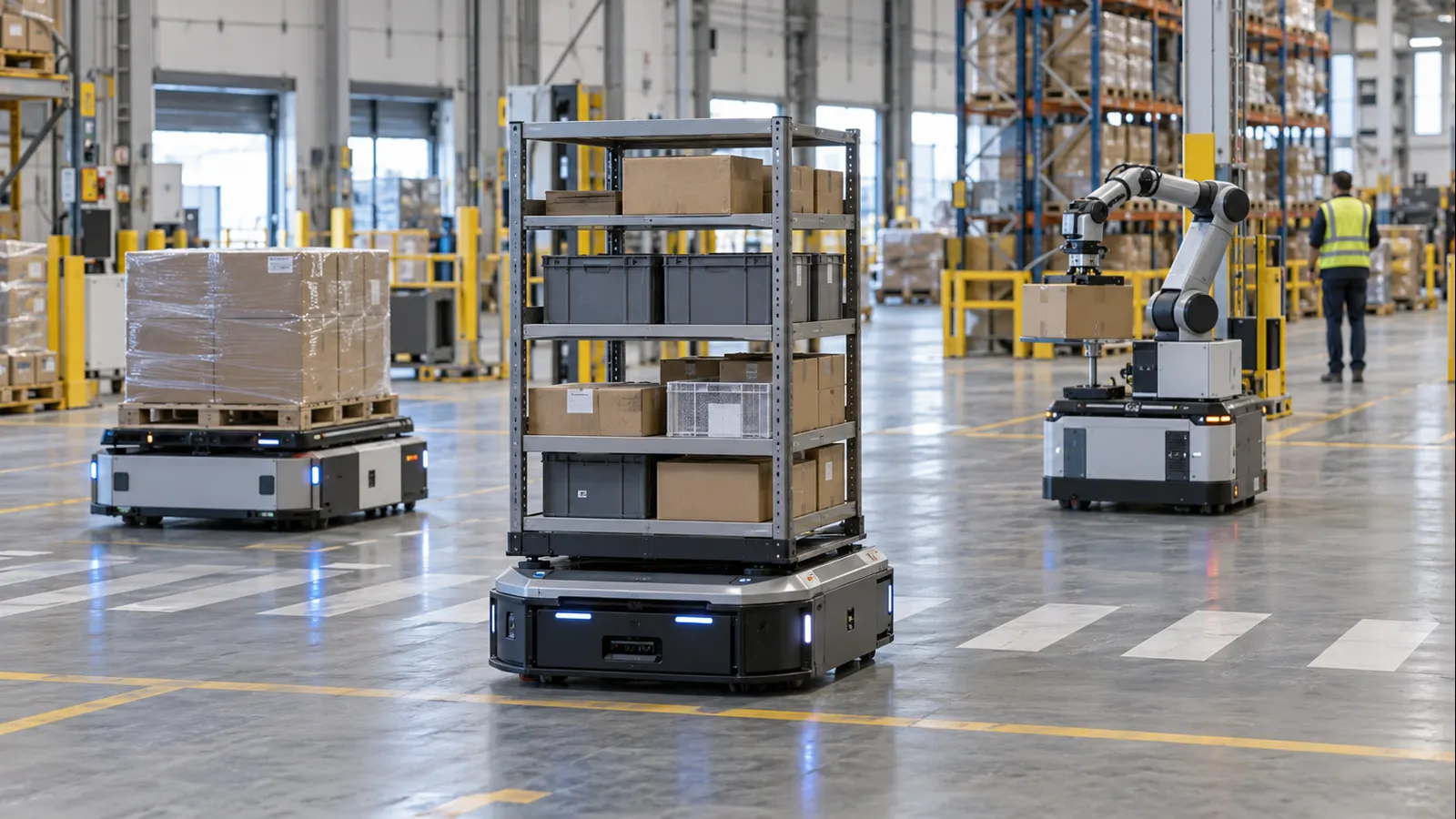
Destro AI has raised $8 million to coordinate different warehouse robots through a shared software layer. The funding is not the most important part of the story: a deployment at Yusen Logistics reportedly expanded from three robots to 26. That turns attention to an underestimated question—who conducts the fleet when the machines come from different manufacturers?
The seed round announced on September 29, 2026 was led by Base10 Partners and Bonfire Ventures, with CoFound Partners also participating. Destro AI does not build its own robot platform. Founded in 2025, the company operates one level above the hardware: its software is intended to plan work across orders, people, material flows and multiple types of robots in the same facility.
According to reports by SiliconANGLE and Superintelligence News, the system is already being used at a Yusen Logistics site in Sumner, Washington. A trial involving three robots there has reportedly grown into a fleet of 26 active machines. A separate 17-robot pilot is said to be underway in Southern California. Those figures are more concrete than a product announcement alone. However, no independently published measurements of throughput, downtime or labor requirements are available yet.
In this article
Why the individual robot is no longer the whole problem
Modern warehouses often run several automation systems side by side. Autonomous mobile robots carry bins, driverless industrial vehicles move pallets, conveyors connect fixed stations and people continue to perform jobs that resist standardization. Each platform arrives with its own controller, maps and priorities.
As long as a fleet remains small and uniform, the robot supplier can make many of those decisions. The challenge grows when an order moves through several systems. An arriving truck has to be unloaded, its goods identified, sorted, temporarily stored and delivered to the correct outbound door at the right time. If every robot optimizes only its own next move, the warehouse as a whole can still stall: vehicles wait in the wrong place, transfer points become blocked or workers stand idle while material is elsewhere.
Destro positions MothershipOS at this coordination layer. The company says the software ingests operational state data and decides which machine or person should perform each task, when and where. A second system called VisionOS is intended to help mobile manipulators perceive and grasp objects. Destro calls the combination a hardware-agnostic intelligence layer—an ambitious promise, because genuine independence requires much more than a unified dashboard.
Twenty-six robots are a signal, not proof of performance
The reported expansion from three machines to 26 matters because it suggests a move from a limited trial toward a larger operational deployment. It does not yet answer how well the system performs. The most useful number is not the fleet size but the improvement over the warehouse’s previous control process.
A meaningful assessment would require at least four metrics:
- Throughput: How many shipments or pallets does the site process per hour before and after deployment?
- Interventions: How often must workers reassign jobs, release a robot or resolve a blocked handover?
- Availability: How much operating time is lost to communication faults, mapping problems and maintenance?
- Integration effort: How long does it take to connect another robot type or an existing warehouse management system?
The available coverage does not provide independently verified results for these points. CoFound’s account also comes from an investor with an obvious interest in the company’s success. A larger deployment at a named logistics operator is therefore a serious market signal, but not evidence that Destro outperforms competing approaches.
The Alpha Bionic view: Coordination creates a new dependency
A shared control layer could reduce vendor lock-in. An operator would not have to buy an entire fleet from one manufacturer simply to make the machines cooperate. At the same time, it creates a different dependency. If the central coordinator fails or makes a poor decision, the impact may spread beyond one robot to the facility’s complete material flow.
That means orchestration software has to reconcile two opposing requirements. It needs a global view to distribute work efficiently. Individual machines must nevertheless continue safely—or enter a controlled stop—when the connection to the higher layer is lost. The separation between optimization and functional safety is particularly important. AI may improve job sequences and routes, but it should not be the only authority governing safe speeds, protective fields or emergency-stop behavior.
Data models are another bottleneck. A shelf-carrying robot exposes different states from a pallet AMR or a robotic arm. A message such as “battery at 35 percent” is easy to normalize. Terms such as ready, blocked or task complete can mean different things across manufacturers and workflows. Truly open orchestration therefore needs robust interfaces, unambiguous states and rules for resolving conflicts. Without them, the universal platform becomes a fresh integration project at every site.
What European warehouse operators should examine
The approach is relevant to German and European companies because many logistics centers are automated gradually. Few facilities are rebuilt from scratch around a single robot system. New machines typically have to coexist with existing conveyors, older warehouse management software and manual workstations. Cross-vendor coordination could be most valuable in precisely these mixed environments.
Operators should ask for more than an impressive fleet visualization before making a decision. A credible pilot needs a predefined comparison: the same product mix, comparable shifts, documented faults and transparent intervention times. Data ownership, cybersecurity and portability also matter. If the orchestration provider changes, who retains the learned rules and operating history?
Destro AI is targeting a genuine robotics bottleneck. As more specialized machines enter real operations, the layer connecting them into one system becomes more valuable. The funding announcement alone cannot show whether MothershipOS already performs that role reliably. The next persuasive step would be a joint evaluation with Yusen of the 26-robot deployment—publishing throughput, intervention rates and downtime rather than fleet size alone.
Sources
- SiliconANGLE: Destro AI raises $8M to coordinate mixed robot fleets, September 30, 2026
- CoFound Partners: Our investment in Destro, September 29, 2026
- Superintelligence News: Destro expands warehouse automation pilot, September 30, 2026