
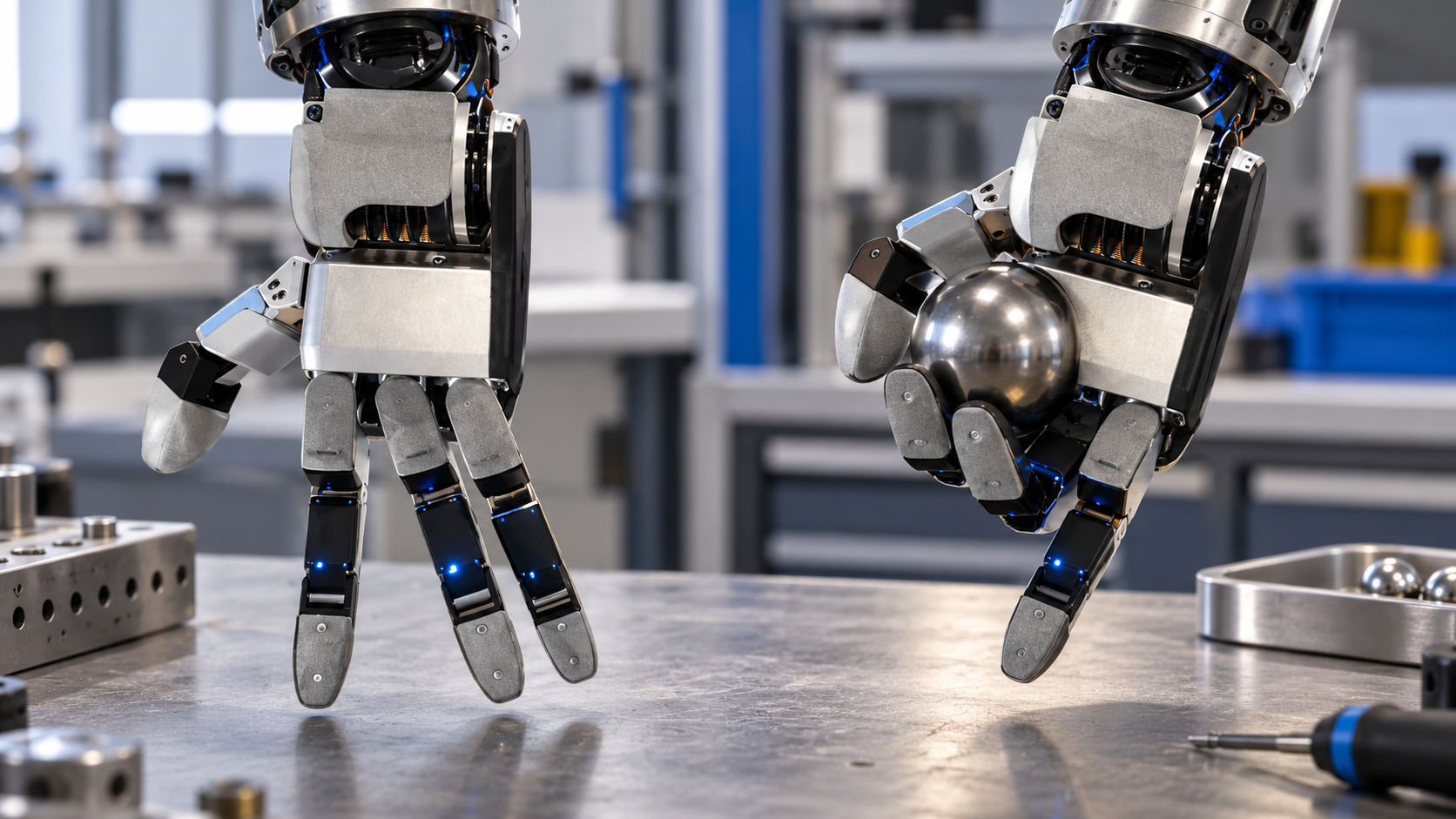
AI illustration based on the real Atlas hand design. The setting and ball grip are generated; this is not a test photograph or an Optimus hand.
Atlas vs. Optimus cannot be settled by counting fingers. Secure grasps, controlled reorientation and reliable contact handling matter more. This article examines manufacturer information from Boston Dynamics, Tesla and Shadow Robot alongside the DeXtreme research paper. It separates documented design features from development goals and proposes a practical evaluation framework.
In this article
Four fingers are a design choice
Boston Dynamics documents four fingers and 13 degrees of freedom for its new Atlas hand. Those figures describe the mechanism rather than a universal performance ranking. Our Atlas hand guide explains the design in more detail.
Optimus: a development goal, not a universal hand specification
Tesla describes Optimus as a general-purpose autonomous humanoid for unsafe, repetitive or boring tasks. The overview examined here does not provide detailed hand specifications or success rates comparable with Atlas. We therefore do not assign an unverified degree-of-freedom count or one drive architecture to every Optimus generation. Extra mobility only helps if control software uses it reliably. Our Optimus overview provides further context.
Tendons are not inherently inferior
Tendon transmission can move actuators away from fingers. Designers then need to account for elasticity, friction and tension. Direct actuation has different mass and packaging constraints. The Shadow Dexterous Hand is a real tendon-driven research platform with several finger configurations. That does not establish a winner; it shows why transmission type alone is an inadequate verdict.
Why turning a ball matters
Reorienting an object inside the hand requires changing contacts without dropping it. It is an interesting subskill, but does not establish that a robot can insert connectors, route cables or work a full shift independently. NVIDIA’s DeXtreme research examines transferring in-hand manipulation from simulation to hardware. Simulation and dependable deployment remain separate tests.
A fair comparison needs five measurements
- Identical objects, starting conditions and permitted assistance.
- A clear distinction between teleoperation and autonomous control.
- Success rates including failures and human interventions.
- Cycle time, dropped objects and surface damage.
- Maintenance, replacement parts and downtime over extended operation.
This is Alpha Bionic’s proposed evaluation framework, not a completed experiment. A tool trial should also check whether the hand retains its pose after pressing the trigger and responds safely when the grip slips.
FAQ
Is there a proven overall winner?
The primary sources reviewed here do not provide a head-to-head test under identical conditions. More joints or fingers alone cannot demonstrate superiority. This is a limitation of the comparative evidence, not proof that either system is inferior.
Are human-like hands unnecessary?
No. They can suit existing tools and human demonstrations. Their extra capability must justify its practical complexity.
What should buyers request?
Repeated task trials with disclosed autonomy, failures and maintenance, rather than inferring production readiness from a single successful grasp.
Boston Dynamics: Robot Hands for Modern AI and Real Work

Author Nico Nuss has worked with mobile computing and automation software since 2001. His many years of experience and strong interest in emerging technologies shape his work on robotics and artificial intelligence.