
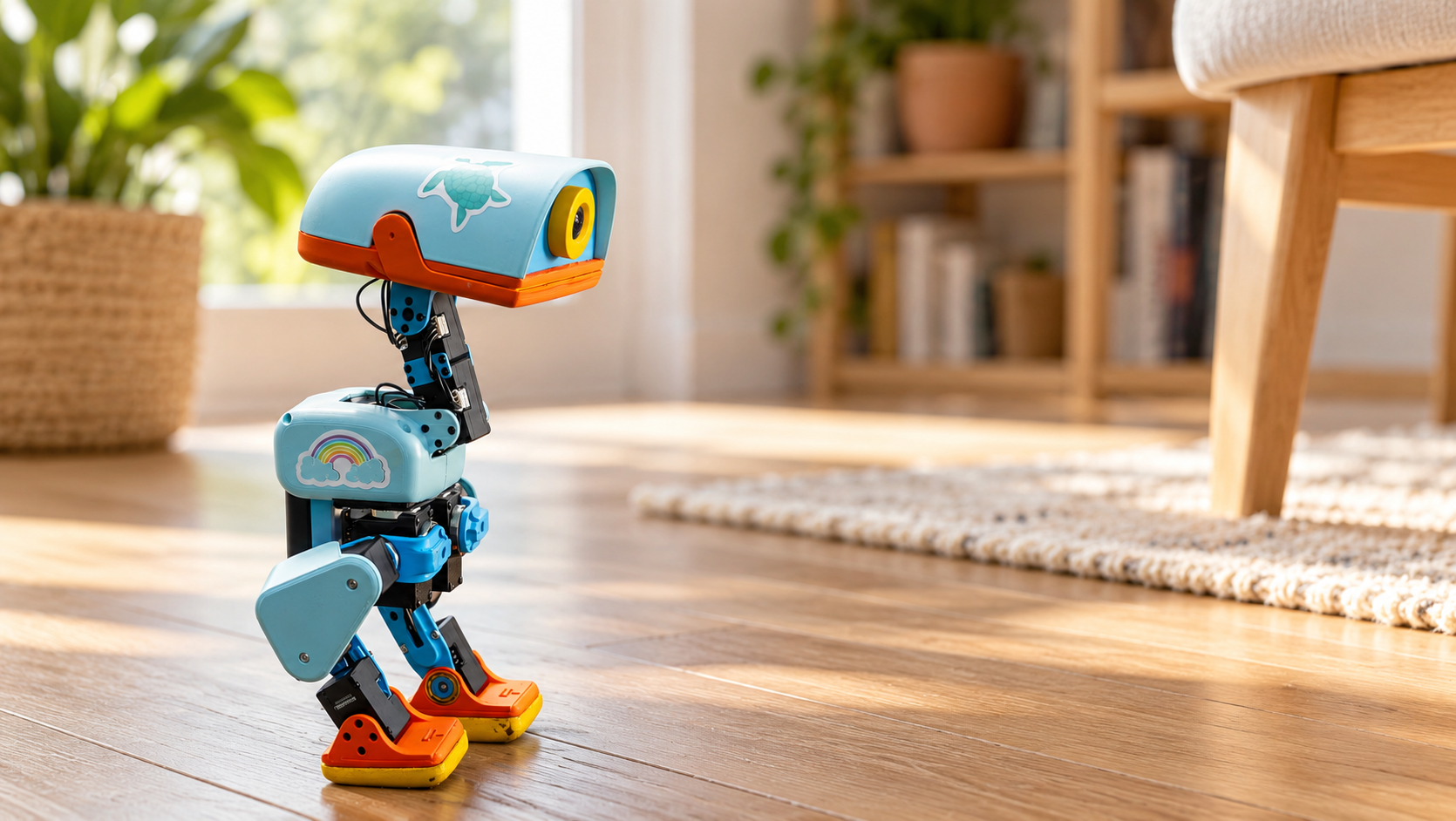
AI-edited illustration based on an official Pollen Robotics Microduck press photograph. The home setting is generated; this is not a photograph of a hands-on test.
Microduck can execute learned movements. That does not mean it understands a household or independently learns new domestic tasks. Pollen Robotics’ small robot duck is interesting precisely because it makes the journey from a simulated movement to a physical machine tangible.
The Robots at Home video is our starting point. This is an editorial analysis of the video and official documentation, not our own long-term test. For product fundamentals, see the Microduck main guide: price, specifications and NVIDIA context.
In this article
Video: Can a Robot Duck Learn to Live in Your Home?
Robots at Home — Can a Robot Duck Learn to Live in Your Home?
Loading the video connects to YouTube and transmits your IP address.
What the hardware provides
The manufacturer lists a height of approximately 25 cm, weight below 800 g and 15 degrees of freedom. A camera, distance sensor and two IMUs provide different measurements; the moving beak also supports grasping. These are resources for experiments, not proof of reliable navigation throughout any home. Specifications come from the official press kit.
How a learned movement reaches the robot
The official training project uses MuJoCo and PPO reinforcement learning to train policies: models that turn observations into actions. A trained policy is exported to ONNX for deployment. Training varies factors such as friction, delay and battery voltage to reduce dependence on ideal simulation conditions.
The runtime repository describes a 50 Hz control loop. Repeatedly responding to measurements and commands is not the same as continuously retraining model weights while playing.
Three different meanings of “learning”
- Calling a behavior: a person selects an existing movement or sends a driving command.
- Training a policy: developers adjust the task, reward and training conditions, then evaluate a new model.
- Understanding a home: the robot would need to combine goals, objects, obstacles and changing situations reliably. The first two capabilities do not establish the third.
Why a living room is a harder test
A short walk across an empty floor says little about a rug edge. A cable changes available movement; a relocated chair changes the route. Getting up successfully demonstrates one skill, not the reliability of an extended task sequence.
Our assessment: repeated trials under documented conditions are more informative than one spectacular clip. How often does the task succeed? When is human intervention required? Does the same command work on a different surface? Those questions separate an appealing demonstration from evidence of everyday robustness.
A useful first comparison
- Choose one short movement on a clear, level floor, away from stairs and fragile objects.
- Record the starting pose, software version, surface and battery condition.
- Repeat under supervision, counting successes, aborts and human interventions.
- Change only one condition next. One successful attempt is not a reliability result.
This is a proposed observation protocol, not an experiment conducted by Alpha Bionic. Follow the manufacturer’s operating and safety instructions.
Frequently asked questions
Will Microduck automatically learn my home?
The reviewed sources do not establish that. They document learned movement policies and their execution, not proven general-purpose household assistance.
Is everything open source?
The manufacturer describes the software as open. This does not mean all mechanical and electronic design files are open.
Who benefits from it?
Learners and developers can explore the relationship between software, a physical body and its surroundings. Anyone expecting a finished household helper should ask for specific task demonstrations and independent reliability data. See the Microduck main guide: price, specifications and NVIDIA context for product details.

Author Nico Nuss has worked with mobile computing and automation software since 2001. His many years of experience and strong interest in emerging technologies shape his work on robotics and artificial intelligence.