
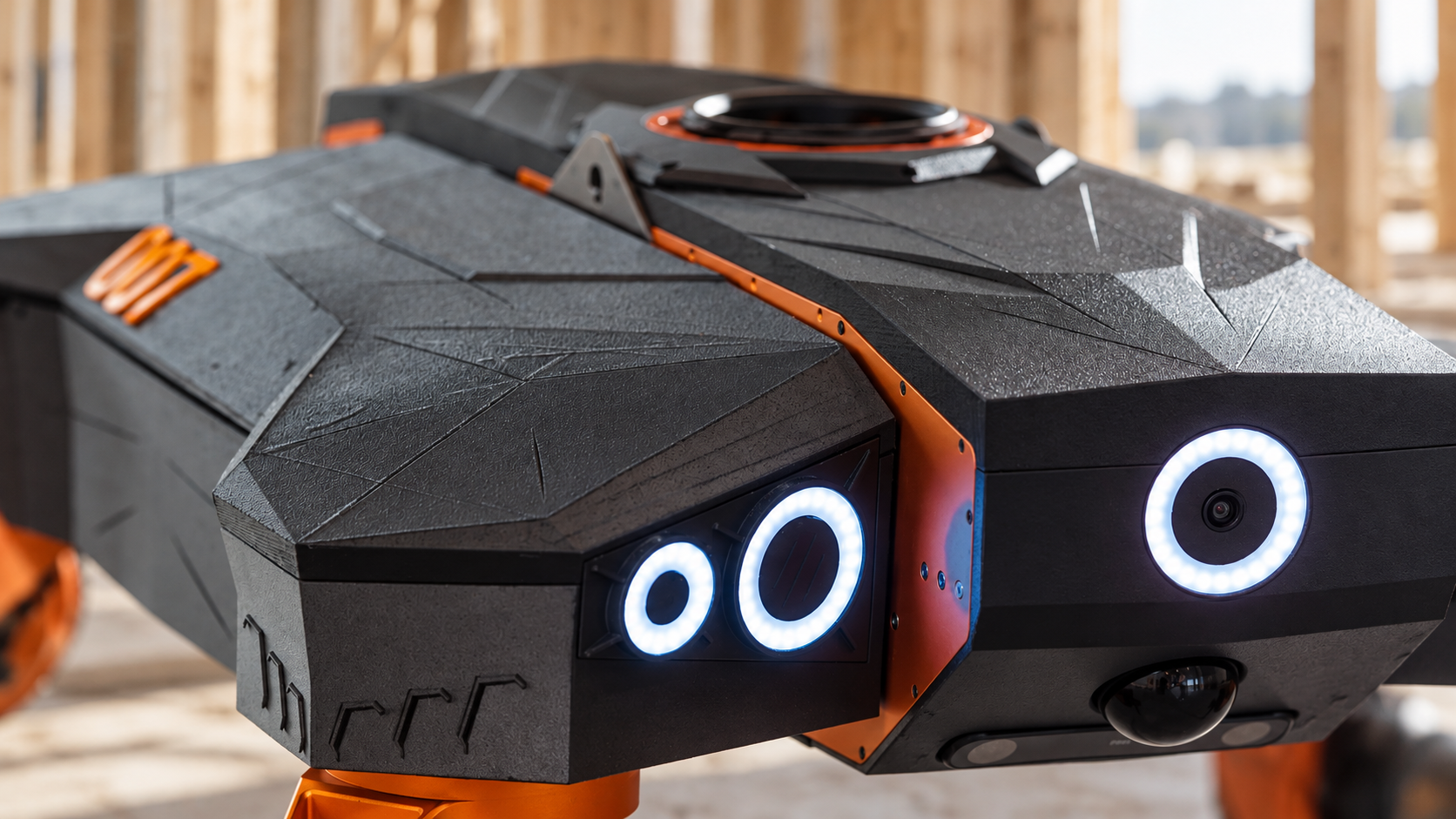
A home does not become affordable just because a robot walks around the building site. But if machines connect design, manufacturing and assembly more effectively, they could change the economics. That is the proposition behind All3’s Mantis. The four-legged construction robot looks unusual. Its underlying promise is much more familiar: less effort, less rework and, ultimately, a lower construction bill.
For anyone waiting for an affordable home, that is an attractive prospect. Yet the number making headlines deserves a closer look. “Up to 30% cheaper” is not an independently established, general saving delivered by Mantis. Published statements use different comparisons. Turning them into a discount on somebody’s next apartment would skip the questions that matter most: cheaper than what, for which work, and demonstrated where?
In this article
30% lower construction costs? The sources do not say the same thing
Frankfurter Rundschau reports All3’s suggestion that difficult urban projects could cost €2,400 or less per square metre rather than around €3,500. It describes potential savings of up to 30% and planned commercial projects. These are company projections, not independently audited accounts from completed customer buildings. Source: FR’s report on Mantis and construction costs.
All3’s 7 October 2026 press release instead describes savings of up to 10% for the integrated approach, with early 2027 the next milestone for deployment on a live project. Its separate cost page advertises a minimum 10% saving guaranteed at contract stage. Sources: All3’s announcement and the company’s cost proposition.
This is not a detail to hide beneath an exciting headline. “Up to” describes a possible ceiling; “at least” describes a floor. Project type, scope and comparison methods may also differ. The public material does not fully reconcile those differences. I therefore treat 30% as a reported potential for a particular context, not as a universal performance metric for the robot. The discrepancy calls for clarification, not an invented explanation.
What the square-metre calculation actually tells us
The arithmetic is straightforward: €3,500 minus €2,400 equals €1,100 per square metre. Against the €3,500 starting point, that is approximately 31.4%. This calculation explains the scale of the claim. It does not validate the underlying offers. Different definitions of floor area can distort a comparison, as can differences in specification, included services or the stage of a project at which prices are estimated.
Consider an explicitly hypothetical example. A project with 1,000 square metres measured on the same basis would produce totals of €3.5 million and €2.4 million for the relevant scope of work. The difference would be €1.1 million. That is not yet a statement about land, finance, infrastructure or the eventual selling price. Those items cannot simply be assumed to fall by the same percentage.
For a client, the biggest headline number is therefore less useful than a transparent comparison. What exactly is included? Who carries which risks? What happens when the design changes? A cheaper assembly process can be valuable without reducing every project cost proportionally. Even a genuine reduction in production cost does not establish how much of the benefit would eventually reach buyers or tenants. Those are separate questions.
Mantis is not a humanoid tradesperson
All3 describes an electrically driven quadruped. Its development account gives a platform mass of 135kg, or 180kg with the working arm, using weight and four legs to create a stable base. It also reports autonomous stair climbing and repeated fastening demonstrations involving eight pilot holes, with tool-tip positioning within 0.5mm. These are manufacturer-reported test results. Source: All3’s engineering account.
The engineering problem is understandable without science fiction. Driving a screw applies a force, and the machine must absorb the reaction. For a mobile robot, that means the base matters as well as the arm. A platform might walk beautifully and still be unsuitable for precise assembly. Mobility gets the tool to the job; stability and control allow useful work once it arrives. Neither capability automatically proves the other.
Reach needs careful reading too. The current announcement describes an arm with approximately 1.8m reach, while a telescopic arm intended to reach four metres remains in development. A planned capability should not be presented as equipment already available. That distinction can determine whether a robot fits a specific task, even if it appears to be a minor footnote in a promotional description.
The robot is only one part of the proposal
All3 connects digital design, industrial component production and on-site assembly. Its Real Time Architecture platform is intended to generate a coordinated building model down to individual components and translate it into manufacturing information. The company describes architecture, structure and building services being developed within one digital environment. Source: All3’s description of RTA.
The Cellular Factory is intended to produce matching components using robotic manufacturing cells. All3 states a 90% automation level and interfaces designed for subsequent robotic assembly. These are supplier statements, not an independent measurement of every production step. Source: All3’s manufacturing description.
For me, the important idea is preparing the work before the robot encounters it. A machine has less to improvise when components, connection points and assembly order suit its process from the outset. Rather than making an arbitrary building site robot-friendly afterwards, the construction method is organised around machine execution. That can help, but it also moves more responsibility upstream into design and production. Preparation is part of the technology, not an optional accessory.
This creates a practical limit on how the promise should be interpreted. Looking at Mantis in isolation misses the point. The claimed benefits cannot automatically be assigned to one device or transferred to unrelated building methods. A good assembly demonstration does not establish that the complete system suits a particular plot, design or contractor. Its interfaces with the rest of the project may matter as much as the robot itself.
What a live construction site still needs to prove
A successful trial establishes that a task is possible under the tested conditions. A dependable construction process also needs to handle repetition, interruptions and deviations. Materials may not arrive at the intended moment. Access may be obstructed. A component may be positioned differently from the plan. The question then becomes not only whether the robot stops, but how work resumes in a controlled and practical way.
At a customer project, I would want to see five things: completed tasks, required human interventions, rework, availability and the cost of the entire workflow. Those measurements should cover a clearly described period. A particularly successful installation cannot replace an account of all attempts, including inconvenient ones. That standard should apply to Mantis and its competitors alike. It is how a promising capability becomes an assessable service.
Construction robotics also covers very different approaches. Our report on Origin’s OG-1 and reported construction-site deployments looks at another route to automating building work. Our coverage of ICON and the Titan construction robot concerns construction-scale 3D printing and the challenge of scaling the technology. These approaches should be compared by their actual tasks, rather than grouped together simply because each is called a construction robot.
Less manual work does not mean no skilled people
Automated assembly can change the work required. It does not make design, site coordination, maintenance, quality checking or exceptions disappear. A credible productivity calculation includes those activities. If an on-site task is removed but additional preparation is required in a factory, both belong in the assessment. Counting only the visibly automated movement would give an incomplete picture of where the effort has gone.
For workers, a useful advance would mean tangible relief from heavy or repetitive tasks. That depends on machines fitting the workflow and the new responsibilities remaining manageable. Teams need clear roles, training and support when faults occur. None of this is as photogenic as a walking quadruped, but it determines whether the machine is helpful during an ordinary shift rather than just impressive during a demonstration.
The Alpha Bionic robotics directory offers a starting point for exploring suppliers and robot categories. A manufacturer profile can provide orientation, but it cannot replace reference projects or an assessment of whether a system matches the intended work. The distinction between a product description, a demonstration and documented operation is the most useful reading rule I know for announcements of this kind.
My view: the most interesting Mantis demonstration will be the final bill
Mantis is interesting because All3 wants to reorganise the path from design to assembly, not merely place a new machine on an otherwise unchanged building site. That is more demanding than one impressive robotic action. It also creates more opportunities to remove avoidable coordination and rework. Whether those opportunities become a dependable benefit will be determined by the whole process working together.
The hope of cheaper construction deserves attention. A blanket 30% guarantee cannot be inferred from the published material, however. The strongest evidence would be a completed building with comparable scope, documented quality and transparent costs. That is a better test than another striking video. For people who need homes, the meaningful achievement would be a project that becomes genuinely deliverable—not a robot that merely makes the promise look convincing.
FAQ: Mantis and lower construction costs
What is the Mantis construction robot?
Mantis is All3’s four-legged construction robotics platform. It belongs to a system combining design, prefabrication and assembly rather than being a universal replacement for every skilled trade.
Has Mantis proved a 30% reduction in construction costs?
The sources reviewed here do not provide a general independent demonstration of that saving. The 30% figure is a reported company potential, while All3 also publishes different cost statements with different wording.
Does cheaper construction automatically mean lower rent?
No. A saving on some construction activities does not mean an identical reduction in total project cost. Nor does it determine how much of a benefit would be passed on to future residents.
Can a demonstration prove everyday reliability?
It can establish a capability under particular conditions. Everyday reliability also requires information about failures, interventions, rework and a sufficiently substantial set of comparable tasks.
Is the robot alone responsible for the potential saving?
No. The proposition concerns a coordinated construction process. Design, production, logistics and assembly need to be assessed together; one robot does not explain the entire cost calculation.

Author Nico Nuss has worked with mobile computing and automation software since 2001. His many years of experience and strong interest in emerging technologies shape his work on robotics and artificial intelligence.