
A small robot stands in the living room, responds to you and moves somewhere other than a screen. For many people, that is the future they have imagined since childhood. PrimeBOT is turning that idea into a consumer product. Before you picture somebody folding the laundry, though, one distinction matters: a personal robot is not automatically an autonomous household helper.
Q1 and T1 are most interesting if you want to play, learn or experiment with robotics. If your priority is saving time on cleaning and tidying, do not infer that ability from a human-like shape. For me, the more interesting question is whether a mobile AI companion can offer something worthwhile after the excitement of the first evening has passed.
In this article
A tempting price is not yet a European offer
Humanoids Daily reports a Chinese launch price starting at 19,999 yuan for each model. That is not a confirmed European retail price. Source: the launch report.
The frequently mentioned figure of approximately €2,700 should therefore not be read as a local price tag. Converting a currency initially gives an equivalent value, not a complete purchasing proposition. It does not establish which version you receive, which services are included or whether the supplier supports operation where you live. An entry offer in one market may differ substantially from a later European package.
Before buying, I would want a complete offer identifying the model, included equipment, shipping, possible additional costs, support and a practical return route. These questions are not a special criticism of PrimeBOT. They apply to any complex technology whose most attractive advertised price comes from another market. A reservation, an accepted order and a confirmed delivery also need to remain separate concepts.
Q1 and T1 offer different ideas of companionship
PrimeBOT positions Q1 around interaction, learning and customisation, including programming and language practice. That describes the intended use, not independently verified educational outcomes. Source: the official Q1 page.
For a product like this, I would care about how easily an owner can realise an idea. Can a beginner understand and modify a short movement sequence? Are mistakes understandable? Can an experiment be stopped and restarted safely? An educational device should offer more than a catalogue of finished tricks. It should help someone understand why an action succeeds or fails, and make that learning process approachable.
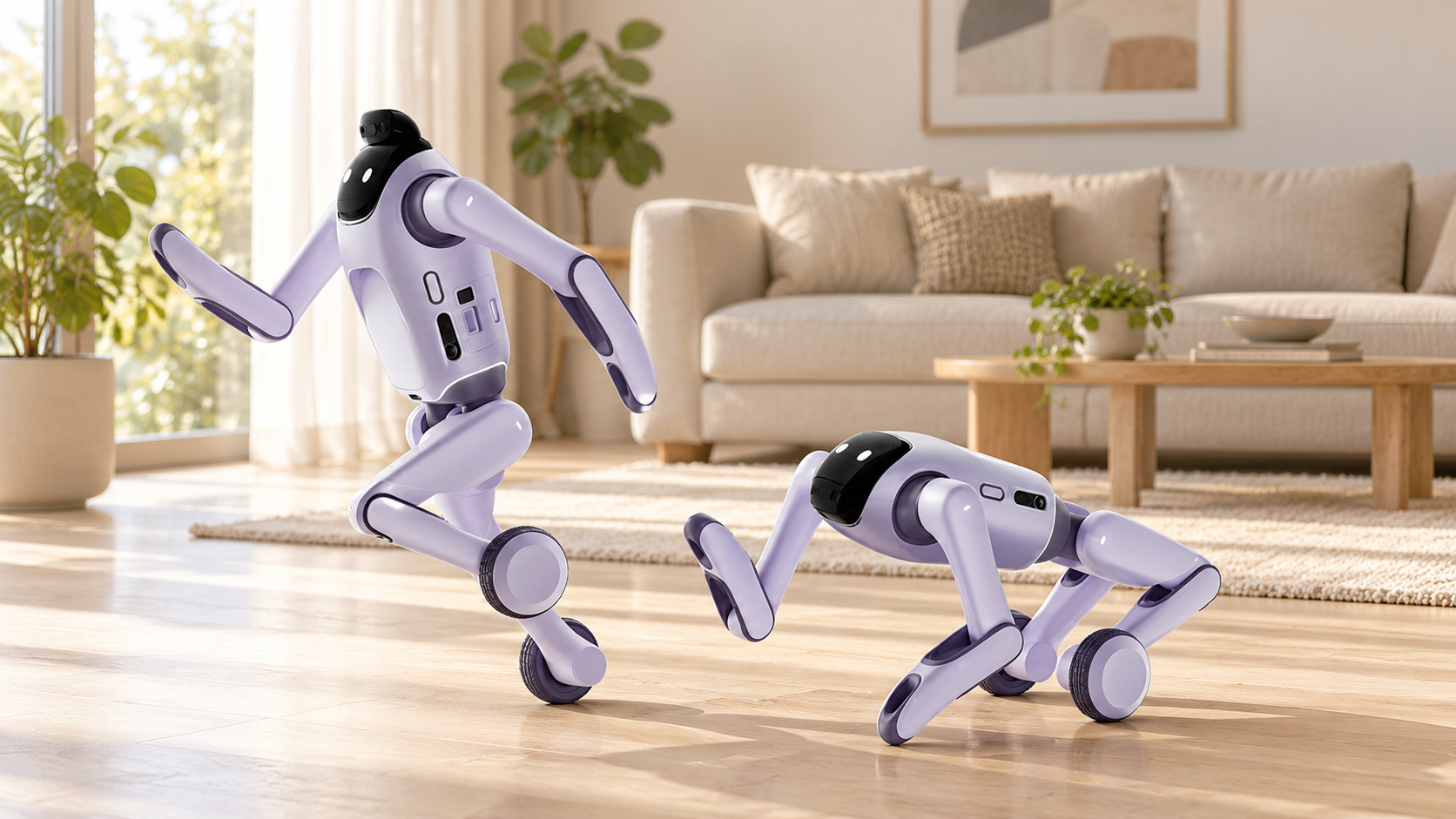
T1 takes a visibly different approach. PrimeBOT shows upright and quadrupedal configurations and emphasises the change between them. Source: the official T1 page.
The transformation is striking, but it does not automatically establish usefulness in your home. Available space, floor transitions, furniture clearance and somewhere to put the device when it is not being used all matter. Interesting engineering still needs to fit ordinary life. A spacious demonstration area should not become the assumed layout of every customer’s living room. Your own environment is the relevant one.
The important difference is in the specification table
PrimeBOT’s T1 comparison lists mobile following for Pro, while indoor navigation and autonomous charging return carry future-OTA notes. Source: the official version comparison and footnotes.
The purchasing lesson is straightforward: a product family’s capabilities are not necessarily the capabilities of its cheapest member. An impressive demonstration may also use equipment different from the package you are considering. Misunderstandings arise when the lowest price, the best demonstration and the most ambitious software roadmap are combined into one supposedly finished product. They need to be checked separately.
I would divide functions into three columns: available now, optional and announced. Only the first immediately explains what can be used after delivery. Optional equipment adds cost and potentially setup work. Announced software leaves questions about timing and regional availability. Future usefulness is a reasonable hope, but it should not silently become the justification for buying a capability as though it already exists.
Why robot arms do not guarantee a tidy home
Tidying sounds simple because people rarely describe all the decisions involved. An object has to be recognised, made accessible, grasped appropriately and moved somewhere sensible without damage. A lived-in room continually creates new combinations: soft clothing, transparent packaging, cables, narrow gaps and objects whose meaning cannot be inferred from appearance alone. The entire sequence matters, not just one attractive movement.
A gesture or conversation therefore does not demonstrate a completed household task. Anyone seeking practical help should ask about that precise job: which objects, in which environment, over how many attempts, and with how much assistance? Those questions say more than resemblance to a human. Our comparison of NEO, Figure 03 and Optimus for the home provides another way to examine household robotics claims without treating every demonstration as equivalent.
This does not make an entertainment robot worthless. A musical instrument does not have to clean the kitchen to justify owning it. The important point is an honest category. If the appeal is creating, experimenting and playing together, that is a legitimate purpose. Trouble begins when emotional imagery implies practical labour savings that have not been established. Different expectations deserve different evidence.
What the production announcement proves—and what it does not
PrimeBOT’s developer portal reports its 5,000th personal robot produced on 25 October 2026. This is a company manufacturing claim, not a count of satisfied households. Source: PrimeBOT’s developer portal.
Manufacturing, delivery and sustained use are separate stages. A growing output figure may indicate progress in production and supply-chain organisation. It does not tell us how long buyers keep using a device, which functions remain dependable or how quickly a fault is resolved. For a new product category, the second half of the story is often more revealing than the launch itself.
I would therefore prefer owner reports with understandable conditions over a compilation of short enthusiastic clips. How much preparation does a session require? What happens after a software update? Is the robot still used once visiting friends have seen it? These questions do not provide a final verdict on a product by themselves. They help separate the novelty effect from durable value.
A camera-equipped companion needs deliberate boundaries
Before a connected device becomes part of private space, it should be clear what information it processes. Useful questions include which functions run locally, when recordings leave the device, whether cameras and microphones can be visibly disabled, and how stored material or an account can be deleted. Without understandable answers, I would not assume that sensitive conversations and private recordings require no further thought.
This is a checklist, not an allegation that PrimeBOT has been found doing something improper. Equally, a friendly appearance does not replace checking the movement area. For an initial experiment, I would choose an uncluttered space, remove fragile objects and learn the stopping controls first. Children should not explore unfamiliar movement routines unsupervised simply because a machine looks small or appealing.
Our article on robot pets and emotional attachment explores how strongly people can respond to this kind of design. Affection can be part of the experience without being a problem. It should not, however, make us automatically attribute understanding, reliability or responsibility to a machine when those qualities have not been demonstrated for the situation in front of us.
My test: what would you still do with it in week three?
Imagine that the initial surprise has faded. Name three things you would regularly do with the robot. Building a movement sequence, completing a small programming project or designing a short interaction together are concrete answers. “It will probably become useful somehow” is a much more expensive bet. A good purchasing decision starts with an intended activity, not a silhouette.
The Alpha Bionic robotics directory offers a route to other manufacturers and robot categories. I would judge PrimeBOT by the same standard as any young robotics product: clear equipment, verifiable availability and value that does not depend on a promised miracle. Q1 and T1 can be interesting as new ways to experiment. That is different from treating them as finished household butlers.
FAQ: PrimeBOT Q1 and T1
Is approximately €2,700 a confirmed European price?
No. A converted Chinese price does not replace a local offer specifying the model, included equipment and all costs. Such an offer was not confirmed for this article.
Should I budget for the robot as household help?
Only for tasks specifically demonstrated and confirmed for the offered version. A human-like body does not establish dependable tidying or autonomous laundry care.
How should future software features be evaluated?
As announcements rather than delivered benefits. Ask about the released version, supported region and actual scope before letting a promised capability determine the purchase.
Does high production volume establish everyday reliability?
No. Production, delivery and sustained reliable use are different measures. Everyday suitability also requires understandable experience reports and information about service.
Who might find a personal robot worthwhile?
People with a concrete plan for playing, creating or learning. Those expecting only completed housework should look for solid evidence of that particular service.
What does the featured image show?
A reference-based AI illustration of T1 in two configurations: two depictions of the same model, not Q1 beside T1. The living room is generated and does not document a hands-on test.
Original reference-based AI illustration: PrimeBOT T1 in two configurations based on official manufacturer imagery. Generated living room, not a documented hands-on test. PrimeBOT T1

Author Nico Nuss has worked with mobile computing and automation software since 2001. His many years of experience and strong interest in emerging technologies shape his work on robotics and artificial intelligence.