
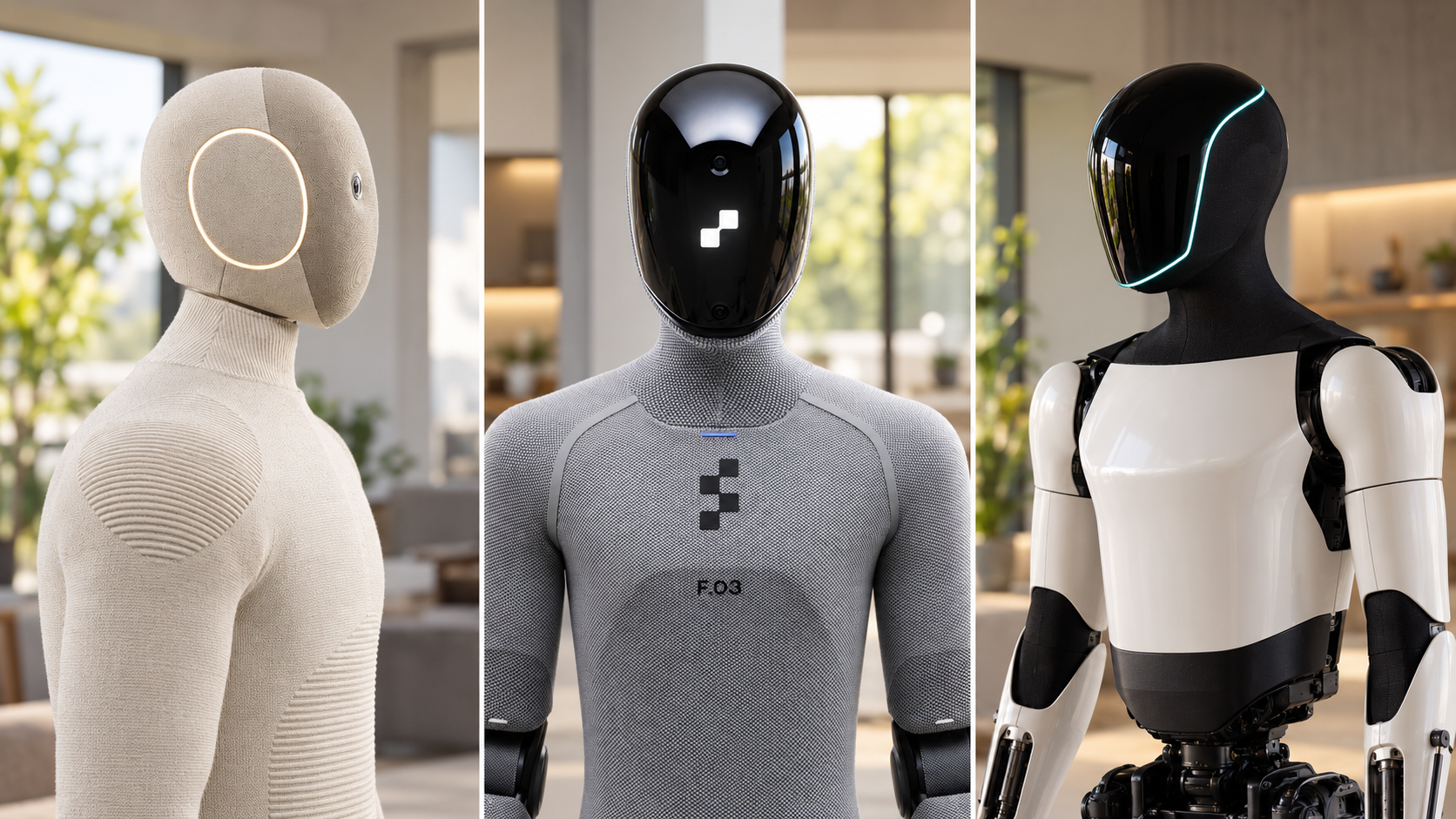
Reference-based AI illustration: 1X NEO left, Figure 03 center, Tesla Optimus in its documented Gen 2 design right. Not a joint test photograph or a confirmed current Optimus retail version.
1X NEO, Figure 03 or Tesla Optimus: which humanoid robot is closest to being useful at home? The answer changes depending on whether you value a concrete ordering route, demonstrated autonomous capabilities or scalable manufacturing. These are different achievements. A robot available for reservation does not necessarily perform every chore independently, and an impressive trial is not the same as a dependable household service. This independently researched comparison separates those issues and identifies the questions a prospective owner should ask.
The central finding is straightforward: NEO has a specific consumer offer, Figure publishes useful evidence about learned tasks transferring to unfamiliar homes, and Tesla reports progress in production. None of that provides a shared performance benchmark. Alpha Bionic has not tested the three robots in a home. Our assessment draws on the primary sources linked below and our own analysis of practical household requirements.
In this article
The comparison at a glance
| Question | 1X NEO | Figure 03 | Tesla Optimus |
|---|---|---|---|
| Main point of interest | Consumer offer and Expert Mode | Helix and unfamiliar-home testing | Production ramp and scale |
| Published home price | US$20,000 Early Access; US$499 monthly subscription offer | Not specified in the sources reviewed | Not specified in the sources reviewed |
| Important limitation | Basic autonomy, with assistance for unfamiliar tasks | Company trials do not guarantee general reliability | Production does not equal consumer delivery |
1X NEO: what the 10,000 reservations actually mean
In its NEO factory report, 1X says its first-year production allocation of 10,000 robots was booked within five days. This is a company statement about demand and allocated capacity. It does not demonstrate that 10,000 robots have already been fully paid for, delivered and used continuously in private households. Keeping those stages separate is essential to understanding a new hardware market.
A reservation indicates interest. A completed machine indicates manufacturing progress. A delivery establishes that somebody received a product. Sustained use, with meaningful failure data, is what starts to establish practical utility. Combining all of these into one sales headline skips the difficult work between them: quality control, support, replacement parts and limits on what the machine can safely do.
The 1X order page lists US$20,000 for Early Access ownership and US$499 per month for a subscription. It also lists a US$200 deposit and says US deliveries start in 2026. These are US offers, not confirmed local retail prices in every country. The deposit is neither the complete price nor a personal delivery-date guarantee. Customers outside the initial market should establish regional eligibility before treating the offer as available to them.
NEO autonomy: human assistance is part of the product
The NEO product page describes foundational autonomy for early users alongside scheduled Expert Mode. For an unfamiliar chore, a remote 1X expert can help guide the robot. That is an important operating distinction, not a minor footnote. A prospective owner needs to know both whether a task can be completed and who is doing the control work while it happens.
Remote help can make a product more useful. It also changes the service being purchased: some tasks involve a combination of robot hardware and human assistance rather than a completely independent machine. Demonstrations should clearly distinguish the two modes. Buyers should also ask whether a supported task can subsequently be repeated without help, how many repetitions were tested, and what changes in objects or layout cause assistance to become necessary again.
Figure 03: what testing in 30 homes demonstrates
Figure reports Helix 2.5 testing across 30 previously unseen homes. The tasks were tidying, folding towels and making beds. According to the company, the pretrained system achieved 56 percent success across the tasks, compared with nine percent without that pretraining. This is company-run research, not an independent head-to-head evaluation against NEO or Optimus.
Here, zero-shot refers to unfamiliar environments and objects. It does not mean that the robot learned nothing about the tasks beforehand. The result matters because a different home changes much more than decoration: furniture height, paths, textiles and lighting all affect action. At the same time, 56 percent illustrates how a meaningful research advance can still leave a substantial gap before an owner receives dependable everyday service.
In its Figure 03 introduction, the manufacturer describes palm cameras, tactile fingertip sensors, textile surfaces and inductive charging. These are relevant design choices for perception, handling and everyday operation. They do not substitute for a long-duration reliability test. Our Figure 03 profile provides additional product context.
Tesla Optimus: manufacturing progress is not a home offer
Tesla’s Q3 2026 update says Optimus production began in Fremont. Its capacity table classifies California as an early ramp and Texas as construction. That is meaningful industrial progress. The update does not provide a regular household purchase price or a specific delivery date for a private customer.
Manufacturing expertise matters: a robot has to be built consistently, tested and repaired. It does not automatically establish autonomous competence. A factory can become better at making a machine while the software still needs improvement at handling unfamiliar objects. Long-term price ambitions are also different from an executable offer. An imagined low future Optimus price should not be compared as though it were a current alternative to NEO’s published commercial terms.
Our Tesla Optimus overview covers the platform in more detail. The related Atlas and Optimus robot-hand comparison explains why joint counts alone reveal little about completed work. At home, perception, grasping, balance and a safe response to failure must work together. An isolated specification cannot replace that system-level performance.
What would a fair household trial look like?
Start with a complete task, such as taking ten dry towels from a basket, folding them and putting them on a shelf. Define the starting arrangement, permitted assistance and success criteria before the trial. One neatly folded towel tells little if someone aligned all its corners first or reset the robot after each attempt. Preparation and recovery time belong in the assessment alongside the robot’s visible working time.
A tidying trial should include different ordinary object shapes without introducing dangerous objects merely for spectacle. Record whether the robot safely leaves an unfamiliar item alone instead of forcing a risky grasp. With cupboard doors, examine reach, collisions and responses to resistance. The objective is documented useful work without damage or additional supervision burdens, not the most dramatic possible demonstration.
Alpha Bionic proposes five measurements: fully completed tasks, human interventions per task, total time including preparation, damaged or dropped items, and maintenance time. This is an editorial evaluation framework, not a set of results we have measured. It becomes a meaningful comparison only when the robots face the same conditions and failed attempts remain in the dataset.
Cost: how much useful help does the money buy?
US$499 per month equals US$5,988 annually or US$17,964 over three years. Those are simple arithmetic totals, not a complete comparison with US$20,000 ownership. Contract scope, duration, repairs, later price changes and ownership at the end may differ. Local charges, delivery and additional services may also affect the bill. A lower monthly payment should therefore not automatically be described as lower total cost.
More useful than cost per robot is effort per successfully completed task. A machine that saves thirty minutes of work but repeatedly needs substantial preparation or remote support may provide less relief than the headline suggests. A practical home evaluation should record time saved and time invested over a week. Convenience can still have real value, but it should not depend on an invented productivity assumption.
Privacy, safe operation and service before ordering
A mobile robot brings cameras and microphones into living spaces. Ask which functions run locally, what information leaves the device, who can connect remotely and how an active connection can be visibly stopped. Guests and other household members also need understandable information. These questions apply to all three platforms; they are not allegations that a particular manufacturer secretly collects data.
A soft covering does not make a moving machine harmless. Important details include operating limits, an accessible stop, behavior after a lost connection and clear manufacturer guidance. Children, pets, stairs, hot liquids and fragile possessions create additional demands. Without suitable authorization and robust evidence, an early home robot should not be treated as unattended care, medical assistance or a universal substitute for human responsibility.
Service questions are just as concrete. Who helps if a hand becomes stuck? How long does a repair take? Are parts and understandable diagnostics available? A robot that cannot work still consumes space and money. A convincing product needs a credible route back into operation, not only promises of capabilities arriving later.
FAQ: NEO, Figure 03 and Optimus
Which robot can a household reserve?
NEO has a public ordering page with a US offer. The Figure 03 and Optimus sources reviewed here do not provide a comparable ordinary consumer ordering route. That does not mean every NEO reservation will be delivered quickly or in every country.
Have 10,000 NEO robots already reached homes?
The company figure concerns booked production capacity after preorders opened. By itself, it does not prove that 10,000 machines were delivered and are operating in everyday household use.
Does NEO work entirely without people?
1X describes foundational autonomy and Expert Mode for tasks the system does not yet know. Prospective owners should establish exactly which tasks function independently rather than assume complete autonomy across chores.
Do Figure’s 30 homes establish full household readiness?
No. The research provides relevant evidence of transfer across three learned behaviors. It does not test every chore or guarantee success in every home and on every attempt.
Is Optimus already the cheapest home robot?
Without a binding consumer price and comparable service scope, that conclusion is unsupported. A production milestone and a price ambition are not a retail price list.
Which robot wins overall?
NEO is particularly relevant for concrete consumer access, Figure 03 for published generalization research and Optimus for industrial ramp-up. The differing evidence does not support an overall winner. A sensible choice follows demonstrated tasks, available service and clear limitations rather than the most spectacular announcement.

Author Nico Nuss has worked with mobile computing and automation software since 2001. His many years of experience and strong interest in emerging technologies shape his work on robotics and artificial intelligence.