
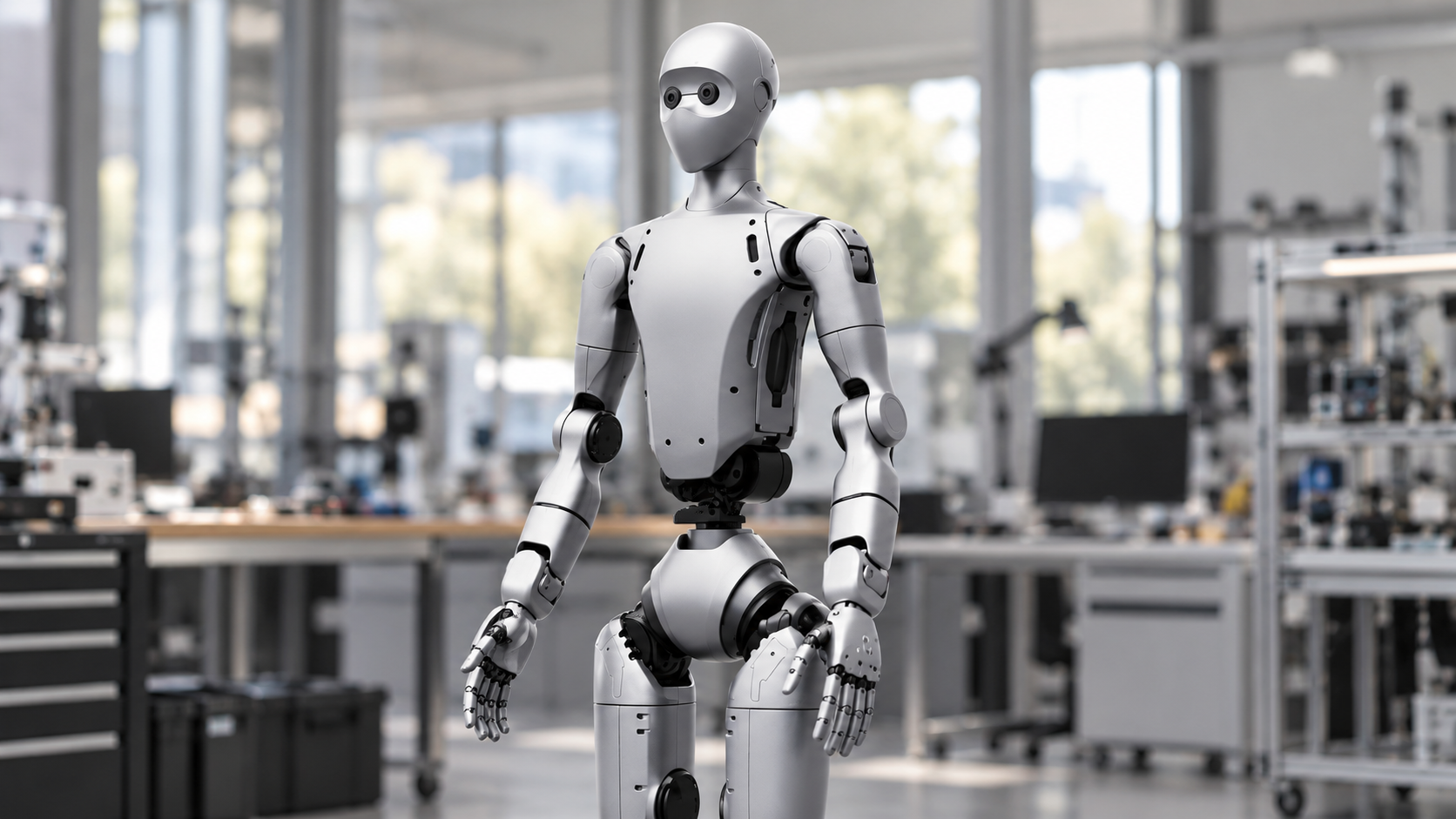
A cup sits a few inches to the left of where it stood yesterday. For us, that barely deserves a second thought. For a robot, it can be the beginning of the hard part: finding the object, aligning the hand, closing the fingers, detecting a slipping grip and correcting it in time. What interests me about NVIDIA’s GR00T reference humanoid is not simply its human outline. It is the attempt to bring those separate problems into one development platform.
This is not a household butler suddenly ready to order. NVIDIA combines the Unitree H2 Plus with tactile Sharpa Wave hands, Jetson Thor computing and Isaac software. The immediate audience is research and development. The useful question is not when it will clean my kitchen, but how much effort researchers could move from assembling basic infrastructure to developing capabilities that actually work.
In this article
The real attraction is not the face
Humanoid robots are easy to explain through spectacular movement. A human-shaped body instantly suggests where the technology might go. It tells us much less about whether cameras, hands, motor control and AI work together reliably. For a laboratory, that connection matters enormously. A powerful computer cannot compensate for mismatched sensor streams or software that assumes movements the body cannot perform.
NVIDIA proposes a reference configuration: a defined relationship between the body, computing hardware and development tools. Its official announcement describes an open, modular design. Teams need not adopt every component. They can incorporate parts of the platform and its workflows into their own projects. That is a more limited promise than a finished artificial worker, but potentially a useful one.
I would judge progress by whether other teams can reproduce results, compare capabilities and start meaningful experiments more easily. A reference platform can help establish common starting conditions. It does not guarantee good training data or safe deployment. It could, however, reduce the need for every laboratory to solve the same integration problems from scratch.
What 75 degrees of freedom actually mean
NVIDIA specifies 75 degrees of freedom for the configuration: 31 in the body and 22 in each Sharpa Wave hand. That arithmetic matters. These are mechanical movement possibilities, not 75 mastered household chores. Whether they produce a stable grasp depends on control, perception, training and the situation in front of the robot.
More movable joints allow more hand configurations, while making coordination harder. A hand must do more than reach an object. It needs appropriate contact, controlled force and a stable grip while the arm moves. A robot with more degrees of freedom is therefore not automatically more effective than a simpler specialist. For a repeated, well-defined task, a dedicated mechanism may still be the better choice.
The H2 Plus provides a roughly human-scale body. That matters because many tools, work surfaces and passages were designed around people. It does not mean every human tool becomes usable without adaptation. Grasp geometry, reach, payload and safe clearance remain practical constraints. Our comparison of Atlas and Optimus robot hands explains why manufacturers take different approaches to these problems.
Why fingers that feel matter
A camera can show where an object is. Vision alone does not reliably reveal how securely it sits between the fingers. The Sharpa Wave combines articulated fingers with tactile sensing. Its manufacturer describes feedback about contact, force and slip. Such information is intended to help control systems adjust a grasp during the action itself.
Consider a deliberately hypothetical example: a smooth cup starts sliding as it is lifted. A suitable controller could notice the change and alter finger force before the cup falls. This describes a development objective, not an H2 Plus test documented here. That distinction matters. A specification sheet is not evidence that a robot already handles an unpredictable kitchen.
The combination of seeing and feeling is what interests me. Hidden contact points, changing surfaces and unfamiliar object positions are ordinary parts of physical life. They make manipulation difficult even when a target looks obvious in an image. Tactile data are not just an extra feature for the brochure. Whether the complete robot uses them effectively across changing conditions still requires repeatable experiments.
Jetson Thor is powerful, not an intelligence score
The reference configuration uses a Jetson AGX Thor T5000 for onboard computing. NVIDIA lists up to 2,070 FP4 TFLOPS and 128 GB of unified memory. Those numbers concern particular AI operations at low numerical precision. They cannot be read as human-like thinking ability or compared indiscriminately with every graphics-card performance figure.
Onboard processing is attractive when perception and motion must work closely together. Yet a fast chip does not establish reliable behavior. Models, software pathways, sensors and control all matter. The configurable 40–130 W range on the Jetson Thor product page refers to the computing platform, not the entire moving robot and its motors.
The same caution applies to battery life. NVIDIA describes approximately three hours for the reference robot. That is a manufacturer figure, not a continuous-duty result measured by Alpha Bionic. Walking, standing and forceful manipulation create different workloads. A research team would need to check runtime for its own experiment, including reserve capacity and a safe stopping procedure.
What happens between a demonstration and a learned action?
GR00T is not simply the name of one humanoid. Here it refers to NVIDIA’s models and tools for developing humanoid capabilities. Human demonstrations, training data, simulation, evaluation and execution on hardware belong to the process. The official Isaac GR00T platform connects those elements into a development workflow.
A person may begin by demonstrating a task or teleoperating the robot. Those actions supply examples. Models are then adapted and tested under different conditions. Isaac Sim and Isaac Lab support virtual environments and training, while Isaac ROS is part of the deployment toolkit. The valuable part is the loop: try, understand failures, improve data and test again.
Simulation can make systematic variation easier, but it cannot replace evidence from physical objects. Friction, flexible materials, camera effects and unexpected contact may differ outside the virtual world. Success in a prepared scene is not proof of a general capability in arbitrary rooms. This distinction also matters when discussing assistance and autonomy in the 1X NEO.
Price and availability still require real answers
NVIDIA’s original announcement described availability through Unitree in late 2026. The H2 Plus product page directs prospective buyers to sales. That does not establish a universal final price or immediate delivery. A serious purchasing decision requires an actual quotation covering configuration, timing, support and operating conditions.
Maintenance and a safe experimental workspace matter too. Research hardware is not a toy cleared for an apartment full of people and animals. Emergency stops and technical safeguards are important, but do not replace a task-specific risk assessment. Costs also extend beyond the robot: setup, supervision, data collection and repairs belong in an honest budget.
Do not confuse this platform with the separately announced Agile ONE SN. That machine comes from Agile Robots, uses a different body and different hands, and was announced for early 2027. Both participate in NVIDIA’s robotics ecosystem, but they are not the same product. Our robotics company directory provides context on manufacturers and their different priorities.
The important demonstration is the hundredth one
A useful evaluation would show more than a successful grasp. It would record failure rates, unfamiliar objects and human interventions. Had the task been practiced? Was the background unchanged? Did someone reposition the object? These questions sound less glamorous than a computing figure, but they make progress understandable.
For me, the strongest part of this announcement is the possibility of a shared starting point. If teams spend less time fighting interfaces, they can spend more time on those tests. Whether that produces dependable everyday work remains open. The H2 Plus with GR00T is a tool for investigating that question, not a finished answer.
FAQ: NVIDIA GR00T and Unitree H2 Plus
Is this a household robot built by NVIDIA?
No. The reference configuration combines a Unitree body with Sharpa hands, NVIDIA computing and software. It is aimed at research and development, not a promised ready-made household service.
Where do the 75 degrees of freedom come from?
NVIDIA counts 31 in the body and 22 in each hand. The total describes mechanical movement, not the number of learned tasks or a guarantee of dexterity.
Can it work without human help?
That depends on the task, trained model and environment. The platform supports capability development. It does not demonstrate unlimited autonomy; teleoperation, demonstrations and autonomous execution must be evaluated separately.
How much does the H2 Plus cost?
The checked Unitree page points to sales rather than a universally applicable complete-system price. Buyers should request the precise configuration, delivery terms, service and additional development costs.
How long does one charge last?
NVIDIA gives approximately three hours for the reference robot. Actual duration depends on workload. This is a manufacturer specification, not a battery endurance test conducted by Alpha Bionic.
Does the article image document a real test?
No. It is an AI illustration of the actual robot model based on official product references. The laboratory setting is generated and does not establish performance or document a particular demonstration.
Reference-based AI illustration of Unitree H2 Plus. The laboratory scene is generated, not a photograph of a hands-on test.

Author Nico Nuss has worked with mobile computing and automation software since 2001. His many years of experience and strong interest in emerging technologies shape his work on robotics and artificial intelligence.