
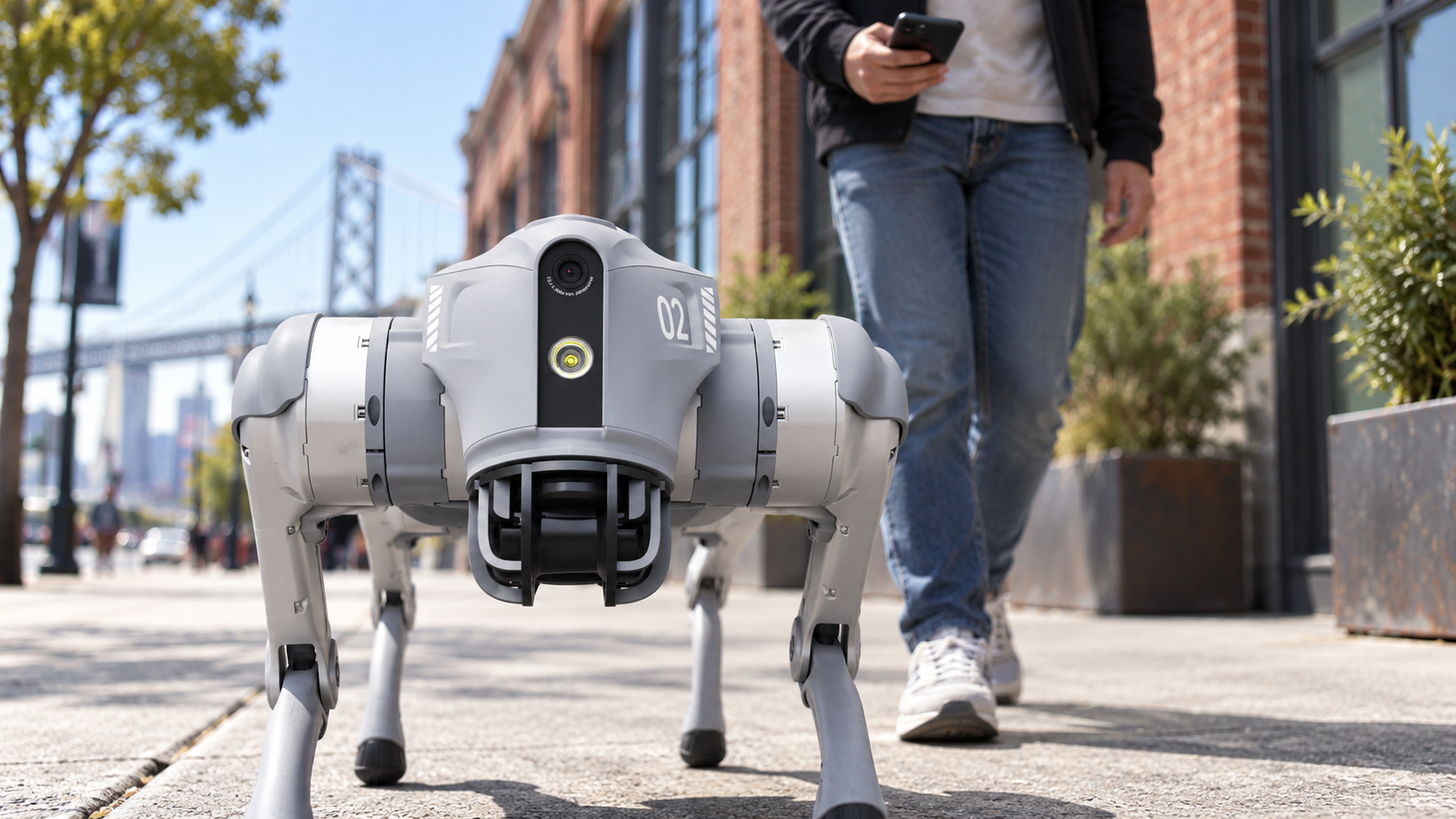
Original AI illustration based on a real Unitree Go2 reference. Generated street scene, not a photograph of Dimensional testing.
Twenty dollars an hour to walk a robot dog sounds like a job invented for a headline. Yet the story points to a serious question: if machines are eventually supposed to move through our world independently, who helps them learn what to do there? In San Francisco, the immediate answer involves an unusual assignment for people, rather than a world in which people have already become unnecessary.
What interests me is not simply the novelty of the job title. It is the gap between a robot that can walk impressively and a robot that can make dependable decisions. A machine may handle its legs well while still needing someone to judge a situation. That gap matters far more to its future usefulness than whether a short demonstration looks entertaining. Calling the work dog walking makes it easy to understand, but also makes it easy to underestimate.
In this article
The real story behind the robot dog walking job
UPI reported that Dimensional offered $20 an hour for supervised robot dog walks in San Francisco. According to the report, the now-deleted Facebook listing was connected to collecting data for robot control, and the quadrupeds came from Unitree. This is a report about a specific project, not evidence of an income opportunity available to everyone.
That distinction matters. An unusual vacancy does not establish that similar jobs are opening everywhere. Nor does a successful trip along a sidewalk prove that a machine is ready to work alone. The more useful observation sits between those two extremes: human supervision can itself become part of developing a robot, rather than merely being an inconvenience to remove from the promotional footage.
The $20 headline is simpler than the listing
The checked Dimensional listing on Indeed is marked expired. Its description gives $20–$28 an hour, while the pay field states $20–$35. It mentions paid training, three-to-six-hour shifts, smartphone use and safely handling equipment weighing about 33 pounds. Previous robotics experience is not required.
| Figure or status | What it means |
|---|---|
| $20 an hour | The widely reported starting figure, not a promise to a current applicant |
| $20–$28 and $20–$35 | Different ranges within the listing examined |
| Expired | No confirmed currently available position on that Indeed page |
I would not suggest making travel plans on the strength of an attention-grabbing headline. Anyone finding a similar opportunity should confirm the duties, compensation and availability with the actual employer. Reporting can explain why a job is noteworthy; it should not turn into an implied offer of employment. The discrepancy in the figures is a reason to ask a clear question, not a reason to select whichever number makes the best headline.
Walking well is not the same as acting independently
Imagine a narrow section of sidewalk. A stroller approaches from the front, a door opens beside you, and someone behind wants to pass. The sensible response might be to wait, leave room and continue. There is nothing visually spectacular about that decision. Precisely for that reason, it is a useful way to think about a helpful robot: the right action at the right moment matters more than an impressive action at the wrong one.
This is an illustrative scenario, not a documented failure in Dimensional’s trials. It shows the questions I would bring to any outdoor demonstration. Can the system recognize a constricted passage? Can it stop without creating another obstruction? What happens when its preferred route is no longer appropriate? Who decides that a test should end? Coordinating four legs does not automatically settle those questions.
When watching robot demonstrations, I therefore pay attention to the edges of the frame. Is an operator present? Has the route been cleared? Are we seeing a continuous attempt or selected successful moments? None of those conditions automatically makes the demonstration worthless. They simply change what it establishes. A successful movement is a meaningful result, but a dependable service also needs a repeatable operating process.
Dimensional’s focus is software, not just another robot dog
The public DimOS project describes an open-source software framework spanning different robot platforms. Its documentation includes navigation, perception and connections to AI agents, and lists Unitree Go2 among supported hardware. It is labeled pre-release beta. These are descriptions of development tools, not independent certification for unattended operation in public places.
To me, this is the more interesting business idea. A company does not have to manufacture every joint to work on making robots useful. It can try to make existing hardware easier to control and different functions easier to combine. Whether that creates practical value must still be demonstrated against a concrete task. A tidy software interface is not, by itself, a completed delivery or a reliable inspection.
What a person can contribute to a robot trial
My picture of a useful operator is not someone distractedly checking a phone while a machine wanders ahead. It is someone attentive enough to notice an unusual situation and describe it clearly afterwards. Where did the route become difficult? When was a pause necessary? Does the same problem occur again? These are examples of feedback I would find valuable, not a published internal procedure from this company.
Human assistance should also remain visible in the results. If a route succeeds only because someone intervenes repeatedly, that assistance belongs in the assessment. An intervention is not necessarily an embarrassing failure. During development, it can mark the precise boundary that needs more work. The misleading step would be to hide the help and then describe the resulting journey as entirely autonomous.
I would therefore ask for more than the longest distance traveled. How much of the route required no intervention? What caused interruptions? How did repeated attempts compare? Those measures would make progress easier to understand than a particularly charming clip. I do not have a complete evaluation with those figures for the walks discussed here, so I would not attach a performance score to them.
A robot can look like a pet without understanding like one
Four legs and a person walking nearby invite an immediate comparison with a dog. That makes the story approachable, but it can also distort expectations. A technical device does not automatically possess the situational understanding people associate with a familiar animal. Our article on robot pets and emotional attachment explores why this kind of design can nevertheless prompt strong human responses.
For trials in shared spaces, I would want straightforward communication about what is being tested, who is responsible and how passersby can keep their distance. If camera data is recorded, understandable information about its handling matters too. These are editorial expectations for responsible testing, not allegations that Dimensional has breached any particular rule. Curiosity about new technology and clear boundaries around its use can coexist.
What prospective robot buyers should take from this
Unitree’s Go2 product page lists a weight of approximately 15 kilograms and several configurations. Go2 is a relevant model example, but the walking report naming Unitree does not establish every configuration used in the project. Our lead image is therefore labeled as an AI illustration based on a real Go2 reference, not presented as a photograph of that trial.
Anyone considering a robot should make the same distinctions: what does the hardware do, which software is included, and how much supervision remains necessary? Our Microduck alternatives comparison separates platforms by intended use. A sensible purchase starts with a task you actually want to attempt, rather than the most impressive movement you have seen online. Otherwise, excitement can turn into a device that has no useful place in your routine.
The Alpha Bionic robotics directory offers another way to explore the companies involved. Hardware manufacturers, software developers and operators have different roles. Keeping those roles separate makes ambitious claims easier to examine. My most useful question remains simple: what works repeatedly under ordinary conditions, and who still has to help? The answer often tells us more than a single peak specification.
FAQ: Getting paid to walk robot dogs
Was the $20 robot dog walking story made up?
No. There are reports of the offer and a corresponding job listing. That does not guarantee current recruitment. The Indeed page checked for this article is marked expired.
Is this a remote job?
The opportunity discussed concerns physical work in San Francisco. It is not evidence of a work-from-home position or an equivalent vacancy in another country.
Would I need to buy a robot first?
The story concerns accompanying company test equipment, not a business scheme in which participants purchase their own robot. It provides no basis for buying hardware in expectation of paid walks.
Why does a walking robot still need a person?
Movement and dependable decisions in changing situations are different requirements. Supervision can help identify the limits of a system while keeping a trial controlled.
Does a successful walk prove full autonomy?
No. We would need to know which decisions the system made and when people intervened. A short successful sequence does not answer those questions by itself.
What is the bigger lesson?
Robotics develops through ordinary, attentive work outside the laboratory as well as technical breakthroughs inside it. The human contribution should remain visible even when the machine gets most of the attention.

Author Nico Nuss has worked with mobile computing and automation software since 2001. His many years of experience and strong interest in emerging technologies shape his work on robotics and artificial intelligence.