
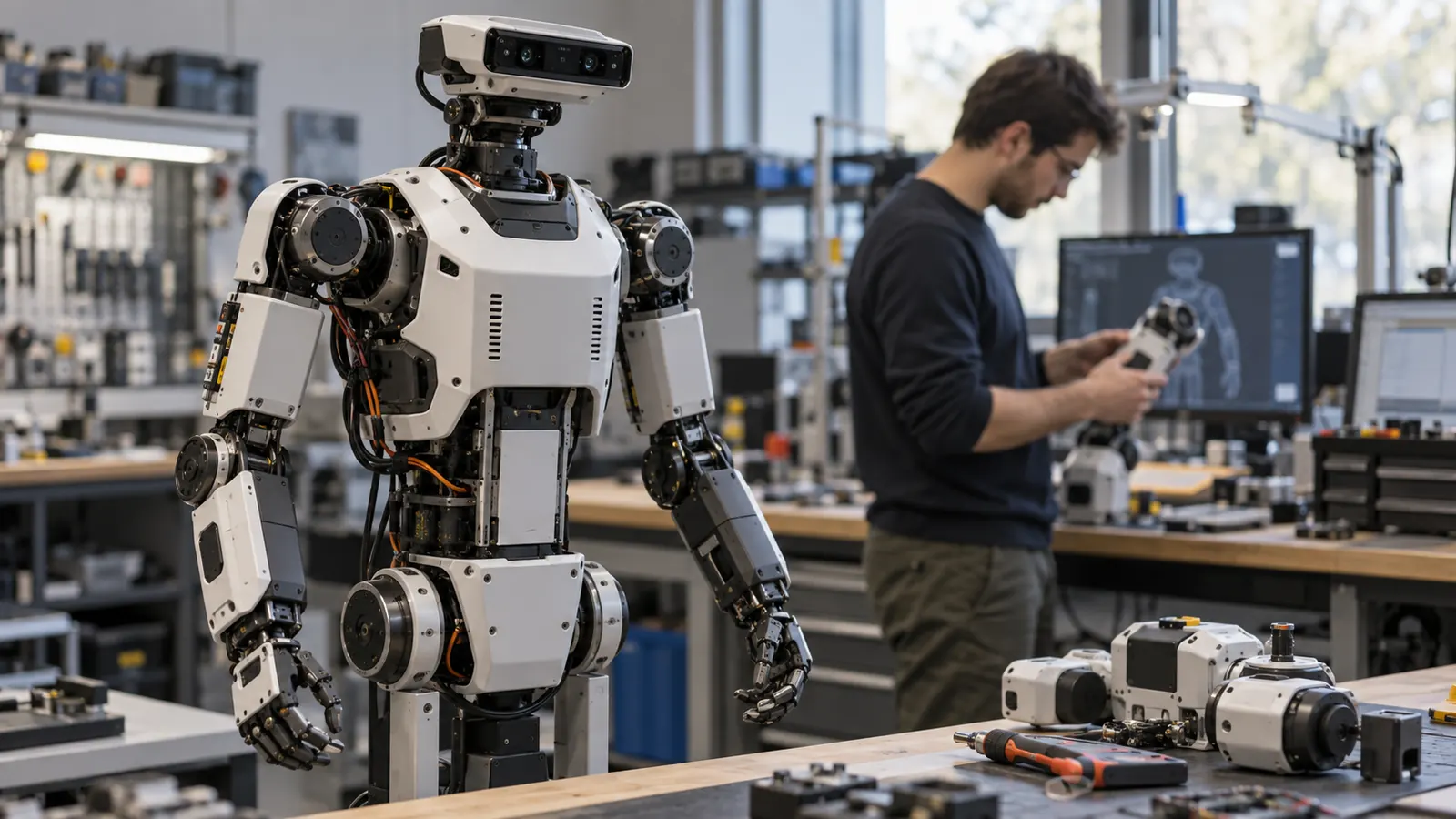
Feather Robotics is positioning a roughly $30,000 humanoid as an open hardware and software platform for third-party developers. Instead of controlling the robot body, AI model and final application inside one closed system, the startup wants to provide a configurable machine that can run models from different robotics-AI providers. It is closer to a development platform than a finished universal worker.
The idea addresses a real bottleneck. Many companies cannot readily buy leading humanoids or freely develop applications on top of them. The early claims still require caution. The price, revenue and customer deployments are mainly reported by Feather and its investors. Customer names, unit numbers and independent performance data have not been disclosed.
In this article
Modularity instead of a closed stack
Feather says developers can change hardware configurations, including arm length, and use software models from several suppliers. That contrasts with vertically integrated strategies in which one manufacturer develops the mechanics, controller, AI and applications while limiting outside access.
An open platform can reduce duplicated work. A science laboratory needs different grippers and safety limits than a restaurant kitchen. Stable interfaces could allow integrators to replace components without redesigning the complete robot for every job.
Openness, however, means more than offering a software development kit. Developers need documented interfaces, spare parts, long-term support, diagnostic tools and clear safety responsibilities. Without those foundations, an “open” robot may only be configurable rather than a genuine platform.
Why the $30,000 price matters
Feather quotes a price of $30,000. That is below many research humanoids and could look attractive beside conventional automation once integration and guarding are included. Purchase price alone does not establish an economic advantage.
Total cost depends on useful operating hours, maintenance, grippers, software, training and human supervision. A cheap robot that works reliably for only short periods can cost more than a specialized machine. A modular body could still be valuable if developers can use it to test several narrow applications quickly.
Early customer signals remain difficult to verify
Feather told TechCrunch that it has passed $1 million in revenue. Its robots are reportedly cooking in restaurants and cleaning science laboratories, and the startup refers to a manufacturer with billions of dollars in annual revenue as a customer.
Those statements show the intended markets, but they do not independently establish the scale or duration of the deployments. A paid trial, a purchase order and continuous production work are different maturity levels. A useful assessment would require shipment numbers, operating hours and evidence of tasks completed without constant support.
The ecosystem may be the real product
Feather describes its strategy as an “Android of robotics.” The analogy is memorable but demanding. Smartphones became platforms through standardized hardware, stable operating systems, app distribution and large user populations. Robots add physical safety, wear and very different work environments.
A robotics ecosystem therefore needs more than applications. It needs repeatable motion, compatible tools, dependable updates and clear responsibility when hardware and AI from different suppliers fail together. These details will decide whether Feather becomes a platform company or simply a low-cost hardware vendor.
A $7.6 million round finances an early bet
The current $7.6 million pre-seed round is led by Gradient Ventures. SEED Innovations says its $1 million participation uses a SAFE with a $60 million valuation cap. The financing is meaningful for a young company, although robotics hardware can consume capital quickly when manufacturing, support and certification expand.
Selling small quantities early may be part of the model. Customers provide real environments while Feather identifies hardware faults and integration problems. That approach can accelerate learning, but it also transfers part of the development risk to early adopters.
What European developers should investigate
For European buyers, the price would be only the first question. CE conformity, machinery safety, spare-parts availability, data protection, remote maintenance and local integration support would all matter. Buyers would also need to know which AI models can run locally and which operational data leave the facility.
An open humanoid could speed up research and pilots. In production, however, it must show a clear advantage over a robot arm, mobile base or purpose-built fixture. A human-shaped body is flexible, but it is not automatically the least expensive answer to every task.
Four pieces of evidence Feather still needs
- named customer confirmations or detailed, verifiable case studies;
- shipment numbers and operating hours rather than revenue alone;
- clear documentation for the supposedly open interfaces;
- total cost and intervention rates for specific tasks.
Feather’s idea matters because it could change access to humanoid hardware. Whether it becomes a real ecosystem will depend less on the Android comparison and more on documented reliability and productive applications built by independent developers.
Sources
- TechCrunch profile and interview, September 24, 2026
- SEED Innovations investor announcement, September 25, 2026
- SEC Form D material for Feather Robotics