
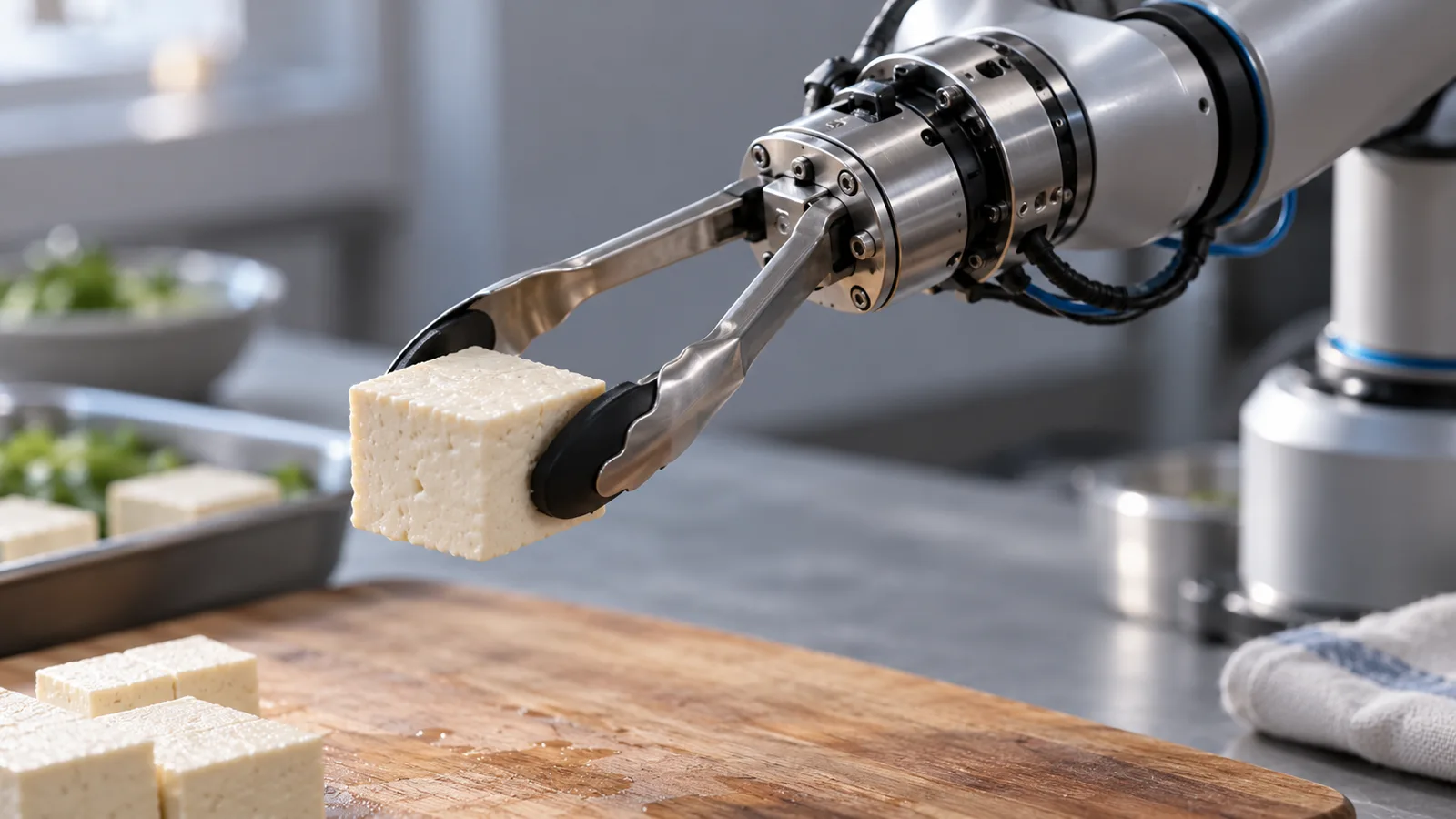
A robot can see a piece of food and still fail to pick it up safely. Researchers at the University of Washington are investigating whether SwapBot, a system of interchangeable tools with tactile sensing, can help. Their preprint, released on October 29, 2026, reports a rise from 35% to 60% successful runs on a multi-stage tofu task when touch is added. This is progress in a laboratory, not evidence of a ready-to-use robotic kitchen.
In this article
Changing tools instead of building a universal hand
SwapBot connects a robot arm to kitchen implements such as a brush, knife or tongs through an adapter. The tools receive pressure sensors, while a common interface enables automatic changes. The project illustrates an alternative to recreating a human hand: adapting the mechanism to the job.
The technical distinction matters. A camera provides information about position and appearance. A contact sensor adds information about what happens during contact. They answer different questions. When a tong tip obscures an object, another image is not automatically a substitute for a measurement at the contact point.
What a 60% success rate means
The complete test combines brushing, transporting and cutting tofu. The researchers compared camera-based control with images plus tactile signals. Their whole-task comparison uses 20 runs per condition, and humans specify the sequence of subgoals in advance.
Our reading of the numbers: 60% means twelve successes in twenty attempts; 35% means seven. That is five additional successful runs, or a gain of 25 percentage points. The better configuration still failed eight times. Describing this as “25% better” would be imprecise; calling it a reliable kitchen robot would promise too much.
In a sample this small, one additional success changes the result by five percentage points. The figures are therefore useful evidence for a sensing approach, not a dependable forecast for an arbitrary kitchen. A fair comparison must also retain the same definition of success: selecting the right tool is not the same as completing a meal.
Automatic tool changes are not independent planning
A system may execute its next movement automatically while a person determines the sequence. Buyers and integrators should keep these levels separate: who defines the goal, who breaks it into steps, and who intervenes when something goes wrong? A demonstration does not necessarily answer all three questions.
The practical comparison is consequently not just robot versus human. It also matters whether a fixed specialist gripper can handle a narrowly defined job, or whether frequent task changes justify the added complexity of a tool changer. The relevant metric is the useful work delivered by the complete setup, not how human-like the mechanism looks.
What a deployment trial would still need to establish
The authors identify sensor wear and predefined task segmentation as limitations. Independent replication was not verified for this article, and Alpha Bionic has not tested the system itself.
For a food business, our next evaluation would be a longer trial with varying ingredients, logged interventions and repeated cleaning. The important outcome would not be successful grasps alone, but undamaged results per operating hour, including interruptions. Instrumented tools also raise the question of whether cleaning and replacement affect measurement quality. These are proposed requirements for a deployment trial, not established SwapBot capabilities.
The takeaway is specific: additional contact information can address a particular manipulation bottleneck. Whether it produces an economical system depends on how often people must rescue a failed operation, clean equipment, reset the task or repair the tools.
Sources
- Zhang et al.: SwapBot research paper, submitted October 29, 2026; preprint, particularly Section III.C and Table III.
- University of Washington: project page and demonstrations, no separate publication date. Both sources come from the research team and do not constitute independent verification.