
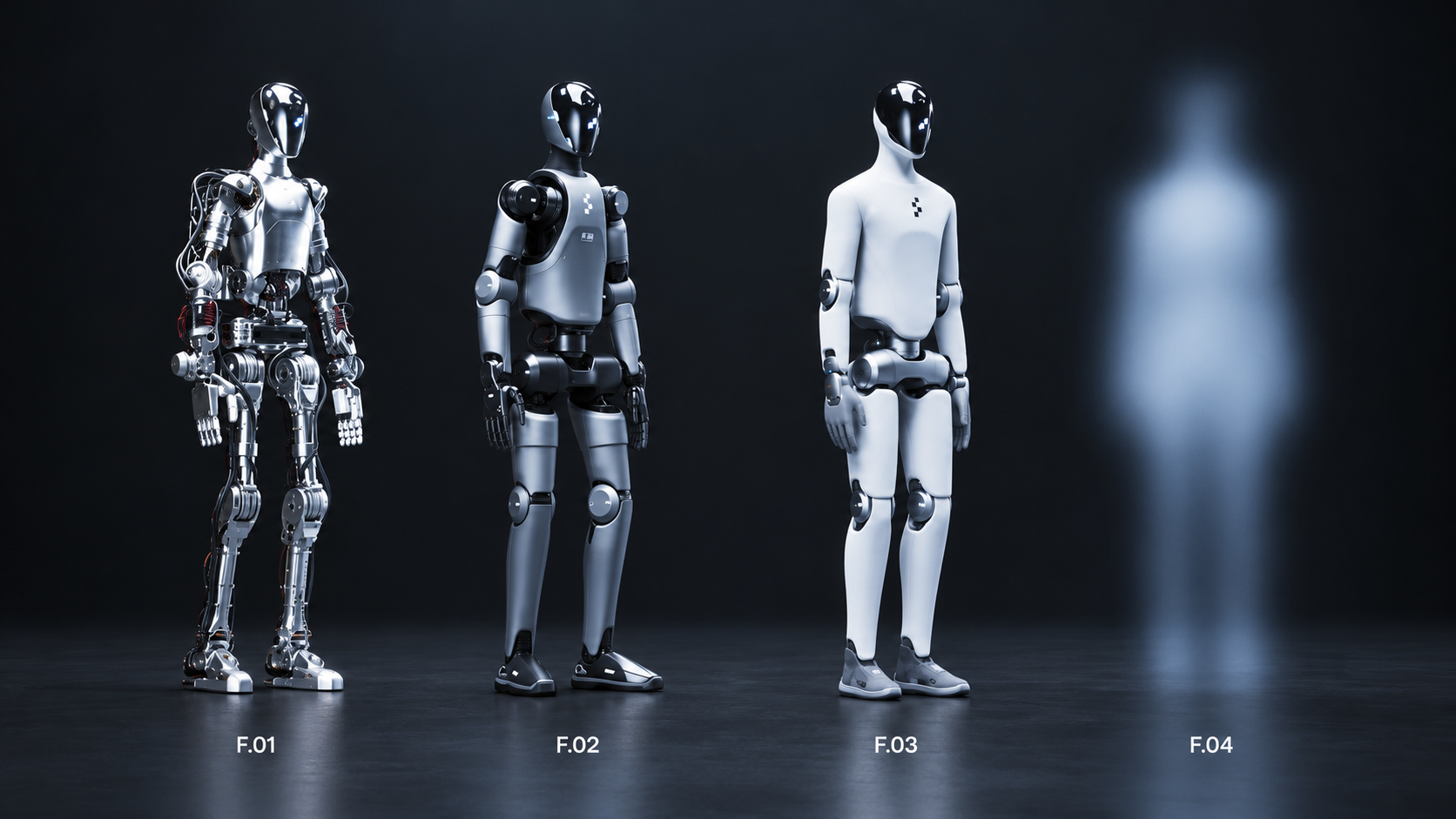
Three familiar robot generations appear on the screen, with a blurred outline beside them. The machine attracting the biggest expectations is the one Figure still refuses to show clearly. Figure 04 has been announced, but its complete appearance remains hidden. To me, that does not make the story less interesting. It changes the important question: what lies behind the promise of a major leap?
The short answer is a new hardware design, work on hands, actuators and batteries, and an AI strategy intended to learn more broadly from human activity. The equally important qualification is that an announced generation is not a finished household assistant. The publications checked do not provide a complete public specification sheet, a firm consumer price or a binding customer delivery date. Understanding Figure 04 means separating progress from expectation.
In this article
Figure 04 announced: what has actually changed?
Figure CEO Brett Adcock describes the fourth generation as an especially large step beyond its predecessors. The company update published on October 22, 2026 gives more detail about development: the design is locked and components are undergoing testing. This is an announcement accompanied by engineering progress, not a complete product unveiling. The deliberately blurred presentation image makes that distinction visible.
The timing matters. Design lock was already communicated publicly in May. The October update is therefore not the first confirmation that a fourth generation exists. It adds information about the journey from a defined design to an integrated machine. Keeping those events separate prevents a fresh report from becoming an imaginary new product launch.
I find this intermediate stage genuinely interesting. Engineers can have a compelling design and still face substantial work. Actuators must behave under load, batteries need thermal validation, and hands must repeat movements reliably. Only when the parts work together does a promising construction become a robot whose overall performance can be meaningfully assessed.
Design lock does not mean living-room readiness
A fixed design establishes a shared basis for engineering, procurement and manufacturing. Put simply, teams no longer have to work from constantly changing assumptions about the next machine. This supports component production and integration tests. It is neither a safety clearance nor proof that volume manufacturing will run smoothly.
Imagine a kitchen whose planning is complete. Dimensions and appliances have been selected, but that does not demonstrate that every drawer has been installed or every connection works. In robotics, the gap between a defined plan and dependable operation is much more complicated. Mechanics, electronics, heat, software and movement influence one another.
That is why I would not fill a missing delivery announcement with a guessed date. A useful assessment leaves room for unanswered questions. For someone considering a future purchase, an explicitly unknown figure is more helpful than a precise-looking number with no foundation. The same applies to runtime, weight, payload and price.
The hands may matter more than the new face
Hands are among the development areas Figure has highlighted. Adcock describes revised designs and work on reproducing human finger movements accurately. The direction makes sense: if a system is meant to learn from human actions, its body must be able to perform suitable motions. AI cannot simply reason away a missing mechanical range of movement.
However, reaching a finger position and reliably handling an object are different achievements. A successful grasp also needs appropriate contact, controlled forces and feedback during motion. A towel behaves differently from a key. A smooth bottle creates different demands from a cardboard box. These are examples of the engineering challenge, not demonstrated Figure 04 capabilities.
In a later demonstration, I would particularly want to know how often a grasp succeeds and how the hand responds to small changes. Moving an object should not make the entire routine unusable. Our comparison of Atlas and Optimus robot hands explains why dexterity cannot be reduced to one attractive specification.
Batteries and actuators must work as a system
The company update also describes actuator testing and battery packs being brought up. Those statements show engineering activity, but do not establish publicly verified Figure 04 endurance or payload. A tested component does not tell us how a complete machine will behave in everyday conditions.
A stronger actuator, for example, can be useful while changing demands on power delivery, cooling and control. A larger energy store would not be a free improvement either: it affects mass and packaging. Without full specifications, it would be misleading to claim which precise trade-offs Figure has chosen for F.04.
Users eventually care about the combination. How long does the robot work on a defined task? How much time does charging take? What happens after a fault? Can a person stop it safely? Those questions sound less exciting than a new model number, but determine whether the machine is useful or needs constant attention.
Figure 03, Figure 04 and Helix are different things
The names are easy to confuse. Figure 03 is a publicly introduced hardware generation. Figure 04 is its announced successor. Helix is Figure’s AI system, with version numbers that follow a separate development cycle. A new Helix version therefore does not automatically mean a new robot generation is being delivered.
When introducing Figure 03, the manufacturer explained its combination of perception, hand technology and a design oriented toward manufacturing. Those published characteristics belong to Figure 03. They must not silently become a specification sheet for Figure 04, even if the successor draws on experience with the earlier machine.
Likewise, household demonstrations using Helix 2.5 are not Figure 04 product tests. Separating generations allows us to recognize existing results without assigning them to hardware that has not been fully revealed. Our comparison of NEO, Figure 03 and Optimus addresses the already public platforms and their limitations.
What the household evaluations really establish
Figure’s Helix 2.5 publication is an important reference point. The company reports three previously learned behaviors across 30 unfamiliar homes: tidying toys, folding towels and making beds. With Index pretraining, its reported full-task success rate was approximately 56%, compared with 9% without that pretraining in the described experiment.
That is interesting research progress, not proof of a dependable autonomous household service. Unfamiliarity refers to the evaluated environments and objects; the tasks were specified using data collected elsewhere. The results also come from the company. They should be read as manufacturer findings, not as an independent everyday-use test by Alpha Bionic.
For a family, the practical question is simple: how much work remains for us? A machine that occasionally needs assistance may be useful in some situations. It is different from an assistant that can be left unsupervised. An honest evaluation must therefore include interruptions, failed attempts and human intervention rather than only the successful moments.
Index and Helix 3.0: learning requires more than uploads
Through Index, Figure collects recordings of human activities for training. The idea is that different people, rooms and objects provide a broader foundation than repeated laboratory routines. Figure also describes filtering, review, removal of similar material and data preparation. A large upload count is not automatically the same number of useful training examples.
For me, the crucial connection is the translation from observation into action. Human proportions, forces and sensory feedback differ from a machine’s. Recorded behavior must not only be recognized; it must become executable by the robot. This is where the data strategy and the hardware redesign meet.
Helix 3.0 has been teased as a next stage. That does not yet provide a complete public list of capabilities. Neither a version name nor an ambitious description replaces reproducible results. A useful next step would be a clearly documented evaluation with tasks, success criteria and visible limits.
What I will look for at the real unveiling
I want more than a better-looking body. Useful evidence would include understandable information about reliability, maintenance, energy demand and interaction with people. Repeated attempts under changing conditions matter, as does a clear explanation of when teleoperation or other human help is necessary.
Manufacturing and service matter just as much. One impressive robot is not a fleet that can work regularly. Spare parts, repairs, software maintenance and safe failure handling belong to the product. The Alpha Bionic robotics company directory helps put different manufacturers and priorities in context.
Figure 04 deserves attention because the announced development considers the body, hands and learning together. The blurred outline is not, however, evidence of performance. I look forward to the reveal, especially the answers that come from understandable operation rather than a polished presentation.
FAQ: the Figure 04 announcement
Has Figure 04 been fully unveiled?
No. Figure has publicly confirmed the next generation and development progress, while withholding the complete design. The official teaser deliberately blurs F.04.
What does design lock mean?
The hardware design has been fixed for implementation. Component testing, integration and validation still follow. The term does not mean production readiness or approval for household use.
When will Figure 04 ship, and what will it cost?
The checked publications provide no binding customer delivery date or firm Figure 04 consumer price. Speculative figures or information about other generations are not substitutes for an actual offer.
Is Helix 3.0 the new robot?
No. Helix is the AI system; Figure 04 is a hardware generation. Their development is related, but their names and version numbers should not be treated as interchangeable.
Do household tests prove Figure 04 capabilities?
No. Published Helix 2.5 results concern the existing platform and selected tasks. They inform the AI development story, not a hands-on test of the still partly concealed successor.
Why is the robot blurred in the article image?
The illustration follows the official comparison of generations. Figure 04 remains deliberately blurred because its complete design has not been publicly shown. This is an AI-generated illustration, not an original photograph or a confirmed Figure 04 product design.
Image: Alpha Bionic. AI-generated editorial illustration inspired by Figure’s generation comparison. F.04 is deliberately blurred; not an original photograph or confirmed design reveal.

Author Nico Nuss has worked with mobile computing and automation software since 2001. His many years of experience and strong interest in emerging technologies shape his work on robotics and artificial intelligence.