
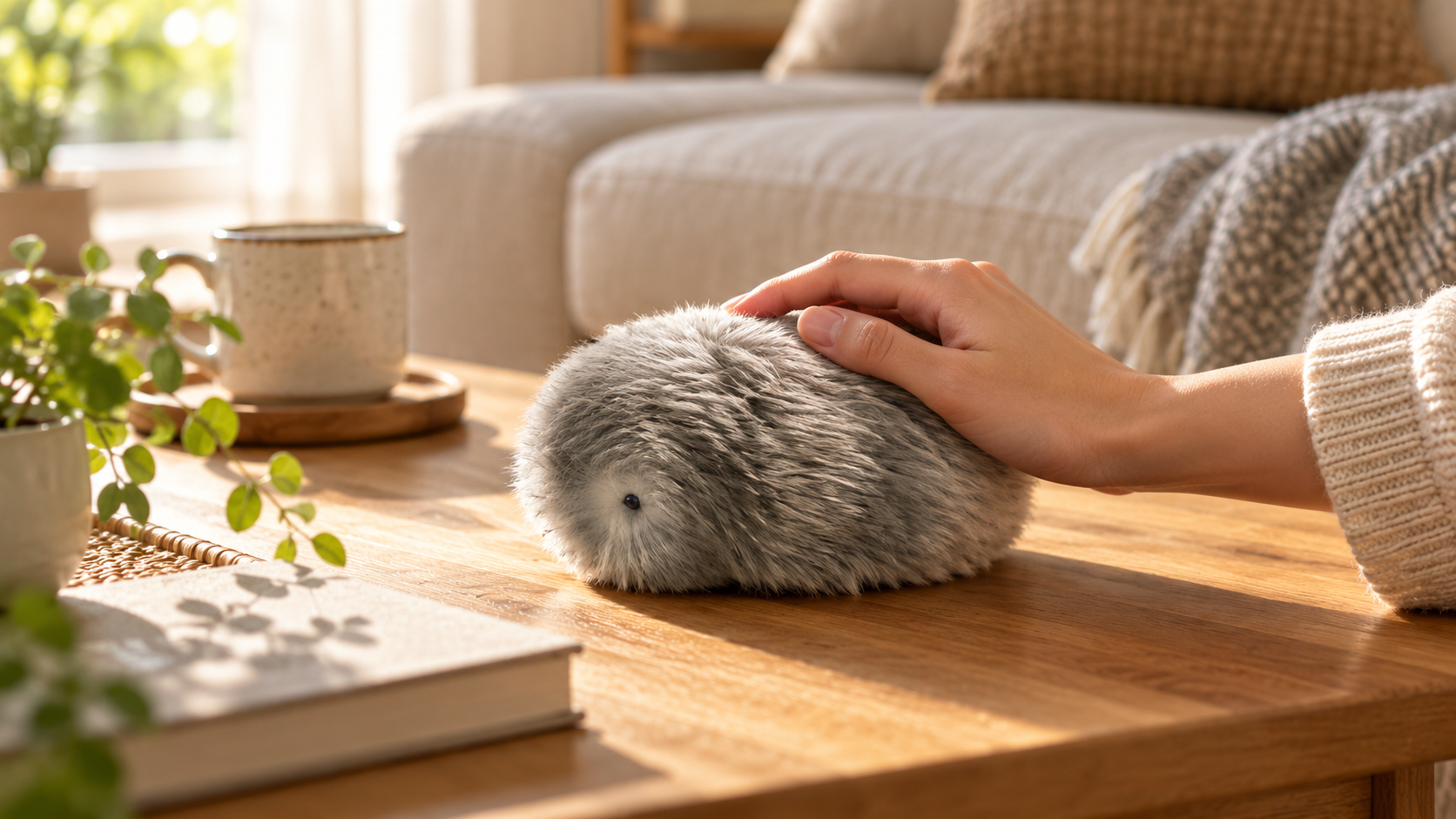
You come home, put down your keys, and something small moves on the coffee table. It lifts its head, makes a quiet sound and responds when you stroke its back. You know perfectly well that there are motors under the fur. Yet you stop, smile and perhaps say hello. That moment explains the appeal of robot pets better than a list of processors ever could.
What interests me about Aibo, Moflin, LOVOT and their relatives is whether the initial surprise can become a pleasant part of ordinary life. A machine does not need human feelings, or the ability to replace a dog, to be enjoyable. But it needs to suit the person living with it. Its promises also need to match its capabilities, support arrangements and the available evidence.
The essential distinction: a robot pet can be a playmate, a tactile companion or a tool within a supported care activity. Those are different jobs. Agile legs do not make a machine suitable for someone’s lap. An affectionate-looking response does not establish a medical benefit.
In this article
Why a machine can still mean something
A familiar photograph or a childhood toy can evoke real feelings without feeling anything itself. A robot adds a response: a movement follows your hand, or a sound answers your touch. Repeated interactions can become a small daily ritual. I find that possibility more interesting than the claim that a device understands us exactly as another person would.
The human response need not be fake. The machine’s apparent emotion needs a different explanation. Terms such as personality, sadness and affection generally describe generated behaviour, not demonstrated subjective experience. Casio explicitly explains that Moflin’s emotional expressions are simulated. Knowing that does not prevent enjoyment. It does help keep expectations reasonable, especially when a manufacturer uses the language of love.
Moflin and Joy for All: companionship without conversation
Casio’s Moflin is a compact furry companion whose appeal rests on small movements, sounds and responses to interaction. It is a different proposition from a robot that runs around the room. Someone who wants a responsive presence beside a book may not want games, spoken commands or a screen demanding attention.
I would start with practical questions: Do I like the sound? Is it comfortable to hold? Would I genuinely enjoy picking it up after the novelty wears off? Charging becomes part of the routine, too. A soft exterior does not make electronics washable or safe around spilled drinks. The care instructions matter more than an appealing lifestyle photograph.
Joy for All Companion Pets also emphasise responsive touch and animal-like sounds rather than open-ended language-model conversations. Simplicity can be a benefit for someone who does not want account management to become part of stroking a robotic cat. It is not a guarantee against faults: batteries, switches, moving parts and cleaning still need attention.
Aibo, LOVOT and Loona: personality meets the living room
Sony’s Aibo explores animal-like behaviour that develops through interaction. Sony describes individual responses, shared memories and cloud services as parts of the experience. That raises a useful purchasing question: what happens if the relevant service, contract or supported market changes? An international product page is not a promise of delivery and continuing support in your country.
Groove X’s LOVOT is explicitly about emotional companionship rather than housework. It is not designed to tidy the kitchen. If reducing chores is your goal, look at specialist home robots instead. If a responsive presence is the goal, touch, sound, movement and the space needed at home matter more. Putting both categories under one heading can lead to an expensive mismatch.
Loona places greater emphasis on expressive movement and play. A wheeled body needs usable routes and an accessible charging station. Before buying, I would picture my own chair legs, rug edges and cables rather than an empty demonstration floor. A cheerful companion becomes less appealing if somebody has to rescue it constantly. Available language and online functions also need checking for the particular regional version.
Ropet, Ollobot and Momobot: read the promises carefully
Ropet combines tactile interaction with a manufacturer-described personality system and GPT-powered conversation. Speech can make an interface accessible, but it creates expectations about memory, understanding and reliability. Does it support the language you actually use? Can stored information be deleted? A friendly answer can still be wrong. A companion device should not be treated as a medical adviser.
Ollobot and Momobot illustrate how strongly newer brands emphasise recognition, emotional presence and learning personalities. I read these descriptions as manufacturer claims, not independent proof of reliable performance in every home. Concrete delivery terms, a usable manual, reachable support and a clear feature list should come before an order. A trade-show demonstration is not the same thing as a dependable daily routine.
Unitree Go2: four legs do not make a cuddly pet
The Unitree Go2 belongs in a separate category. It is a mobile quadruped with appeal for robotics enthusiasts and technical applications. Mechanical agility is not the same thing as gentle interaction on a lap. Unitree also lists different configurations, so development access and advanced functions should not automatically be attributed to the cheapest version.
Someone interested in programming or motion control may find that distinction exciting rather than disappointing. Someone seeking a quiet companion for a person with limited mobility has different priorities. Space, mass and safe handling become more important than impressive manoeuvres. I would not choose a machine like this as a surprise present simply because its recipient likes dogs.
PARO and Tombot Jennie: promise is not proof
The robotic seal PARO responds to inputs including touch, sound and posture. Controlled research makes it worth examining carefully. That does not justify saying that robot pets in general treat dementia, depression or loneliness.
A randomised trial involving 415 people with dementia compared PARO with a similar plush toy with its robotic functions disabled and with usual care. Against the plush toy, PARO’s advantage was principally engagement. The standardised agitation measure found no difference between groups. That qualification matters: an emotionally powerful interaction does not establish every suggested therapeutic effect.
Tombot’s Jennie takes the form of a Labrador puppy and is being developed with a supportive purpose. However, the manufacturer’s website points to a waiting list and preparations for initial deliveries. I therefore would not describe it as a widely available, immediately deliverable retail product. Nor would I repeat a precise therapeutic success rate without a clearly identifiable study supporting it.
Families considering a robot in the context of dementia or another health condition should discuss the idea with the relevant care or clinical team. The person’s preferences, response and continued willingness matter. A device does not replace treatment or human contact. If someone dislikes it, that is a reason to stop, not a challenge to persuade them harder.
Five questions I would ask before buying
Who actually wants it? A gift should not make an unsolicited judgement about somebody else’s loneliness. Trying a device together is more respectful than presenting a supposedly necessary replacement friend. Adults can also enjoy these products simply as interesting objects, without needing a therapeutic justification.
What does a full year cost? Subscriptions, accessories, batteries, delivery and repairs may sit outside the headline price. A foreign price is not necessarily the final local price. Ask for a clear explanation of what the specific offer includes before paying.
What happens to personal data? Cameras, microphones and conversations make storage, deletion and understandable account controls important. Visitors should know when recording is possible. An appealing animal shape does not make a camera less significant for privacy.
What works without the internet? Ask for a demonstration of local functions and an explanation of what happens when a subscription ends. Check replacement parts and repair arrangements as well. A device that becomes familiar is not emotionally interchangeable with the next model simply because the manufacturer launches one.
Who maintains it? Charging, cleaning, updates and troubleshooting still require somebody’s attention. Care settings also need hygiene procedures and clear responsibility. Our guide to robots in care homes distinguishes companionship from genuine workload reduction. The robotics company directory provides wider context on suppliers.
My view: the smartest robot is not necessarily the right one
I like the possibility that a small technical object can bring pleasure to an unremarkable day. Enjoying that does not require belief in artificial love, or a declaration that the robot is part of the family. We can appreciate it while asking who controls its functions, what ownership costs and how long support lasts.
For me, the useful test is ordinary life rather than a specification contest. Is the interaction enjoyable? Is it voluntary? Does it remain manageable? A robot pet can have a place when those answers are positive: not instead of people and animals, but as something different alongside them.
Frequently asked questions
Do robot pets have real feelings?
Convincing behaviour does not demonstrate subjective experience. These products generate responses technically. People can nevertheless feel genuine affection or enjoyment. Those two facts should not be confused.
Which robot pet is best for loneliness?
There is no universal winner. Preferences, accessibility and desired interaction vary. A device may be an enjoyable addition, but it should not displace human relationships or be presented as a guaranteed solution.
Do all robot pets need the internet?
No. Simple sensor-based products and networked companions have different requirements. Check which functions work offline, which require an account and which depend on an ongoing contract.
Can I buy Tombot Jennie for immediate delivery?
The manufacturer’s checked website describes a waiting list and preparations for first deliveries. Rely on a specific confirmation from the company rather than general price or availability claims in rankings.
Can robots be used in dementia care?
Supported uses and research exist, especially for PARO. Findings are nuanced and cannot be transferred to every product. Professional guidance and the person’s consent or clear acceptance remain important.
What matters when giving one as a present?
Genuine interest, suitable sounds, manageable controls and clear ongoing costs. Ideally, the recipient tries it first. Agree who will help if charging, setup or technical problems become difficult.
Reference-based AI illustration of Casio Moflin. The home scene is generated, not a photograph of a hands-on test.

Author Nico Nuss has worked with mobile computing and automation software since 2001. His many years of experience and strong interest in emerging technologies shape his work on robotics and artificial intelligence.