
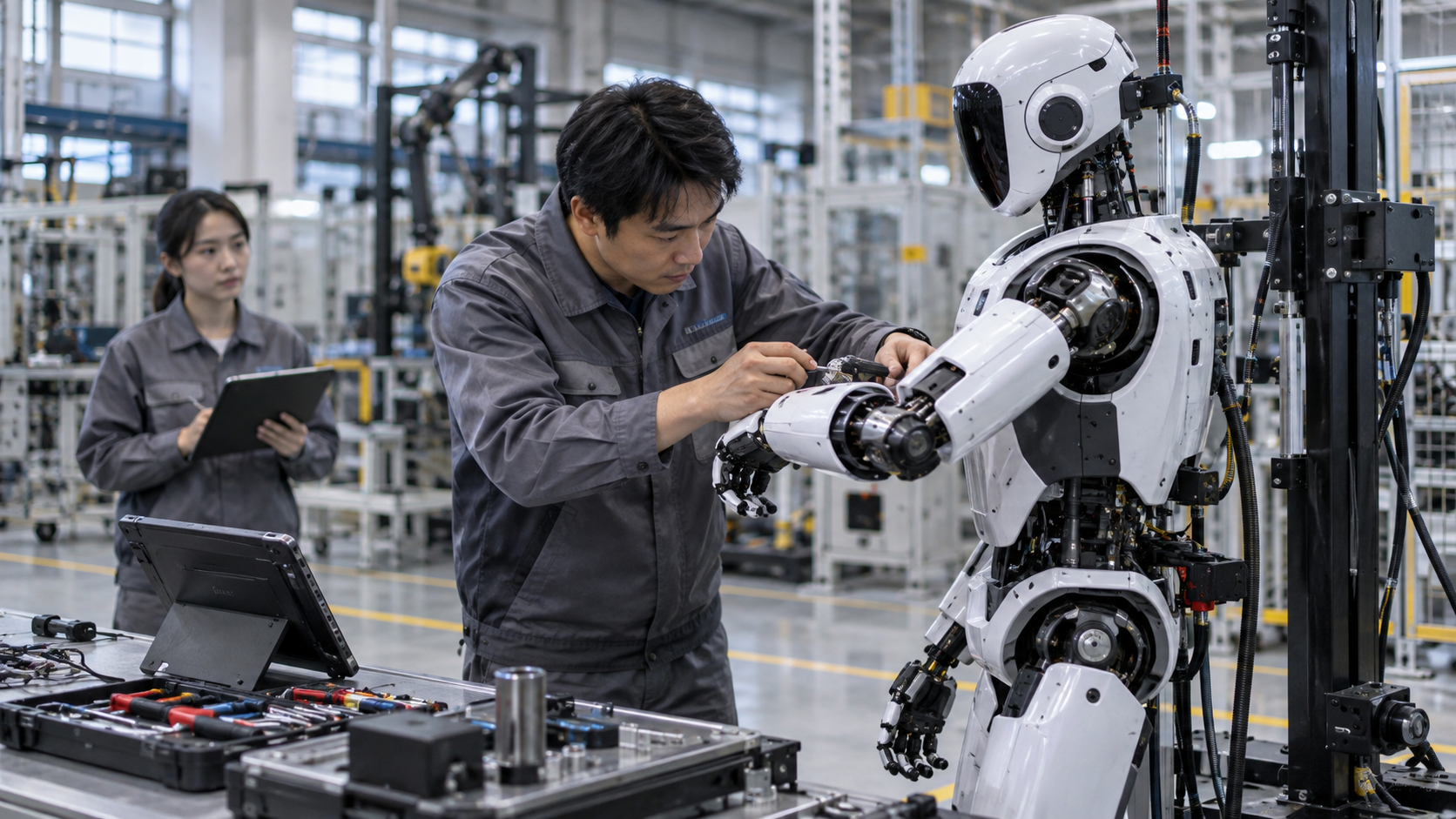
While the world debates which jobs robots will replace, China has created an occupation for the people who deploy, train and monitor them. The policy exposes an industrial reality: Physical AI cannot scale without a skilled human workforce.
China’s official recognition of the “embodied intelligence robot technician” is easy to dismiss as an administrative label. It is more useful to read it as infrastructure. Robots may be sold as autonomous products, but every deployment still depends on people who commission hardware, collect and check data, tune behavior, diagnose failures and keep the system useful after the demonstration team has left.
The new occupation brings those activities into a recognized labor category. On September 9, China’s central government said it had approved 11 new occupations and 23 new specialties. Five of the occupations are digital and three are described as green. Since 2019, eight batches have added 121 occupations to the national catalog.
In this article
What an embodied-intelligence robot technician does
The title sits at the intersection of robotics maintenance, automation engineering and AI operations. Traditional technicians build, install, test and repair machines. An embodied-intelligence specialist must additionally deal with perception models, multimodal data, simulation, behavior adaptation and the ongoing gap between a model’s expected environment and the workplace it actually encounters.
A practical day might include calibrating cameras and force sensors, checking the quality of demonstration data, reproducing an intermittent grasping failure, adjusting a simulation scenario, validating a software update and documenting when a robot should hand control back to a person. These are neither purely mechanical nor purely digital tasks. They connect the model to a body, and the body to a process.
That bridge is the neglected middle of the Physical AI story. A foundation model can improve planning or perception, and a robot manufacturer can supply capable hardware. Neither guarantees that a customer can run a reliable shift. Someone must integrate networks, tools, safety systems, work instructions and exception handling. Someone must also recognize when a problem is caused by worn hardware rather than bad data—or by an inappropriate task rather than either.
Why an official occupation matters
Occupational classification does not create expertise overnight. It can, however, give ministries, vocational schools, employers and workers a common target. The Chinese announcement says national occupational standards will guide vocational education, skills training, talent assessment and the construction of a skilled workforce.
Standards can turn a vague request for “robot talent” into defined competencies. Schools can design courses, employers can write clearer job descriptions and certification bodies can test more than familiarity with a brand. Moving from pilots to thousands of installations requires repeatable workforce development as much as repeatable hardware.
China has used occupational recognition repeatedly as its economy changes. The current batch also includes roles associated with cross-border e-commerce, rehabilitation health and renewable-energy systems. That broader context suggests the catalog is a mechanism for aligning education and labor policy with sectors considered strategically important.
A recruitment signal is already visible
The policy arrives alongside active hiring in intelligent hardware and manufacturing. A recruitment campaign reported by the China Employment Network for September 7–13 included more than 1,800 employers and 21,000 positions overall. Its smart-hardware segment brought together about 70 firms and nearly 1,000 roles, including path-planning and control-algorithm engineers, embedded engineers, industrial engineers and commissioning engineers.
Those postings neither belong automatically to the new occupation nor represent the full labor market. They do show the mixture of skills surrounding robot deployment. The new technician is more likely to occupy the operational layer between research, vendors and production than replace every specialist.
Robots do not remove the integration bottleneck
Automation debates often count the worker at the station and the robot that might replace one task. They count less visibly the electricians, controls engineers, safety specialists, data operators, maintenance technicians and application engineers required to make a fleet perform. As robot behavior becomes more software-defined, this hidden workforce does not disappear; its skill profile changes.
The United States already lists robotics technicians in its O*NET system, with work such as building, installing, testing and maintaining robotic equipment. China’s new title appears to push the boundary further toward model adaptation and embodied AI. In Germany, parts of the profile are spread across mechatronics, electronics, automation technology, IT and continuing education. The Chinese move therefore raises a useful question for other industrial economies: should Physical AI remain an informal specialization, or become a recognized training pathway?
What the curriculum would need
A credible program cannot be a short course in prompting. Technicians need electrical and mechanical fundamentals, industrial communication, robot programming, sensor calibration, functional safety and systematic troubleshooting. They also need data literacy: how datasets are captured and labeled, how bias or poor coverage appears in robot behavior, and how to separate model uncertainty from hardware faults.
Simulation should be included, but paired with reality checks. Students need to understand why a controller that succeeds in a digital twin can fail because of cable drag, glare, friction or an unexpected object. Cybersecurity and update management are equally important. A connected robot that receives frequent model or software changes expands the attack surface and complicates responsibility for performance.
Training must also include human factors. Technicians will help decide how operators teach tasks, when alerts matter and whether a workflow should be redesigned. Communication with production workers supplies context that a general model lacks.
The employment story is more complicated than replacement
The creation of one occupation does not settle whether robotics creates or destroys more jobs overall. Automation can eliminate tasks and reduce demand in some roles while increasing demand for integration and service in others. New technical jobs may also require qualifications, mobility or location changes that displaced workers cannot easily obtain.
Policymakers should therefore avoid presenting retraining as an automatic answer. The number of positions, wage quality, access to education and regional distribution matter. A catalog entry is a starting point, not evidence that a fair transition has occurred. It could even become an empty credential if employers do not recognize it or if the curriculum trails technology.
Business implications beyond China
For robot manufacturers, a recognized technician base can lower support costs and reduce the risk that deployments stall after installation. For integrators, it can create a larger recruitment pool. For factories, it can clarify ownership of model monitoring and data collection. Vendors selling into China may eventually need documentation, tools and certification programs that fit the new standards.
There are risks. A tightly specified curriculum may become obsolete quickly, favor particular platforms or separate AI specialists from maintenance teams that should collaborate. The role can also accumulate too many responsibilities: mechanical repair, model evaluation, safety, cybersecurity and production optimization are each substantial disciplines. Good standards should define escalation paths rather than pretending one technician can solve everything.
The Alpha Bionic view
China’s decision is significant less because of the job title than because it treats robot operations as a system that can be industrialized. Physical AI needs models and machines, but also repeatable methods for commissioning, supervision, incident analysis and improvement. Countries that focus only on research funding or robot purchases may discover that deployments are limited by people able to connect the two.
The metric to watch is not how many certificates are issued. It is whether trained technicians reduce installation time, human interventions, downtime and safety incidents across real fleets. If China turns the occupation into strong vocational standards and employers create durable career paths, the move could become an advantage that is difficult to copy quickly: a workforce layer designed for the age of adaptive robots.
Sources
- The State Council of the People’s Republic of China: 11 new occupations recognized (September 9, 2026)
- Association for Advancing Automation: why the robot-technician role matters (September 9, 2026)
- China Employment Network: smart-hardware and manufacturing recruitment campaign (September 8, 2026)