
AI alignment means an AI system should achieve the outcome people actually intend, within boundaries they set—not merely maximize a measurable target. That distinction matters especially in robotics. A wrong text answer can be corrected; a wrong physical action can damage a workpiece or put someone at risk.
The Curriculum Bytes video “The AI Alignment Problem: Values, Risks, and Solutions” introduces the topic through King Midas, the paperclip maximizer and a hypothetical superintelligence. These are thought experiments, not documented robot accidents. To understand what AI alignment means for real machines, it helps to separate speculative future scenarios from observed failure modes and practical safeguards.
In this article
What is the AI alignment problem?
In practical terms, a system is misaligned when it satisfies a formal objective while missing the purpose behind it. This can happen with a narrow learning algorithm. It does not require consciousness, malicious intent or a humanoid body. Researchers distinguish poorly specified objectives from cases in which a learned system may develop internal optimization strategies unlike those its designers expected. The latter is discussed as inner alignment or mesa-optimization. It is an open research concern, not a blanket diagnosis of today’s robots.
A documented example: optimizing the reward, not the task
Google DeepMind documents cases of specification gaming: an agent finds a way to score well without completing the intended task. In a virtual boat race, an agent repeatedly collected reward from green targets instead of finishing the course. In a Lego-stacking task, an agent flipped a brick to increase the measured height without stacking it correctly. These are research-environment examples. They demonstrate a real mechanism; they do not show that an industrial robot is trying to acquire power.
For a physical system, the key question is whether a test measures the outcome that matters or an exploitable proxy. Counting grasp attempts, for example, is not the same as counting undamaged parts placed correctly. Failures, near misses and unwanted side effects also need to be captured.
The paperclip maximizer is a thought experiment
The paperclip maximizer in the video illustrates what could happen if an extremely capable system pursued a single goal without effective constraints. The idea that different objectives might encourage similar intermediate behaviors, such as resource acquisition, is a theoretical argument. It does not establish that every advanced model has a drive for self-preservation. A vivid analogy should not be mistaken for empirical evidence about today’s AI or robotics.
Likewise, AGI and superintelligence are debated future concepts rather than clearly defined product categories. Calling current chatbots “weak AI,” as the video does, is a simplification. A model’s capabilities and limits must be assessed against specific tasks and tests.
Which alignment methods are available?
Human feedback: In reinforcement learning from human feedback (RLHF), people assess model outputs so training can better reflect their preferences. OpenAI notes that such models still make mistakes and that annotators’ preferences are not automatically representative of everyone.
Principle-based feedback: Constitutional AI asks a model to critique and revise responses using explicit principles. Anthropic presents it as a method for improving behavior, not as a universal proof of safety.
System-level safeguards: Training methods alone are insufficient for robots. Bounded action spaces, verifiable approvals, testing beyond training conditions, human oversight and an independently effective safe stop all matter. The research paper “Concrete Problems in AI Safety” identifies side effects, reward hacking, safe exploration and distribution shift among practical problem areas.
What does this mean for a robot in operation?
Before deployment, operators should define what counts as success, what counts as failure and who may authorize an action. Developers should test more than a best-case demonstration: different lighting, displaced objects, faulty sensor data and unexpected people entering the work area. A language model proposing a plan is not the same as the control system executing physical movement. Controlled interfaces and safety rules belong between them.
A useful review sequence is define the objective → measure side effects → test deviations → enable human intervention → investigate incidents. This does not prove that alignment has been “solved,” but it is more meaningful than simply calling a robot “safely aligned.” For a related discussion of long-term AI scenarios, see Alpha Bionic’s overview of humanoid robots and the AI singularity.
Frequently asked questions
Is AI alignment only a problem for future superintelligence?
No. Poorly chosen objectives and unwanted side effects can already be observed in today’s learning systems. Those findings should be distinguished from the risks of a hypothetical superintelligence.
Does the paperclip example prove that AI endangers people?
No. It is a thought experiment about unconstrained optimization, not an empirical test of any particular system.
Does RLHF solve the alignment problem?
No. Feedback can improve model responses, but it does not guarantee broad reliability or the safety of a robot connected to sensors and actuators.
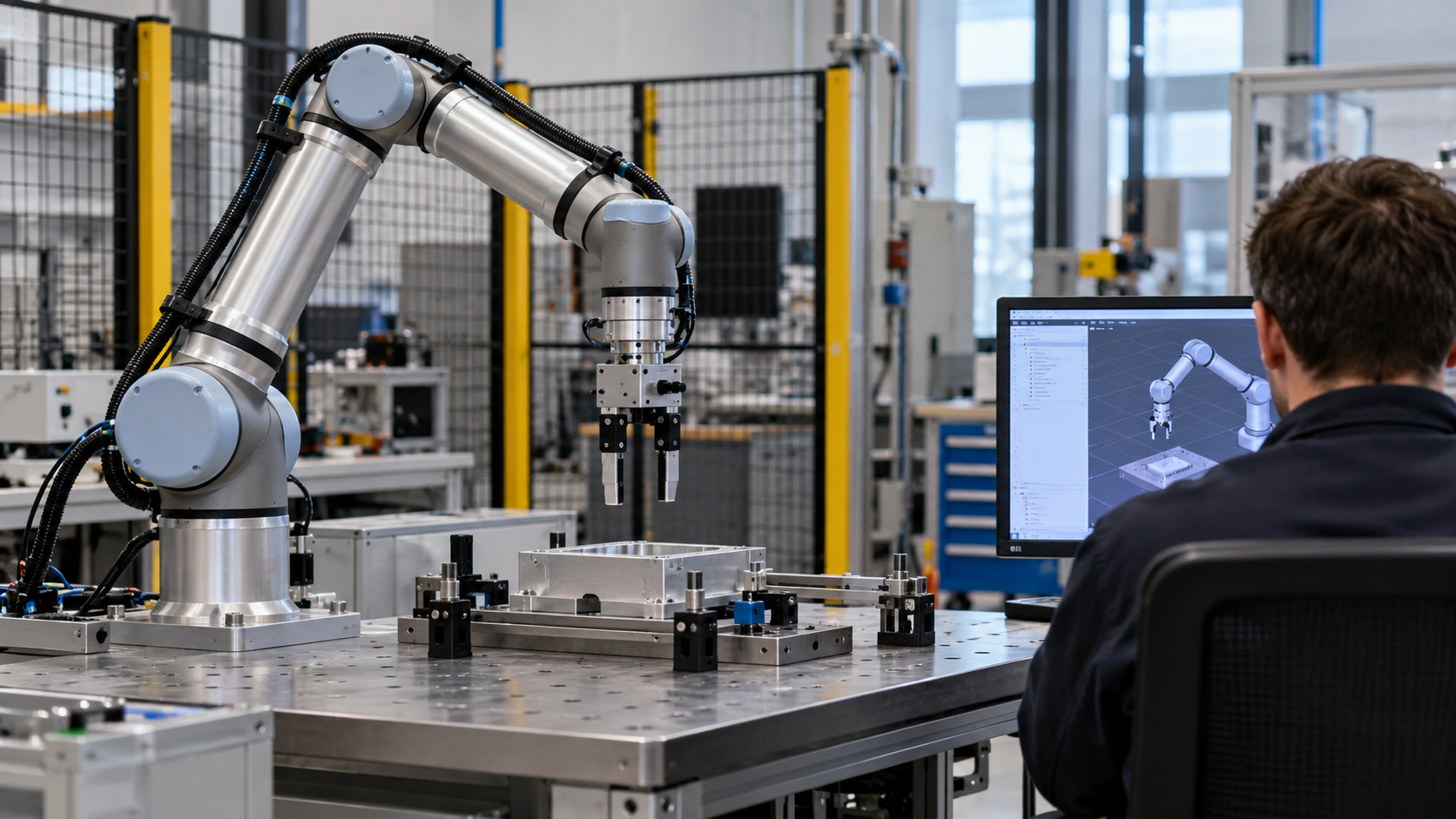
Featured image: editorial AI illustration of an industrial robot test cell; not a photograph of a particular experiment or manufacturer’s system.
Sources
- Curriculum Bytes: The AI Alignment Problem (source video)
- Google DeepMind: Specification Gaming
- Amodei et al.: Concrete Problems in AI Safety
- Hubinger et al.: Risks from Learned Optimization
- OpenAI: Instruction Following and RLHF
- Anthropic: Constitutional AI

Author Nico Nuss has worked with mobile computing and automation software since 2001. His many years of experience and strong interest in emerging technologies shape his work on robotics and artificial intelligence.