
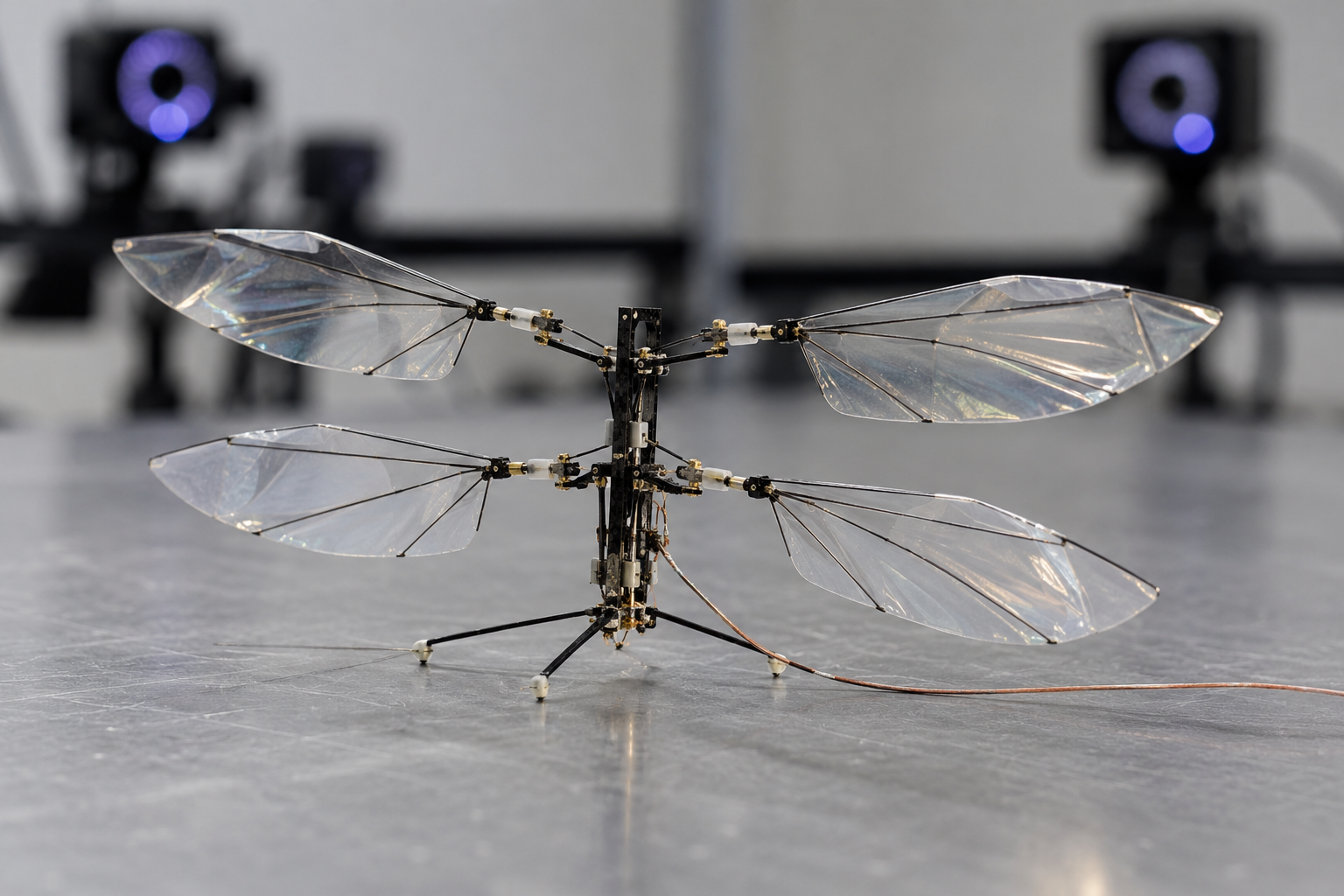
MIT’s 750 mg insect-scale flying robot completed ten consecutive flips in eleven seconds and reached 1.97 metres per second in laboratory tests. The result is an advance in flight control, not evidence of an untethered autonomous rescue drone.
In this article
What the tiny flying robot demonstrated
The research prototype reported in Science Advances measures roughly 4 × 4 × 0.9 cm. It has four independently driven wings beating at about 330 Hz. Researchers demonstrated rapid turns, an X-shaped flight path and ten flips in eleven seconds. The measured peak lateral speed was 197 cm/s (1.97 m/s), with acceleration reaching 11.7 m/s².
Reported improvements of 447% in speed and 255% in acceleration compare this experiment with earlier subgram flying robots. They are not a universal performance boost that AI would deliver to any robot.
What the AI controller actually does
The team used imitation learning to train a compact neural network on the decisions of a more computationally demanding robust tube model-predictive controller. In flight, control commands are updated at 1,000 Hz. This specialized learned controller helps the robot correct its motion during fast manoeuvres and disturbances. It does not provide general intelligence, independent navigation or mission planning.
The important limitation: external cameras, computing and power
For these 750 mg aerobatic flights, six motion-capture cameras tracked the robot in a lab. An offboard computer ran the control system, while high-voltage amplifiers and an external tether supplied what the actuators needed. The paper even notes that the tether could interfere with experiments. Thus, the results demonstrate controllable flight manoeuvres in a prepared environment—not free, self-contained flight inside buildings or outdoors.
Practical inspection or search-and-rescue work would require power, sensing and computing to fit on the vehicle while retaining useful endurance and reliability. The ten-flip experiment did not solve those engineering challenges.
A separate 2026 step toward onboard autonomy
A subsequent 2026 preprint describes a different, heavier 1.29 g platform with onboard sensing and computation and flights outside a motion-capture volume. It should not be confused with the 750 mg aerobatic prototype. Power autonomy remains future work. The flip demonstration itself was described in the peer-reviewed 2025 paper.
Frequently asked questions
Can MIT’s 750 mg robot fly without a tether?
No. Its published aerobatic demonstrations relied on external power, cameras and computation.
Is it ready for search and rescue?
No. That is a possible long-term application, not a demonstrated capability of this prototype.
Image note: AI-generated illustrative image of a four-wing tethered laboratory microrobot; it does not depict the actual MIT device.
Sources: Science Advances paper · MIT News · Separate-platform preprint · Robots-Blog report.

Author Nico Nuss has worked with mobile computing and automation software since 2001. His many years of experience and strong interest in emerging technologies shape his work on robotics and artificial intelligence.