
A robot remembers your name, looks towards you and answers in a familiar voice. The unsettling part may arrive later: how much of that apparent relationship belongs to you, and how much depends on a service you keep paying for? AI companion robots bring that question out of the phone and into the room.
Adult dolls, expressive robot heads and conversational humanoids now appear in the same debate. They deserve closer inspection because their abilities, intended uses and commercial terms differ considerably. For me, the useful question is what remains after the novelty wears off: reliable conversation, manageable costs, clear privacy controls and a device its owner can actually maintain.
In this article
Harmony, MetaBox and Echo: what is being sold?
RealDoll describes Harmony as combining conversation, configurable personality and expressive facial movement. These are manufacturer claims. Harmony product page.
That description identifies several separate systems. A conversational service produces replies. Settings shape the character presented to the user. Actuators move parts of the face. None of those functions, alone, establishes that the machine can navigate a home or carry out physical tasks. A convincing face can make us mentally fill in abilities that have not been demonstrated.
WM markets MetaBox around cloud conversation and touch sensors, rather than independent walking. WM MetaBox information.
That distinction matters when comparing products. A body with an adjustable internal skeleton, a motorized expression and a mobile humanoid are different engineering propositions. I would ask a seller to demonstrate every movement included in the quoted configuration. A promotional scene should not become an unwritten promise that the delivered machine will do everything visible around it.
Realbotix positions Echo for conversation and social interaction, including uses beyond the adult market. Echo overview.
It would therefore be misleading to label every lifelike robot a sex robot. Appearance does not define the application. A reception character, an entertainment installation and an adult companion may share components without being interchangeable products. Readers need the proposed use, available hardware and operating conditions before a comparison becomes meaningful.
The price tag is only the beginning
Realbotix lists Echo Tabletop at US$11,950, Full-body at US$59,950, with AI plans starting at US$19.99 monthly. Official pricing.
The practical calculation is straightforward: add the chosen hardware, recurring service, delivery, applicable taxes, accessories and expected maintenance. Ask which items are essential and which are optional. Compare the same period of ownership rather than placing a one-time purchase beside a monthly fee as though they were equivalent totals.
Realbotix’s terms restrict reservations to US delivery and estimate shipments from the second half of 2027. Dates are not guaranteed. Reservation terms.
A reservation consequently answers a different question from stock availability. An international reader should establish whether a seller can deliver and support the exact model locally. Payment timing also matters: a small initial deposit can precede much larger invoices. I would keep a written configuration and delivery agreement rather than relying on an exciting launch announcement.
For a connected companion, the service conditions deserve as much attention as the body. What remains usable after cancellation? Can a different account take ownership? Can memories move to another device? These questions are especially important when a product encourages familiarity over time. Continuity becomes part of the experience being purchased.
Why the China–US race is difficult to score
A 2025 China Daily report attributed MetaBox’s conversational and sensor features to WMdoll’s founder. Those historical statements are not current delivery guarantees. Reporting from March 2025.
National competition makes an effective headline, but a useful comparison needs a common task. One supplier may prioritize appearance, another expression, another software integration. Without identical test conditions, a lower advertised price cannot establish better capability. Nor does a highly polished demonstration establish a dependable production run.
My comparison would begin with response quality in the intended language, understandable controls, documented servicing and stable operation. Next I would check what the customer receives, when it arrives and who handles repairs. The supplier’s country matters less to this particular decision than the evidence behind those answers. A market forecast does not repair a broken actuator.
A lifelike face does not settle the engineering question
Reuters reporting adapted by VOA documented EX Robots demonstrating motorized facial imitation in Dalian in 2024. EX Robots reporting.
Facial expression is an interesting achievement, but I would judge a companion across a complete interaction. Does it interrupt appropriately? Can it recover when it mishears a name? Does the face remain synchronized when the connection slows? Is a conversation comfortable after ten minutes, rather than impressive for ten seconds? These are proposed evaluation questions, not results from a hands-on test.
Physical assistance needs its own evidence. Our examination of NEO, Expert Mode and household autonomy explains why human help and independent action must be identified clearly. A machine that talks naturally has not thereby demonstrated the ability to lift, balance or manipulate household objects safely.
Privacy: follow the conversation, not just the camera
Realbotix says Echo’s conversation records stay locally while replies use external AI services; Vinci vision data stays on the robot and paired phone. Privacy policy.
Local storage and local processing answer different questions. For any connected companion, I would ask where speech is processed, where persistent memories are kept and how deletion works across paired devices. A reassuring sentence about one camera should not stand in for an explanation of the complete data path.
Imagine moving a robot from a private study into a shared living room. Guests may speak within microphone range without having chosen the service themselves. A household agreement about recording, recognition and quiet periods is therefore practical, not abstract. Clear indicators and accessible controls would make that agreement easier to follow.
Can artificial companionship help without overpromising?
Professor Kate Devlin’s research considers technology, intimacy and human responses to machines. King’s College London profile.
That is a better starting point than assuming every attachment is either a breakthrough or a disaster. Someone can enjoy an artificial character while understanding how it works. The relevant questions concern its place in daily life: does it add something welcome, respect boundaries and leave room for other relationships? Those answers require observing real use over time.
Our article on robot pets and everyday attachment approaches a related question through different machines. Emotional response alone does not prove clinical benefit. I would be cautious about turning personal testimonials into promises that a commercial device treats loneliness or replaces professional care.
Realbotix’s safety guidance explicitly says Echo does not replace a caregiver or emergency services. Safety principles.
What I would check before committing
First, request a live demonstration of the actual configuration. Use ordinary speech, change subjects and introduce a correction. Then ask for the ongoing bill and a clear explanation of cancellation. Finally, inspect support arrangements, spare parts, safe positioning and the controls for stopping movement. Those steps make the decision tangible without pretending this article tested any individual device.
The Alpha Bionic robotics atlas offers a starting point for exploring manufacturers and applications. My interest in companion robots is real, but so is my preference for evidence that survives a demonstration. A familiar voice is compelling. An understandable product, supported over time, is what would earn my confidence.
FAQ: AI companion robots
Are all lifelike robots designed for intimate use?
No. Check the manufacturer’s stated application and the exact configuration rather than inferring purpose from appearance.
Does conversation prove physical autonomy?
No. Speech, expression, movement and independent task completion need separate demonstrations.
How should I compare ownership costs?
Use the same time period and include hardware, necessary services, delivery, taxes and maintenance.
What should a privacy explanation cover?
Speech processing, stored memories, paired devices, external providers and practical deletion controls.
Do these images document a product test?
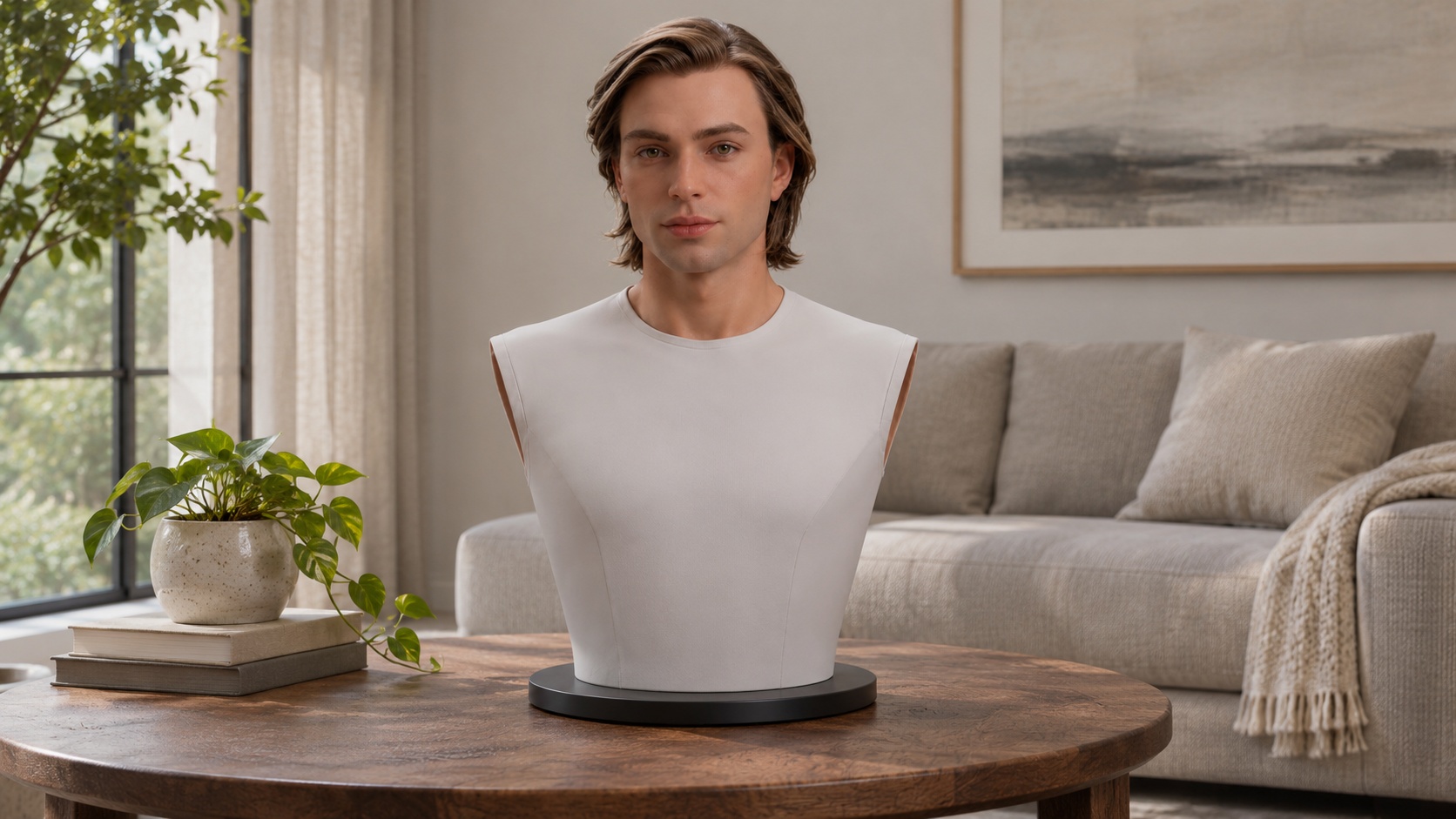
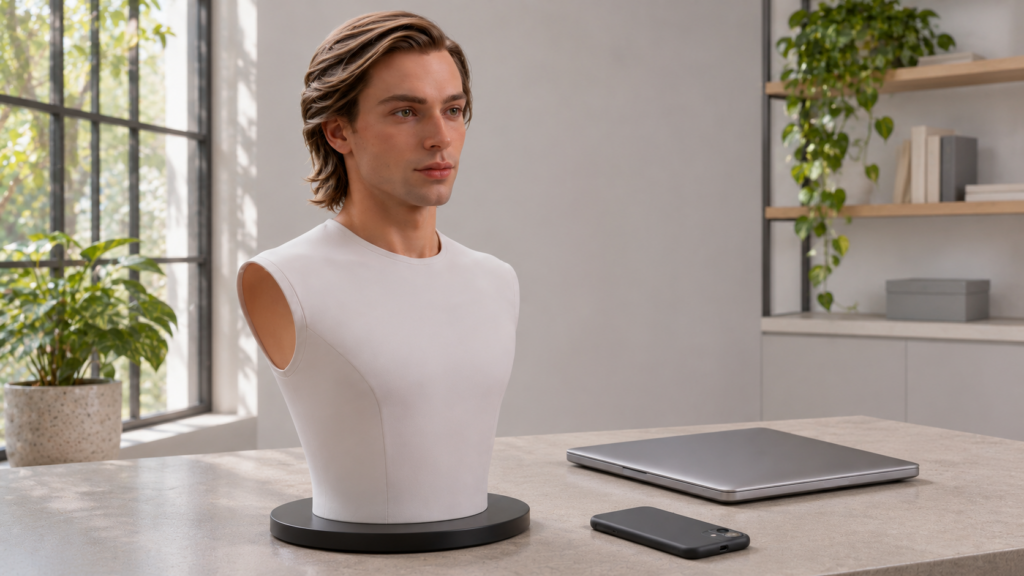
No. They are original AI-generated reconstructions inspired by the published Echo tabletop design, placed in illustrative settings.
What makes a demonstration useful?
The actual purchasable configuration, ordinary conversation, visible limitations and answers that can be checked afterwards.

Author Nico Nuss has worked with mobile computing and automation software since 2001. His many years of experience and strong interest in emerging technologies shape his work on robotics and artificial intelligence.