
When an AI company heads towards the stock market, the big questions arrive immediately. Is this the next industrial transformation, or are investors paying for a future nobody can deliver yet? Meanwhile, new models are changing how software works and how convincingly digital spaces can be created. Both things can be true: technology can advance while expectations for the business run ahead of reality.
For me, the useful question is not how spectacular a valuation sounds. It is what still works after the demonstration ends. Anyone using AI at work, building a product or following robotics needs something more useful than a daily contest for the biggest number. Anthropic’s proposed listing, new working models and spatial AI provide interesting—but very different—pieces of that picture.
In this article
Anthropic’s IPO: a filing is not an offer price
Anthropic announced its S-1 filing on October 26; share count and price range remained undetermined. Official announcement.
That distinction sounds technical, but it prevents a common misunderstanding. A valuation being discussed is not a completed market transaction. Company value, newly raised capital and revenue are also different quantities. Mixing them can turn an exciting headline into a completely mistaken impression of how much money actually enters a business. Big numbers need labels before they need exclamation marks.
A successful offering would not certify every product’s technical quality. Equally, a disappointing valuation would not establish that AI is useless. Capital markets price expectations about future returns; users assess completed work. Those perspectives intersect without becoming interchangeable. Good editorial analysis keeps them alongside each other instead of treating one as proof of the other. This article is not a recommendation to buy or sell securities.
A risk chapter is neither reassurance nor a crash forecast
The preliminary SEC prospectus identifies model reliability, computing capacity and oversight of autonomous systems among its risks. SEC filing.
Such disclosures deserve attention without becoming a countdown to collapse. Naming a risk initially describes something that could go wrong. Listing it does not establish its probability. What matters is the response: understandable safeguards, their limitations and what happens when they are insufficient. A long list cannot substitute for either a safety assessment or an analysis of the business.
For a workplace, I would draw a practical lesson: automation needs a defined operating boundary. A system preparing a draft has different consequences from one placing orders or modifying customer records. Approvals, logs and recovery options should match the task. Not everything must remain manual, but responsibility does not disappear because a screen responds smoothly or an assistant sounds confident.
The better cost question: what does completed work cost?
An inexpensive model call is not necessarily an inexpensive workflow. Setup, review, corrections and exception handling belong in the calculation. An assistant producing nine useful results and one difficult-to-detect mistake needs a different checking process from a tool that reliably stops when uncertain. Time to the first response is only one part of the experience, and often not the decisive part.
Consider two systems asked to produce twenty product descriptions from approved information. Both respond quickly. One invents accessories for several products; the other flags missing details. Measuring text volume and speed alone could reward the worse result. Looking at the fully checked publication reveals the difference. This is a proposed test scenario, not a model comparison conducted for this article.
Before switching tools, I would assemble a small, fixed set of tasks: easy cases, typical cases and deliberately awkward exceptions. Count correct outcomes, human interventions and total working time. One attractive demonstration tells me less than a week of repeatable results under consistent rules. Broader deployment should follow that evidence, not replace the experiment that would establish it.
GPT-6.1 Terra and Gemini 4 Carbon are different decisions
OpenAI describes GPT-6.1 Terra as supporting visual reasoning, computer use and writing. Official model documentation.
The work-oriented combination is what interests me. Interpreting an image and operating an interface are separate steps that can form one process. Nevertheless, someone needs to verify that the correct file was changed and the result really saved. A persuasive explanation of an action is not evidence that it happened successfully. Useful automation ends in a verifiable outcome, not just a reassuring message.
Google initially announced Gemini 4 Carbon access for selected cyber defenders and trusted partners. Google’s announcement.
Access therefore belongs in every comparison. Announced, being tested by a limited group and generally available are three different states. A leaderboard offers little practical help if you cannot use the relevant model or connect it to your existing work. Instead of declaring a universal winner, I would first compare the actual task, necessary permissions and available environment.
Genie 4, Echo-3 and Simulon: three approaches to spatial AI
Genie 4 begins as a research preview for selected testers, generating interactive worlds with sound. Google DeepMind.
SpAItial describes Echo-3 as reconstructing real spaces from phone captures. SpAItial. Simulon places generated subjects into captured surroundings. Simulon.
Spatial representation is the common ground, not necessarily the purpose. An invented environment can help someone develop a scene. Reconstruction should be assessed against an existing place. Creative insertion deliberately changes the picture. Treating these tasks as identical confuses imagination, measurement and design. The distinction becomes particularly important when an attractive output is interpreted as technical validation.
Imagine a virtual workshop. A convincing camera move might be enough for a film concept. Planning a workstation requires reliable distances. A robot adds questions about reach, contact and movement. An object looking right does not establish that it behaves the same way in a physical experiment. The appropriate standard depends on the decision somebody intends to make from the representation.
Why robotics needs a closer look
A convincing simulation is especially tempting in robotics. We see fluid movement and mentally supply the missing evidence. I would resist that shortcut. A scene can explain an idea without proving its reliability. What matters is the transition from a controlled representation to a repeatable task under changing conditions. Visual polish and experimental evidence answer different questions.
Our article on NVIDIA GR00T and the Unitree reference robot introduces the connection between AI and robot hardware. For any such system, I would ask what inputs it receives, who corrects it, which failures trigger a stop, and whether the performance shown was achieved on real equipment or only inside a digital environment. Those questions should accompany the demonstration, not arrive after deployment.
The distinction between assistance and independence matters just as much. Our coverage of NEO, Expert Mode and everyday autonomy addresses that expectation. Human intervention does not automatically make an application worthless. It does change what can reasonably be said about independence and how much ongoing support a purchaser may need. Honest boundaries are more useful than an all-or-nothing label.
Startup opportunities extend beyond another chatbot
Y Combinator’s current startup requests include robotics supply chains and specialised infrastructure. Requests for Startups.
My conclusion is not a list of guaranteed business ideas. The interesting direction is towards concrete questions: where does an existing process fail, what information is missing, and who will pay to remove the bottleneck? An unglamorous solution with an identifiable customer can be more compelling than a dazzling demonstration without a clear owner. The Alpha Bionic robotics directory offers a way to explore manufacturers and application areas.
A pilot project should define success and stopping conditions in advance. What quality is needed, what budget is available, and who decides whether to continue? There should also be a route back to the previous method. Small teams can benefit from improving one specific process instead of rebuilding the model, information base and organisation all at once.
My conclusion: measure progress without losing curiosity
The most interesting shift is not another superlative. It is the requirement to judge AI by concrete outcomes. One fewer unfinished task, another verified file, a demonstrably better draft: these are modest but meaningful advances. They require neither a guaranteed success story nor a prediction that everything will collapse tomorrow. They require a fair test and the willingness to record disappointing results too.
Anthropic’s plans and the new models are reasons to look closely, not reflexively celebrate or dismiss the entire field. Users need reliable tools. Businesses need workable processes. Robotics ultimately has to answer to the physical world. Keeping those tests separate makes the news easier to understand—and makes it harder for excitement to quietly take the place of evidence.
FAQ: making sense of the AI news
Does an IPO filing establish a successful offering?
No. Filing, final offering terms and actual trading are separate steps. A headline should not skip the differences between them.
How do I recognise an economically useful AI deployment?
Look at a complete, checked task. Include setup, review, corrections and exception handling alongside the direct usage cost.
Are newly announced models available to everyone?
Not necessarily. Check access for your account, region and required application. An announcement is not sufficient evidence of availability.
Does a realistic simulation prove a robot works?
No. Physical tasks need appropriate tests, repeatable outcomes and understandable conditions. An image cannot replace those checks.
How should a useful comparison begin?
Use identical inputs, predefined quality criteria and typical exceptions. Record mistakes and human interventions rather than only successful examples.
Do the images show actual company facilities or software tests?
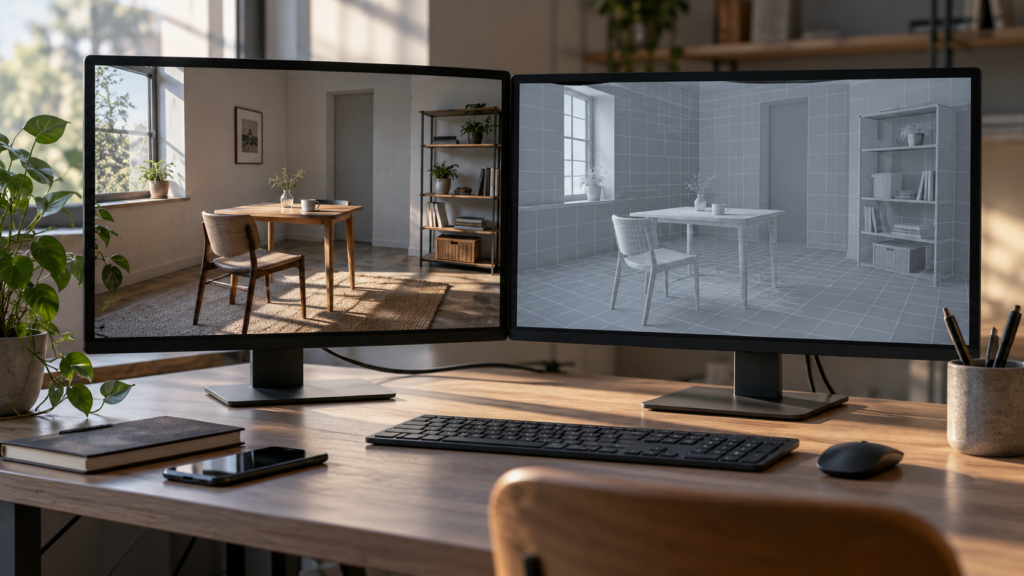
No. Both are newly generated AI illustrations showing generic computing equipment and an illustrative spatial workspace, not documented facilities or product interfaces.

Author Nico Nuss has worked with mobile computing and automation software since 2001. His many years of experience and strong interest in emerging technologies shape his work on robotics and artificial intelligence.