
Xiaomi reports an eight-hour trial of its humanoid robot at a sorting station in its own car factory. IT Home reported on November 3, 2026, citing Xiaomi Technology, that the task involves center-console side covers. The manufacturer describes a first eight-hour work challenge, autonomous correction of anomalies and coordination with production-line systems. For factory operators, the relevant step is a longer workflow rather than a single successful grasp.
This does not establish independently verified, economically viable continuous operation. The announcement mainly concerns duration and integration for one specific task. It is not evidence that a robot can take over arbitrary factory jobs.
In this article
The sorting station is not new; the duration is the news
Xiaomi’s own 2026 interim report provides a useful baseline. On page 9, the company describes July deployments at two additional stations in final-assembly logistics: center-console side-cover sorting and returnable-box folding. It reported a 90 percent success rate for each task at that time.
The latest development is therefore not the first encounter with this sorting job. It is the reported longer trial, including error recovery and coordination with the line. The earlier percentage must not be presented as a measurement from the November test. Nor can a new success rate be calculated from eight hours alone.
The same interim report gives a 98 percent figure for a different operation: dual-side tasks at a self-tapping threaded-insert nut loading station. That figure does not belong to the current sorting station either. Keeping tasks, periods and metrics separate matters more than combining them into an apparently impressive headline.
Why recovery can matter more than a perfect grasp
Our technical assessment: A sorting system needs to do more than pick up a part. It must recognize its position, choose a suitable grasp, coordinate placement and establish whether the operation actually succeeded. A displaced part must not silently become the next process error.
Autonomous recovery could therefore have practical value. A robot could detect an unsuccessful attempt and try again without immediately requesting assistance. Evaluating that capability requires the frequency of these incidents, the additional time they consume and the number of cases that still need human intervention. Xiaomi’s statement describes a capability; it does not replace a complete incident log.
Eight hours is not a productivity calculation
A shift-length figure is easy for buyers to understand. On its own, however, it answers neither the battery-runtime question nor the question of how many parts were sorted correctly. That requires information on how pauses, retries, replenishment, charging or swaps, and human support were counted. The information reviewed here does not support a reliable overall calculation.
For a German or European plant manager, a useful acceptance test would therefore specify four measurable quantities:
- Good parts per hour: How many correctly sorted, undamaged parts actually leave the station?
- Interventions per shift: How often must staff help, and for how long?
- Cycle time and recovery: Does the station maintain the required production rhythm after an error?
- Total cost: What do integration, supervision, maintenance and energy cost per successfully handled part?
These are our evaluation criteria, not test results released by Xiaomi. Comparable measurements would be needed to decide whether a humanoid body offers an advantage over a fixed robot arm, a mobile manipulator or a manual workflow.
What the announcement changes
Compared with a short demonstration, Xiaomi is moving its claim toward shift-length work within an existing factory process. That is more specific than a general mobility demonstration. The reviewed sources do not establish a verified production release or operation across many consecutive shifts, however. Several reports of the same manufacturer announcement are not several independent tests.
For earlier context, see our German report on Xiaomi’s World Robot Conference presentation. The decisive follow-up question is narrower: how many usable parts does this particular sorting station deliver over repeated shifts, and how much support does it require?
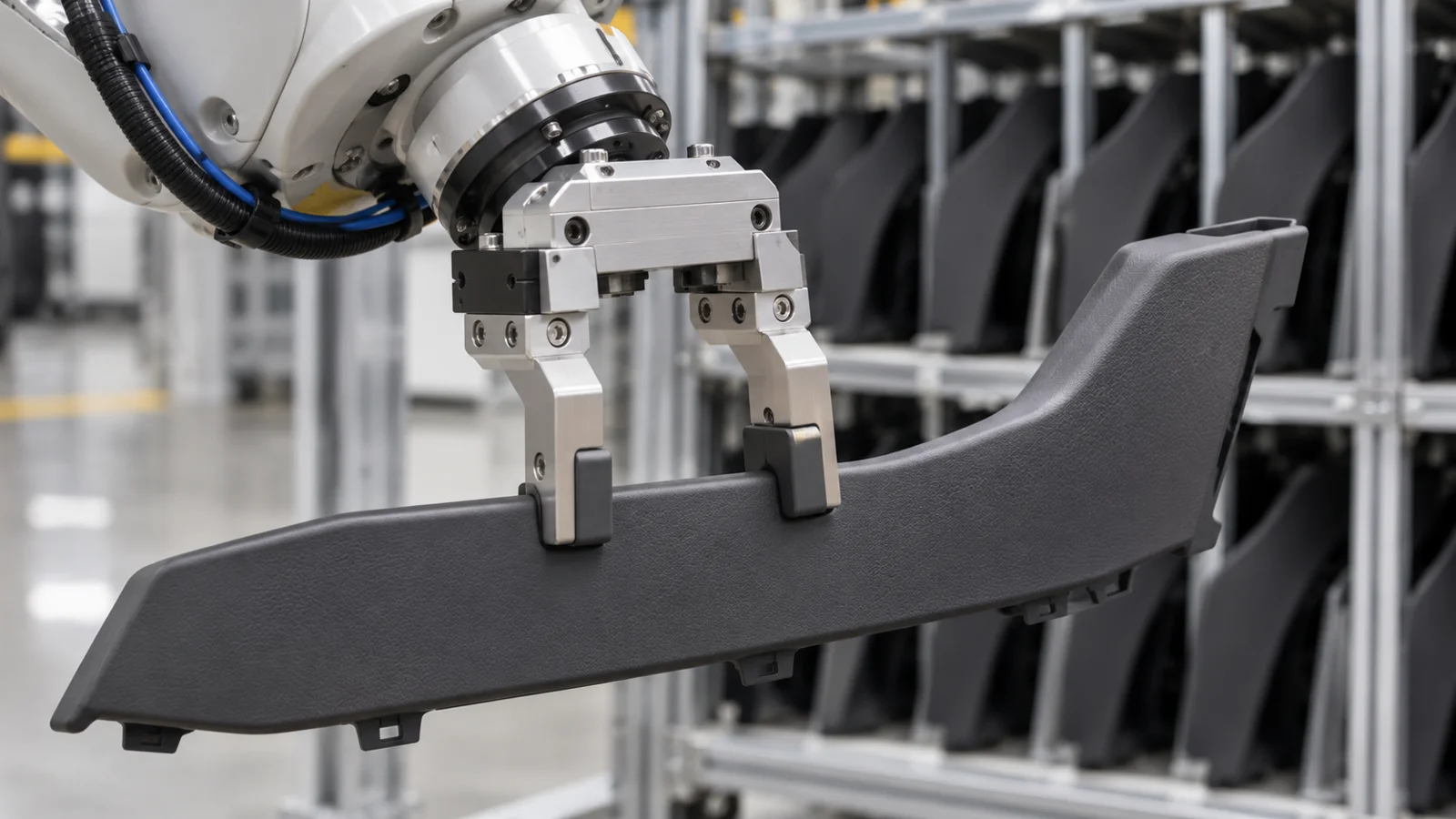
Image: an original AI-generated symbolic illustration of a robotic gripper holding an interior trim panel. Not a photograph of Xiaomi’s trial or an exact rendering of the hardware used.
Sources
- IT Home, republished by Sina: Xiaomi reports its eight-hour work challenge, November 3, 2026. Reporting based on Xiaomi Technology; not an independent operating assessment.
- Robotique Store: Xiaomi humanoid robots sort car parts for 8 hours, November 3, 2026. Analysis of the released demonstration, not an on-site test.
- Xiaomi Corporation: Interim Report 2026, page 9. Primary source for the company’s account of July progress and its task-specific success rates.