
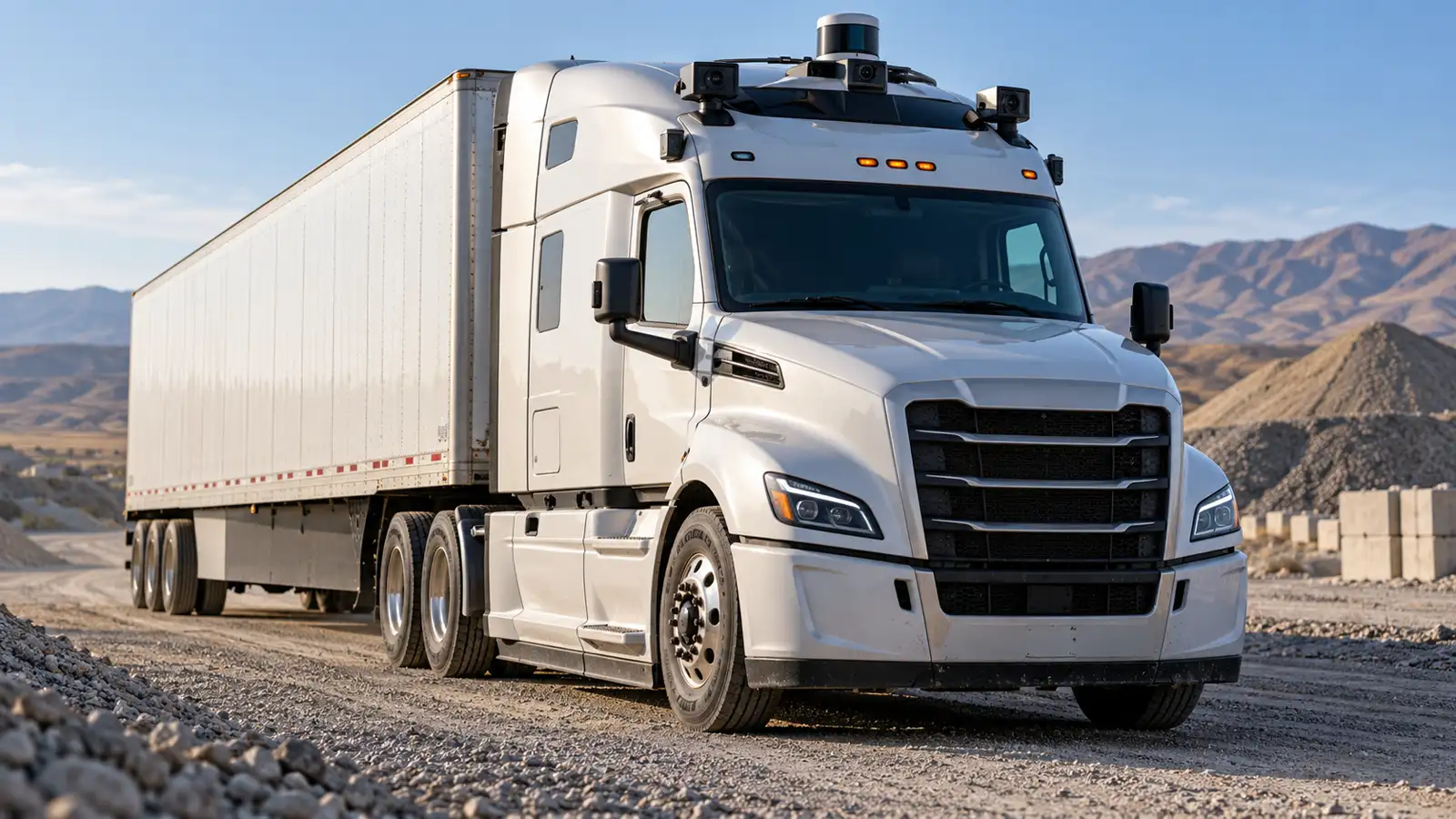
Kodiak AI says one of its driverless trucks in Texas’s Permian Basin went 64 consecutive days without a restart of its autonomous-driving system between June 30 and September 1, 2026. The company disclosed the result on October 20. It describes system uptime across a period, not 64 days of nonstop driving. That distinction is central to understanding what the number says about autonomous freight.
In this article
Why uptime matters
A truck must do more than complete a single impressive trip. It must remain dispatchable through stops, loading, servicing and changing daily conditions. An unplanned restart can delay a delivery and require staff to diagnose the problem. A long uptime streak is therefore relevant to operational reliability. But uptime alone does not establish road safety, profitability or how many miles the vehicle actually drove.
Kodiak says five more trucks each exceeded 45 days without a restart. That makes the announcement broader than a one-off vehicle showcase. Still, the public figures do not answer several questions needed for a fair benchmark: How many driving hours and miles did each vehicle record? What maintenance was allowed during the period? How often was remote assistance needed? What exactly counts as a system restart? The figures are company-reported; the linked coverage does not provide an independent audit of the streak.
A real deployment with a defined operating area
According to Kodiak, the trucks serve industrial routes in the Permian Basin. This is commercial driverless work, not simply a laboratory demonstration. Yet a geographically and operationally defined deployment cannot be equated with unrestricted driverless operation on public long-haul highways. Route familiarity, traffic patterns, pickup points and support procedures can all affect performance. Any claim about autonomous driving should specify its operating domain.
As of June 30, Kodiak reported a fleet of 35 driverless trucks and a cumulative 40,000 paid driverless operating hours. Those fleet-level figures have a different measurement window from the 64-day streak. They are not the mileage of one truck or proof that one vehicle moved continuously. Kodiak’s aim of 100 trucks by mid-2027 is a target rather than an achieved fleet size. Keeping these dates and units separate prevents an uptime headline from becoming a misleading claim about scale.
Availability is not the same as useful work
In computing, “uptime” usually describes how long a service remains available. In transport, managers also need to know whether a truck could take a job, actually drove, and completed the delivery without human intervention. Those four measures can diverge. A parked truck with its computer running may have excellent technical uptime while carrying no freight. Conversely, scheduled vehicle maintenance can reduce availability without indicating a software failure. Any comparison across fleets needs a published definition of the metric and its measurement period.
Nor does the absence of a restart mean there were no safety events. An autonomous system might stop safely, ask for remote support or abandon a task without rebooting. Such events can matter more to customers and regulators than a single stability record. Kodiak’s figure deserves attention, but it should be read alongside intervention and service data.
The test for a transport customer
For a carrier, the important question is whether vehicles can be scheduled predictably at an acceptable cost. Paid hours per day, delivery reliability, maintenance, insurance, safety requirements and behind-the-scenes staffing all enter the calculation. A truck may stay online for weeks and still have a weak business case if it completes too few jobs or needs frequent human help.
A more useful public scorecard would report unplanned downtime, remote interventions, completed deliveries and cost per unit moved for each vehicle over a common period. It would also show miles and hours driven, rather than only calendar days. That would connect uptime to transport output and make comparisons less vulnerable to different definitions.
What the result does, and does not, mean elsewhere
European operators also have tightly defined use cases, including ports, industrial sites and fixed shuttle routes. High availability may become economically relevant there before broad public-road autonomy. But Kodiak’s Texas results cannot simply be transferred to European licensing, infrastructure or labour conditions. Those applications need their own evidence and safety case.
The next meaningful milestone is not merely a longer streak from one truck. It is evidence that a larger fleet can maintain comparable reliability over months while delivering documented transport output with few human interventions and predictable costs.
Sources
- Kodiak AI, uptime and fleet announcement (October 20, 2026).
- TruckNews, report on Kodiak’s announcement (October 20, 2026; not an independent measurement).