
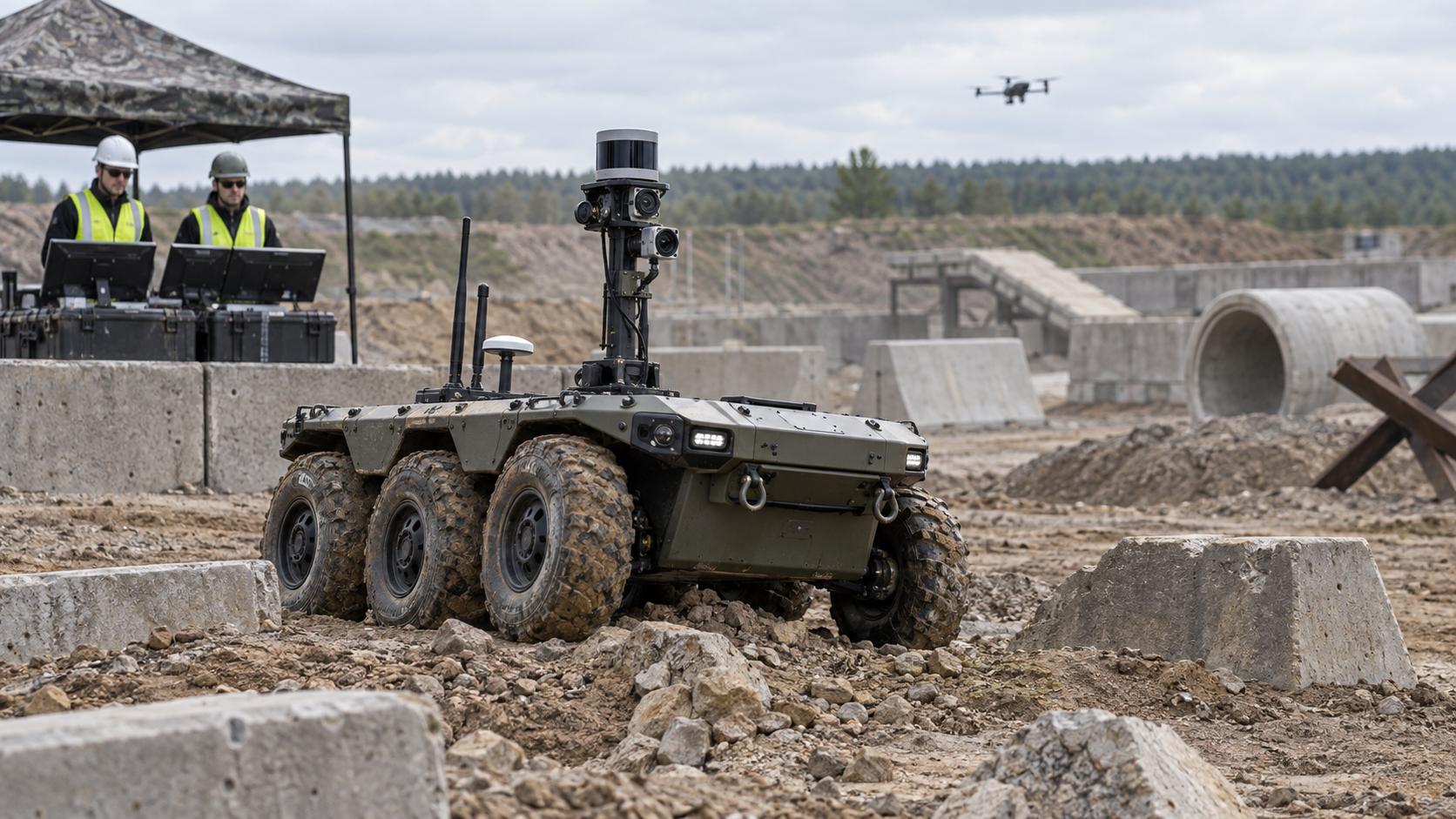
A $20 million U.S. Army contract is pushing autonomous ground robots beyond isolated demonstrations and toward a coordinated engineering system. The central idea is straightforward but technically demanding: one operator should be able to direct several unmanned vehicles through dangerous terrain while drones and modular tools help identify and clear obstacles. The important caveat is that this is still a development and assessment program, not proof of an operationally mature autonomous force.
Overland AI announced the award for the Army’s Engineer Autonomous Breaching Capability, or EABC, initiative in September 2026. The company says its team will combine ground autonomy, command-and-control software, aerial reconnaissance and mission equipment into a single capability package. The Army had previously selected four contractors—Caterpillar, Forterra, IDV USA and Overland AI—to build and evaluate different approaches.
In this article
What the Army is actually funding
Breaching is the military engineering task of opening a route through obstacles such as barriers, trenches or minefields. It is especially dangerous because personnel can be exposed while examining the obstacle, deciding where to create a lane and operating heavy equipment. EABC is intended to move more of those steps away from people by using robotic platforms that can work beyond an operator’s direct line of sight.
The contract does not represent an order for a declared number of finished vehicles. According to reporting by Tectonic Defense, it covers a capability set: several ground vehicles, aerial systems, sensors, control software and specialized tools intended to work together. Subsets are expected to be developed and demonstrated before a unit-level assessment planned for early 2027. That distinction matters. A funded prototype program can be technically serious without yet being ready for routine field use.
One operator, many machines
The most consequential part of the concept may be the shift from remote driving to supervisory control. Traditional unmanned ground vehicles often require a person to steer each machine or continuously watch its video feed. That model scales poorly: adding more robots can simply add more operators, screens and communication links.
Overland AI’s proposed architecture uses its OverDrive autonomy stack to perceive terrain, plan routes and adapt vehicle movement. Its OverWatch command system is designed to let one person assign tasks and monitor several platforms. In theory, the operator specifies the objective while the machines handle much of the low-level navigation. This resembles the direction of warehouse robotics, where a fleet manager allocates jobs while individual mobile robots make local movement decisions.
The comparison has limits. A warehouse is mapped, structured and protected from hostile interference. An outdoor engineering mission may involve mud, dust, slopes, vegetation, poor visibility, damaged roads and incomplete maps. Radio connections can be intermittent, and sensor data can be ambiguous. Autonomy that works on a prepared test course still has to prove that it fails safely when the environment stops matching its assumptions.
Why a drone joins the ground robots
The announced team includes companies working on aerial systems, obstacle intelligence, electronic protection and mission-specific equipment. A drone can survey the route from above, provide a wider view than vehicle-mounted cameras and help identify possible obstacles before a heavy platform approaches. A ground robot can then carry larger sensors or tools and operate for longer periods close to the terrain.
Combining air and ground machines sounds efficient, but it adds another integration problem. Locations, maps and task status must be shared in a common coordinate system. The software must avoid contradictory commands and keep track of which sensor observation is current. If a drone loses its link or a ground vehicle becomes immobilized, the operator needs a clear picture of what the remaining machines can still do.
Autonomous does not mean unsupervised
The word “autonomous” can obscure the human workload. Even if a vehicle selects a path without continuous steering, people still define the mission, authorize consequential actions, supervise system health and decide when conditions have become unsafe. Maintenance, transport, calibration and recovery also remain human responsibilities.
For Alpha Bionic, the useful question is therefore not whether the robot replaces the engineer. It is how the engineer’s role changes. The operator may move away from direct exposure, but gains responsibility for interpreting several machines at once. Interface design becomes a safety issue: alerts must be prioritized, uncertainty must be visible and manual intervention must remain possible without overwhelming the user.
The technical tests that matter
A convincing assessment should measure more than whether a vehicle reaches the end of a course. Reliability across different terrain types, navigation without dependable satellite positioning, obstacle classification and recovery after a blocked route are essential. The system also has to show how it behaves when sensors disagree or a network connection drops.
Fleet coordination creates its own metrics. How many platforms can one person supervise before workload becomes excessive? How often does the operator need to intervene? Can a machine explain why it stopped or changed its route? How quickly can a damaged or stuck platform be removed without blocking the rest of the team? These details determine whether “one operator to many robots” is a practical advantage or merely a demonstration slogan.
Cybersecurity and electronic resilience are equally important. A robotic fleet depends on authenticated commands, protected software updates and trustworthy position and sensor data. The inclusion of electronic-warfare and counter-drone specialists in the wider team indicates that the project is being considered as a system rather than as a single self-driving vehicle. The public information, however, does not establish how those protections perform under realistic disruption.
From demonstrations to a production decision
The Army says the four selected contractors will move through demonstrations and assessments culminating in feedback from an operational unit. That competitive structure is significant. It allows evaluators to compare modified commercial machinery with purpose-built robotic platforms and to examine whether a modular autonomy kit can work across different vehicle types.
Overland AI already points to earlier government demonstrations and off-road testing. Experience matters, but demonstrations are not the same as sustained deployment. A polished video can show a successful run; an operational evaluation asks how often the system succeeds, how quickly it can be repaired and how it performs across repeated missions with ordinary users rather than the development team.
What can be learned beyond defense
The application is military, yet several engineering lessons are relevant to civilian robotics. Wildfire response, disaster recovery, mining and work around unstable infrastructure also require machines to navigate rough terrain beyond direct sight. The same building blocks—terrain perception, resilient communication, modular payloads and supervisory fleet control—could reduce human exposure in those environments.
Transfer is not automatic. Civilian deployments operate under different safety rules, budgets and acceptable risk levels. A system designed for a military test may not meet the certification, accessibility or liability requirements of emergency services or commercial operators. Still, progress in off-road autonomy can improve the components and operating concepts available to other sectors.
The Alpha Bionic assessment
The $20 million award is evidence of a serious prototype program, not evidence that autonomous breaching has been solved. Its strongest signal is architectural: the project treats autonomy as coordination among vehicles, drones, sensors, tools and a human supervisor. That is more credible than presenting a single robot as an independent replacement for a complete engineering team.
The next meaningful milestone will be the planned unit assessment in early 2027. Useful evidence would include intervention rates, mission completion across varied terrain, operator workload, recovery time and performance during communication loss. Until those results are available, the defensible conclusion is measured: the Army is funding the transition from demonstrations toward an integrated capability, while operational readiness remains an open question.
Sources
- Overland AI: $20 million EABC contract announcement, September 8, 2026
- U.S. Army: selection of four EABC contractors and assessment plan, July 8, 2026
- The Defense Post: contract and program overview, September 10, 2026
- Tectonic Defense: team, systems and development schedule, September 2026