

A car drops you home, picks up another passenger and keeps earning while you are already on the sofa. That is the image that makes Tesla’s Cybercab so compelling. It turns a vehicle from something expensive sitting in a parking space into something that appears to work for its owner. Yet the distance between a convincing ride and a money-making business is an operating calculation that can change remarkably quickly.
I am less interested in the biggest possible fleet on a presentation slide than in the number of paid journeys left after charging, waiting, cleaning and repairs. That question exposes both the opportunity and the weak point. You do not need a dramatic prediction about success or failure. You need to see what the vehicle earns, what the whole operation consumes and which assumptions connect those two figures.
In this article
What we can establish about Cybercab
Tesla’s rider guide describes a gold two-seater without a steering wheel or pedals. Cybercab overview.
That design puts the passenger at the centre of the vehicle. It also raises a practical dispatch question: which requests suit it? A commuter carrying a bag has different requirements from a family, a large group or someone needing additional assistance. A fleet operator has to match the request with the vehicle. Appealing hardware does not, by itself, solve that allocation problem or establish how much demand can be served profitably.
Tesla’s Q3 update reports an Austin launch on September 3 and installed annual Cybercab capacity above 125,000 vehicles. Quarterly update.
I would read a factory capacity figure separately from a sales or deployment figure. A plant may be capable of making vehicles faster than a transport operation can put them to productive use. Materials, service planning and local demand connect the two. For a meaningful assessment, vehicles produced, vehicles delivered and vehicles completing paid work should be reported separately. Treating them as interchangeable makes an expansion look more complete than it is.
Dallas: a target month needs a bookable journey
November was named as the Dallas Cybercab target; the report gave no specific opening day. Report on the announcement.
The next useful evidence would be a passenger booking showing the actual vehicle and service area. A vehicle sighting, depot photograph or target month does not fully answer that customer question. Anyone planning to try a service should check what the booking process offers for that journey. A familiar city name alone does not establish which model is taking passengers there at that particular moment.
Tesla’s FAQ lists limited Austin areas for Cybercab rides and a commercial buyer interest form. Tesla Support.
An interest form starts a conversation. It does not provide enough information to calculate a business return. Before committing, I would want a binding price, delivery terms, operating responsibilities and the arrangement for sharing revenue. The mundane questions matter: who pays during a workshop visit, who arranges cleaning and who carries the cost when a vehicle remains unavailable longer than expected? The answers determine what ownership actually means.
Nevada’s 5,000 figure: permission and productive work
Nevada approved up to 5,000 autonomous Tesla vehicles in the first permit year, subject to conditions. Official announcement.
A ceiling gains economic meaning through actual use. It cannot tell us how many paying passengers are travelling today or how much a fleet will earn over a year. I need at least three more inputs: vehicles genuinely working, paid distance per vehicle and the full cost of doing that work. Skipping these steps gives an impressive headline the appearance of a measured financial result.
Location matters too. A dense neighbourhood with frequent short journeys presents a different scheduling problem from dispersed suburbs. Requests may arrive in the same place at the same time. Vehicles can then be left in the wrong area after the peak subsides. More cars improve availability economically only when enough additional suitable journeys appear. Otherwise the same customer spending is spread over a larger collection of assets.
What a robotaxi could earn: an explicit worked example
The calculation below is my own hypothetical model, not a Tesla forecast or a measured cost statement. I assume 330 operating days, revenue of US$1.50 per paid mile and variable costs of $0.45 per total mile driven. I also assume annual fixed costs of $20,000. These deliberately chosen inputs illustrate how strongly utilisation can alter the outcome. They should not be read as current fares or quoted operating expenses.
Variable costs here are intended to cover energy, wear, routine cleaning and operational support. The fixed allowance includes assumed insurance, parking and depreciation. Actual commercial quotes could differ substantially. Financing, taxes, platform charges and central development costs are not additionally included. The remaining amount is therefore not net profit, a promised owner payment or an estimate of Tesla’s reported earnings. A real proposal would need its own complete cost categories.
| Per-vehicle model | Weak | Middle | Strong |
|---|---|---|---|
| Paid miles per day | 80 | 160 | 240 |
| Total miles per day | 160 | 240 | 320 |
| Annual revenue, US$ | 39,600 | 79,200 | 118,800 |
| Annual variable costs, US$ | 23,760 | 35,640 | 47,520 |
| Fixed costs, US$ | 20,000 | 20,000 | 20,000 |
| Remaining model amount, US$ | −4,160 | 23,560 | 51,280 |
The formula is straightforward: paid miles multiplied by the fare and operating days, minus all miles multiplied by variable cost and operating days, minus fixed costs. The columns do not assign a probability to any result. They show how identical hardware can produce very different outcomes under different demand. Whenever a particularly attractive return is presented, I would work backwards to the daily journeys needed to produce it.
In the middle example, annual revenue happens to be $79,200 and total annual distance happens to be 79,200 miles. Those matching numbers are a coincidence of the assumptions, not the same measure. Only 52,800 annual miles are paid. Applying the passenger fare to every mile accidentally turns pickup journeys and other empty running into customer revenue. That mistake alone can make an operating plan look much more attractive than it should.
Why a bigger fleet does not automatically fix the economics
Multiplying the middle example by 5,000 produces $396 million in annual revenue and a remaining model amount of $117.8 million. This is arithmetic applied to our assumptions, not a Las Vegas forecast. It assumes every vehicle achieves the same demand and cost structure. A larger fleet can instead compete with itself for existing requests. The multiplication is useful precisely because it makes that hidden requirement visible.
I would first examine a smaller area with repeat demand. What happens to waiting times when vehicles are added? Does the total number of paid journeys increase, or are the same journeys divided among more cars? These questions tell us more than a photograph of a busy depot. The fleet has to work as a network. A collection of vehicles ready to drive is only one ingredient in that network.
Someone still has to run the service
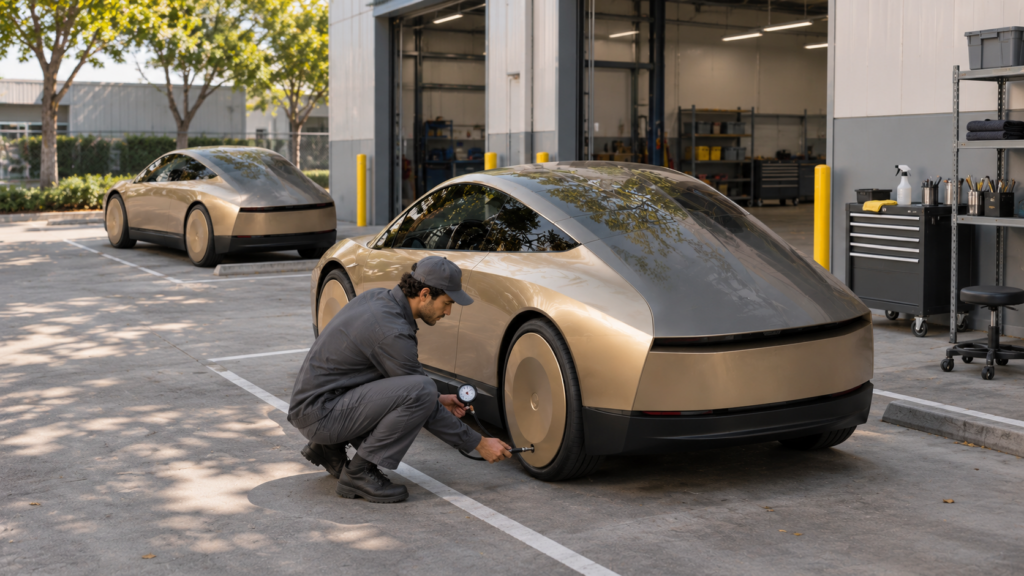
A passenger leaves a phone behind, a seat needs cleaning or a tyre loses pressure. A serious operating plan needs a response to each. Such events can require extra travel, people and downtime. I would ask for those responses before a service is expanded. A cheap average journey is less useful if every unusual incident triggers an expensive individual intervention with no clear responsibility for the bill.
The timing of charging and maintenance is equally important. A task’s duration does not tell you which revenue opportunities it displaces. Being unavailable during a demand peak may be especially costly. My preferred measure would therefore be revenue per operating day after both planned and unplanned interruptions, accompanied by the cost of providing that availability. That connects technical performance to the ordinary working life of the business.
Safety and permissions belong in the operating plan
NHTSA opened an inquiry into Tesla’s Cybercab self-certification on September 4. Agency announcement.
The opening of an inquiry is neither a final finding nor a clean bill of health. It is a reason to read official documents and subsequent decisions carefully. Anyone committing capital and staff to a service should consider how changed operating conditions would affect the plan. A viable business requires the technical capability and the permitted deployment to fit together. A successful demonstration cannot settle every question about that relationship.
The wider issue is familiar from humanoid robotics: repeated work answers more questions than a demonstration. Our article on NEO, Expert Mode and everyday autonomy explores how to interpret human assistance. For transport, I would similarly ask what support is needed outside the vehicle and who is responsible for providing it. Removing a person from one task does not make all supporting tasks disappear.
My view: look at the time between paid journeys
Cybercab could become economically interesting when the vehicle, demand and operating organisation fit together. I would not jump from an appealing vehicle price to a large recurring profit. Dispatch, maintenance, customer support and unproductive time all influence whether a fleet earns money. Each deserves a place in the same calculation, rather than being treated as a detail to resolve after the headline return has already been announced.
Three pieces of evidence would help readers assess the next announcement: bookable journeys, clearly defined operating costs and understandable results per vehicle. Our analysis of AI and business expectations develops the same focus on verifiable performance. The robotics company atlas offers more manufacturers and applications to explore. The most persuasive development, for me, would be ordinary service delivered consistently, with numbers that explain how it is sustained.
FAQ: Tesla Cybercab and robotaxi economics
Is robotaxi revenue already profit?
No. Variable expenses, fixed costs and any contractual charges must be deducted from fares. Only a complete calculation reveals the business result.
Why do empty journeys matter?
Driving without a paying passenger still takes time and consumes resources. Paid distance and total distance therefore need separate measurement.
Are the table figures Tesla business results?
No. They are deliberately selected assumptions in an original worked example. They illustrate utilisation sensitivity and do not promise income.
What should a prospective fleet buyer check first?
Binding terms, total costs, responsibility for downtime and the permitted operation. An expression-of-interest form cannot replace these documents.
Which measure helps compare providers?
A result per vehicle and operating day calculated on equivalent terms, with journey volume, empty running, downtime and included costs clearly shown.
Do the images document actual journeys?
No. These newly generated AI illustrations follow the real Cybercab design and depict possible everyday settings. They establish no journey, permission or fleet size.

Author Nico Nuss has worked with mobile computing and automation software since 2001. His many years of experience and strong interest in emerging technologies shape his work on robotics and artificial intelligence.