
Your aircraft is at the gate. Most passengers have boarded, but one baggage cart has yet to arrive. Down on the apron, a small missing piece can turn an apparently smooth departure into another announcement. That is why some of the most useful airport robots will never greet travellers or pose for a photograph. They move luggage, help people lift it, or tackle awkward physical jobs beside an aircraft.
Robotics in airport ground handling is no longer just a future scenario. But there is a considerable distance between a driverless transport route and a fully automated airport. To understand the progress, look at the individual job rather than the shape of the machine. For me, that is the interesting story: the winner does not need to resemble a person. It needs to complete a demanding, time-sensitive task reliably.
In this article
At Changi, baggage already travels without a driver
On 20 January 2026, Changi Airport announced that two driverless baggage tractors were operating between the baggage areas of Terminals 1 and 4. More than 5,000 test trips preceded the deployment. A control centre supervises operations, with human intervention available when required. Additional vehicles and routes were announced, but those expansion plans should not be confused with the deployment already confirmed. Source: Changi Airport Group’s launch announcement.
That may sound less dramatic than a humanoid in a cockpit. It is also much more tangible. A recurring transport job can be bounded: a departure point, a destination, a load, traffic rules and a handover. Once that chain works reliably, every trip no longer has to tie a person to a driving seat for its entire duration. The value lies in the completed job, not the novelty of an empty seat.
Changi describes the initial connection as a seven-kilometre route. It also distinguishes that route from the more demanding move into aircraft stands, where vehicles must interact closely with other handling activities. That distinction makes the progress credible. Solving one transport task does not establish that every movement around an aircraft can be automated. Source: Changi’s account of operations and the next deployment stage.
Why an airport apron is harder than a factory aisle
Several teams work towards the same departure. Baggage, catering, cleaning, fuel and technical support have to finish their respective tasks. A transport robot therefore does not inhabit a neat little world of its own. Its route intersects with other vehicles, workers and changing operating conditions. A lane that was clear a few minutes ago can look different after equipment has been repositioned.
There is also a basic difference between driving and handling. A vehicle may reach the correct destination while the overall job remains unfinished: the intended cart is unavailable, nobody is ready to accept the load, or the next station has run out of capacity. A useful assessment follows the entire assignment. An impressive journey alone does not prove that a suitcase will reach the right aircraft on time.
The same perspective matters outside aviation. Our guide to robots in industry and logistics explores the relationship between machines, material flows and people. Airports make that integration problem especially visible because handovers are time-sensitive. A robot does not need unlimited ability. It needs predictable behaviour within its approved operating conditions and a clear way to communicate when it cannot continue.
Lifting suitcases: progress does not have to come on wheels
Following a pilot project in 2023, Schiphol decided to purchase 19 baggage robots from Cobot Lift to reduce the heavy lifting performed by workers. That historical procurement announcement documents a concrete commitment. It does not demonstrate a fully automated baggage operation or a current performance rate across every workstation. Source: Schiphol’s baggage robot announcement.
For the people doing the work, this kind of assistance can matter more than a futuristic appearance. The question is not simply how many bags move per hour. It is also how often someone must pick up a heavy object from an awkward position, whether assistance fits the actual working rhythm, and whether unusual bags create extra handling. A machine only reduces strain if its help survives contact with the real workflow.
A meaningful evaluation would therefore include varied cases: rigid suitcases, soft bags, awkward shapes and closely packed luggage. The aim is not to demand that one machine handle every conceivable object. It is to establish a workable route for items beyond its capabilities. If staff repeatedly have to improvise around those exceptions, the solution is not yet properly integrated, however good the normal demonstration looks.
A.R.C. tackles an awkward job: connecting ground power
A.R.C., a development project involving Schiphol, KLM and NEURA Robotics, addresses a different task. In November 2025, Schiphol described a technology trial involving moving a ground-power cable, positioning at the aircraft, opening the access panel and inserting the connector. The airport reported a demonstration and further development, not airport-wide routine deployment. Source: Schiphol’s account of A.R.C..
This is a useful illustration of why robotics is about more than navigation. A cable is not a rigid carton. Its position changes, it needs controlled handling, and it must not interfere unpredictably with the work area. The machine must also identify the right location and perform a precise movement beside an aircraft. Several individually plausible skills need to work together reliably. Those transitions often separate a compelling demonstration from a useful operational tool.
That is why I would not describe such a machine as a replacement for an entire ground crew. It addresses one bounded step. Whether it becomes an economical service also depends on availability, maintenance, supported conditions and recovery from faults. A successful connection is an important piece of evidence. It is not the whole operating record, and treating it as one would hide the most interesting engineering questions.
What passengers might gain—and what cannot be promised
Most travellers will never see this technology working. You do not need to know which tractor carried your suitcase. Potential benefits are less avoidable disruption, more dependable handovers and staff available for situations that require personal attention. These are possible outcomes of well-integrated automation, not automatic results of buying robots. The quality of implementation matters as much as the capability of the machine.
Flights can be delayed for many reasons. It would therefore be misleading to turn a driverless baggage route into a general promise of punctual departures. The relevant question is whether that route previously caused a bottleneck and whether improving it avoids simply moving a queue to the next station. A faster component does not necessarily create a faster turnaround. The whole chain needs to be considered.
It is equally important not to merge terminal operations with airside handling. A cleaning robot in a departure hall faces different conditions from a baggage tractor near aircraft stands. Our report on airport cleaning robots and the role of integrators covers that complementary environment. Both areas are worth following, but a performance claim from one should not be transferred casually to the other. They are different operating problems.
Five questions that tell you more than a polished video
First, what is actually operating? An expression of interest, a demonstration and a regularly completed commercial task represent different stages. A useful report identifies the location, the assignment and the scope. When those details are absent, caution is sensible. The word autonomous is not enough on its own: it does not tell you when people intervene or which conditions the system can handle.
Second, how is a successful job counted? Ideally, measurement follows an assignment from dispatch to confirmed handover. Aborted journeys, waiting time and manual assistance belong in that picture. A percentage based only on uncomplicated parts of a route can look better than the actual working day. Without a clear denominator and a description of the task, a headline success rate tells the reader surprisingly little.
Third, what happens when something goes wrong? Someone must be responsible for a stopped vehicle, a blocked route or a load that has not been handed over. A practised fallback matters. A safe stop is essential, but it is not the end of the operational problem: the remaining handling work still has to proceed. Safety and recovery are connected responsibilities, and both need to be designed into the service.
Fourth, does the job actually become easier? Less driving or fewer manual lifts can help. Extra monitoring, frequent troubleshooting or awkward controls can introduce new burdens. Workers should be involved before the machine is considered finished, not merely asked to comment after installation. Their knowledge of inconvenient exceptions is valuable engineering input. The best demonstration conditions rarely capture everything an experienced operator knows.
Fifth, what does a completed assignment cost? Purchase price is only one element. Charging infrastructure, maintenance, spare parts, training, supervision and backup capacity belong in the calculation. A fair comparison needs the same task and the same required availability on both sides. The Alpha Bionic robotics company directory can help readers explore suppliers, but a directory listing is not a substitute for a site-specific operational assessment.
My view: the useful revolution looks surprisingly ordinary
The most convincing development is not a machine that looks as human as possible in a promotional clip. It is a machine that takes responsibility for a clearly defined task and fits into other people’s work. Changi provides a confirmed example of driverless transport in operation. The Schiphol examples show how different other jobs—and their stages of development—can be.
That points towards a sensible approach: do not automate everything at once. Begin where benefits, limitations and recovery procedures can be tested. For travellers, the best outcome may not be a robot worth photographing. It may be a suitcase that arrives when expected, supported by a ground crew whose work has become less physically demanding. That is a more useful ambition than a futuristic airport with nobody in sight.
FAQ: robotics in airport ground handling
Are driverless baggage tractors already operating?
Yes. Changi confirmed two driverless vehicles on a defined route in January 2026. Remote supervision remains part of the system. This is evidence of a specific deployment, not of a completely driverless airport.
Will airport robots replace the entire ground crew?
The examples discussed automate individual tasks. Handover, exceptions, supervision and other handling activities still need to be organised. Automating one transport job does not establish that all staff can be replaced.
How do baggage robots differ from autonomous tractors?
A tractor moves loads between locations. A lifting or manipulation robot assists with individual bags. Both may contribute to the same handling chain, but they address different operational problems.
Is A.R.C. already deployed throughout the airport?
The Schiphol publication used here describes a technology trial, a demonstration and further development. It does not establish widespread routine deployment of automated ground-power connection.
Do robots automatically make flights more punctual?
No. A dependable component can help when it improves a genuine bottleneck. Whether the complete turnaround becomes faster or more resilient must be measured in the actual operation.
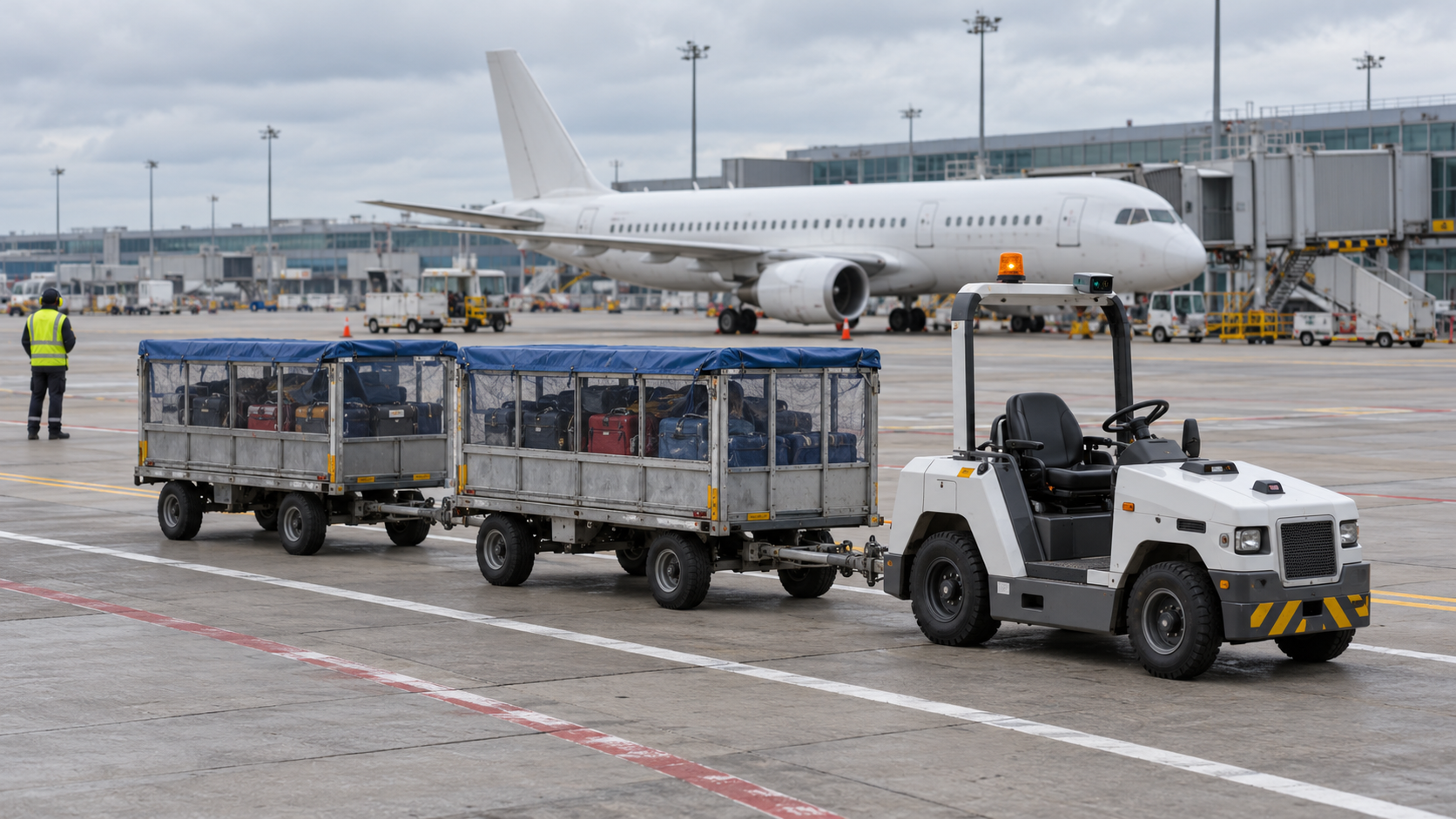
Does the featured image show an actual airport project?
No. The original image is an AI-generated, realistic illustration of a baggage tractor. It does not document Changi or Schiphol and is not an exact depiction of a named commercial model.
Original AI-generated illustration: an autonomous baggage tractor in a generic airport scene. Not a photograph from Changi or Schiphol or an exact depiction of a commercial model.

Author Nico Nuss has worked with mobile computing and automation software since 2001. His many years of experience and strong interest in emerging technologies shape his work on robotics and artificial intelligence.