
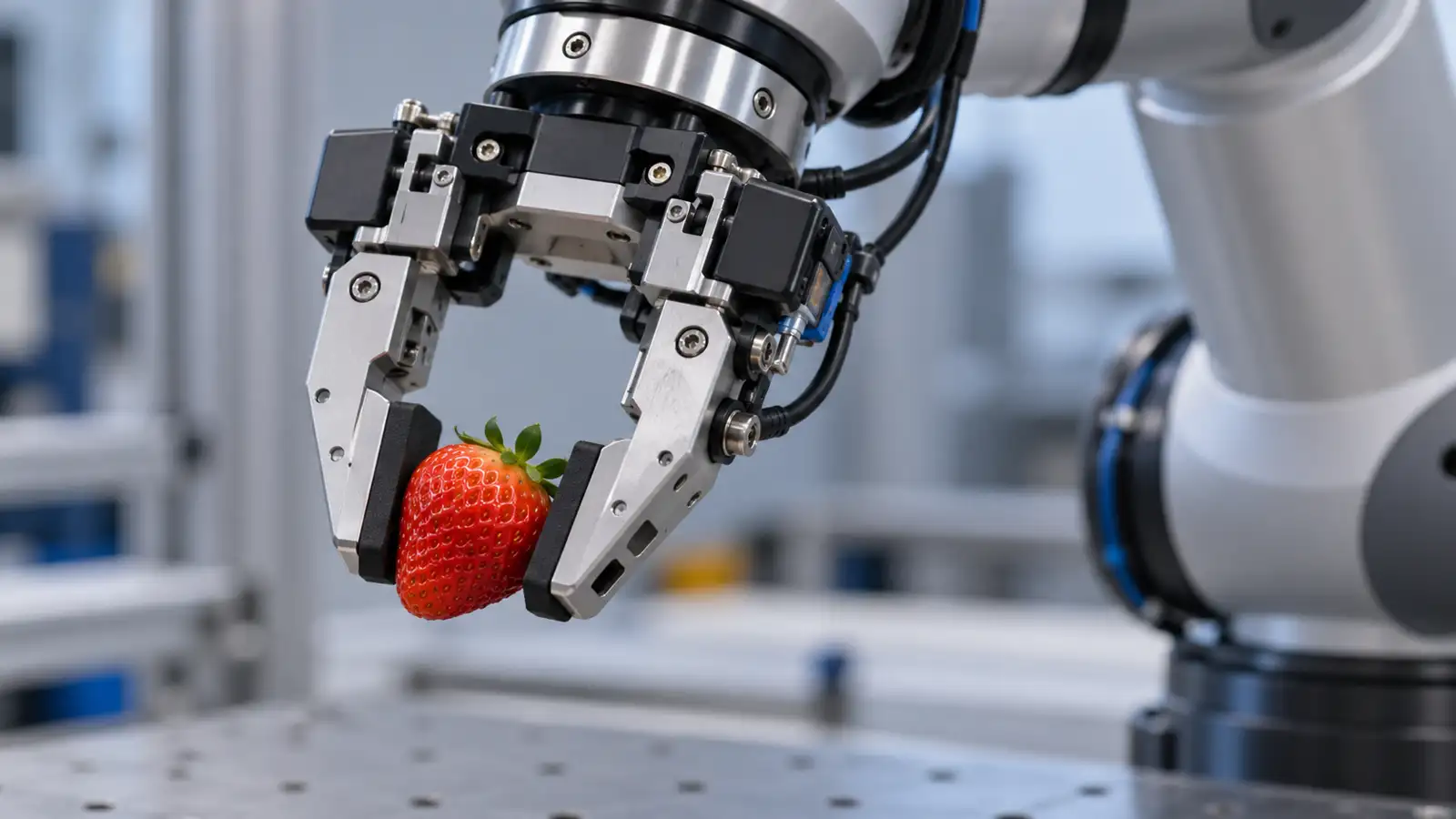
Eka Robotics said on October 20, 2026, that it had raised $150 million in Series A funding to develop a robot-learning system that combines camera images, force feedback and actions. The financing, led by Andreessen Horowitz and F-Prime Capital, is a significant bet on a familiar industrial problem: robots can repeat a movement precisely, yet still struggle when an object shifts, bends or needs just the right pressure. The funding is confirmed by the company and an investor; it is not evidence that the technology is already operating reliably in customers’ factories.
In this article
Why force feedback matters
A camera can show where a strawberry is, but not exactly how firmly a gripper is squeezing it. For that, the machine needs information about contact forces and a controller that adjusts its movement before the fruit is crushed or slips. Eka describes its approach as a vision-force-action model: perception and force measurements feed into a policy that selects the next action. The company says it also trains in simulation using reinforcement learning. That means the robot practices many attempts in a digital environment and is rewarded for successful outcomes. The difficult step is transferring those learned responses to messy physical conditions.
The distinction is more important than the funding headline. Industrial robots have long used force sensors and carefully programmed gripping. What Eka is trying to improve is adaptability: handling variation without manually designing a new sequence for every object and position. A practical system must notice contact early, change force smoothly and recover if the item moves unexpectedly. It also needs to perform this repeatedly over hours and shifts, not merely in a selected video clip.
The throughput claim needs context
Eka says its system has achieved 1,500 operations per hour, compared with a stated human baseline of 600. Those numbers are striking, but they are company claims, not an independently verified, like-for-like factory comparison. “Operation” is not a universal measure. The type of object, the permitted error rate, replenishment of workpieces, interruptions and the share of the task automated all change the result. A robot that performs a narrowly defined pick extremely quickly may still need people for loading, exception handling and quality checks.
For an operator considering this kind of system, the more useful questions are: What is the success rate across a full shift? How many different items can it handle without retraining? What happens after a failed grasp? How much downtime is required for maintenance or recalibration? Throughput matters only together with yield, availability and integration costs.
Funding is a development signal, not a deployment record
The round gives Eka money to expand its model, hardware and testing. TechCrunch reports a valuation of $1.45 billion, illustrating how strongly investors are pricing possible progress in so-called physical AI. That valuation should not be mistaken for revenue, proven savings for users or widespread deployment. The company says further customer deployments are planned. “Planned” is different from a documented customer installation, and a pilot is different from dependable production across multiple sites.
This is especially relevant to European manufacturers. An adaptable gripper could help where parts arrive in varying orientations or where products change often enough that rigid automation is expensive to reprogram. But an industrial buyer also needs evidence on machine safety, integration with existing cells, traceability and service support. A fast learning model cannot bypass those obligations. The strongest business case may come not from replacing a whole workstation, but from automating one variable handling step that currently blocks a production line.
What would prove a real advance?
A credible next milestone would be a named application with a defined task, operating period, error rate and human intervention rate. Ideally, the customer or an independent tester would report the conditions. That would allow the public to separate a promising demonstration from sustained economic performance. Until then, Eka’s financing shows investor conviction and its demonstrations suggest an interesting technical direction, while the claimed speed and wider usefulness remain to be tested under transparent operating conditions.
Sources
- Eka Robotics, funding and technology announcement (October 20, 2026).
- Andreessen Horowitz, investment announcement (October 20, 2026).
- TechCrunch, financing and valuation report (October 20, 2026).