
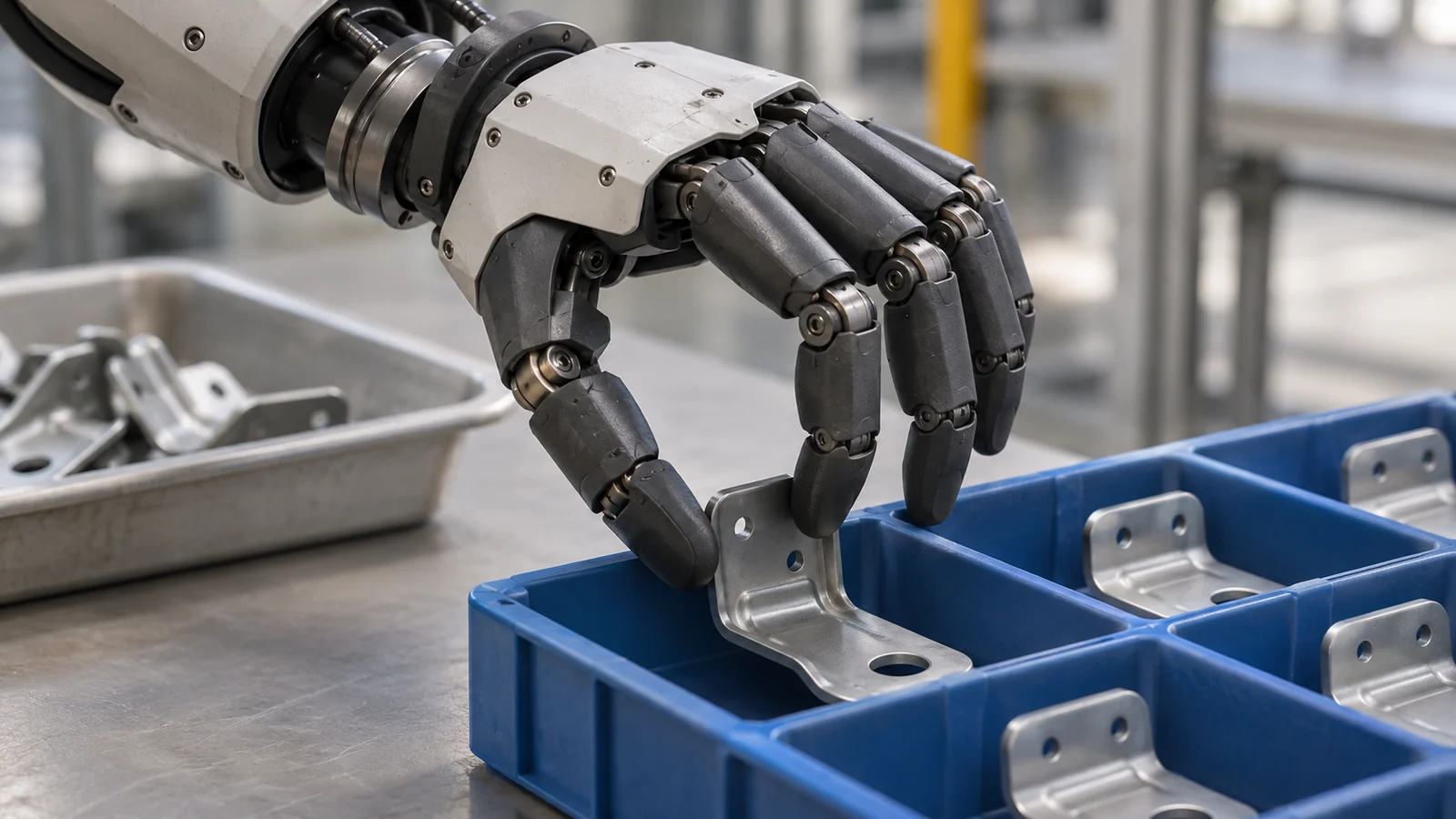
AI-generated illustration of robotic parts sorting. Not a photograph of the Mercedes pilot or an exact depiction of Apollo 2.
Google DeepMind introduced Gemini Robotics 2.5 on November 10, 2026, alongside a specific industrial trial: Apptronik’s Apollo 2 humanoid sorts automotive parts at Mercedes-Benz plants. Google reports a 96% success rate for the proof of concept. This is a supplier’s pilot result, not independently verified continuous production.
In this article
From a parts bin to the correct sequence
According to Google, the trial takes place on active production lines in Kecskemét and Sindelfingen. Apollo 2 picks metal brackets from a bin and places them into sequencing containers to match vehicle order, using five-finger Sharpa Wave hands. Gemini Robotics 2.5 controls movement, while a Robotics ER model helps track the workflow.
A vision-language-action model links visual information and language instructions to movement. The practical question is not whether the machine looks human. It must identify the correct component, choose a workable grasp and place it in the intended location.
What 96% does—and does not—tell us
The figure is a useful signal, but not yet a business case. The announcement does not provide a sufficiently detailed trial count or a complete account of cycle time, retries, human interventions and availability. Coverage of the same announcement does not constitute an independent validation of the pilot.
Our analysis starts with the definition of success. Does a failed first grasp count as a success after a retry? Can the system detect an incorrectly placed part? Does someone have to reposition the bin? Those distinctions change staffing requirements even when the headline percentage remains unchanged.
Purely arithmetically, 96% means four unsuccessful operations per 100 equally defined attempts. This is not the actual sample size. A detected error that the robot fixes itself has different consequences from an unnoticed sequencing mistake.
Compare the task, not the silhouette
For European manufacturers, the production-line setting matters because it brings the trial closer to an actual material flow. The setting alone does not establish full-shift operation or economic value. Disruptions, rework and integration with the existing process also need measurement.
The relevant alternative could be a dedicated gripper or cobot, not just another humanoid. A versatile hand would help if it handled changing components with less retooling. A simpler solution may suffice for a fixed task. A fair comparison would use cost per correctly prepared part under matching conditions.
This trial goes beyond the earlier Google robotics planner cloud tests. Robotics 2.5 is initially rolling out to robotics partners; that does not imply general availability for factory operators.
The next useful evidence would be a clearly bounded, longer test: how many correct parts per hour does the system deliver, including corrections, and how much human assistance does it require?
Sources
- Google DeepMind: Gemini Robotics 2.5 — 2026-11-10
- The Decoder: Mercedes-Benz-Pilot — 2026-11-10