
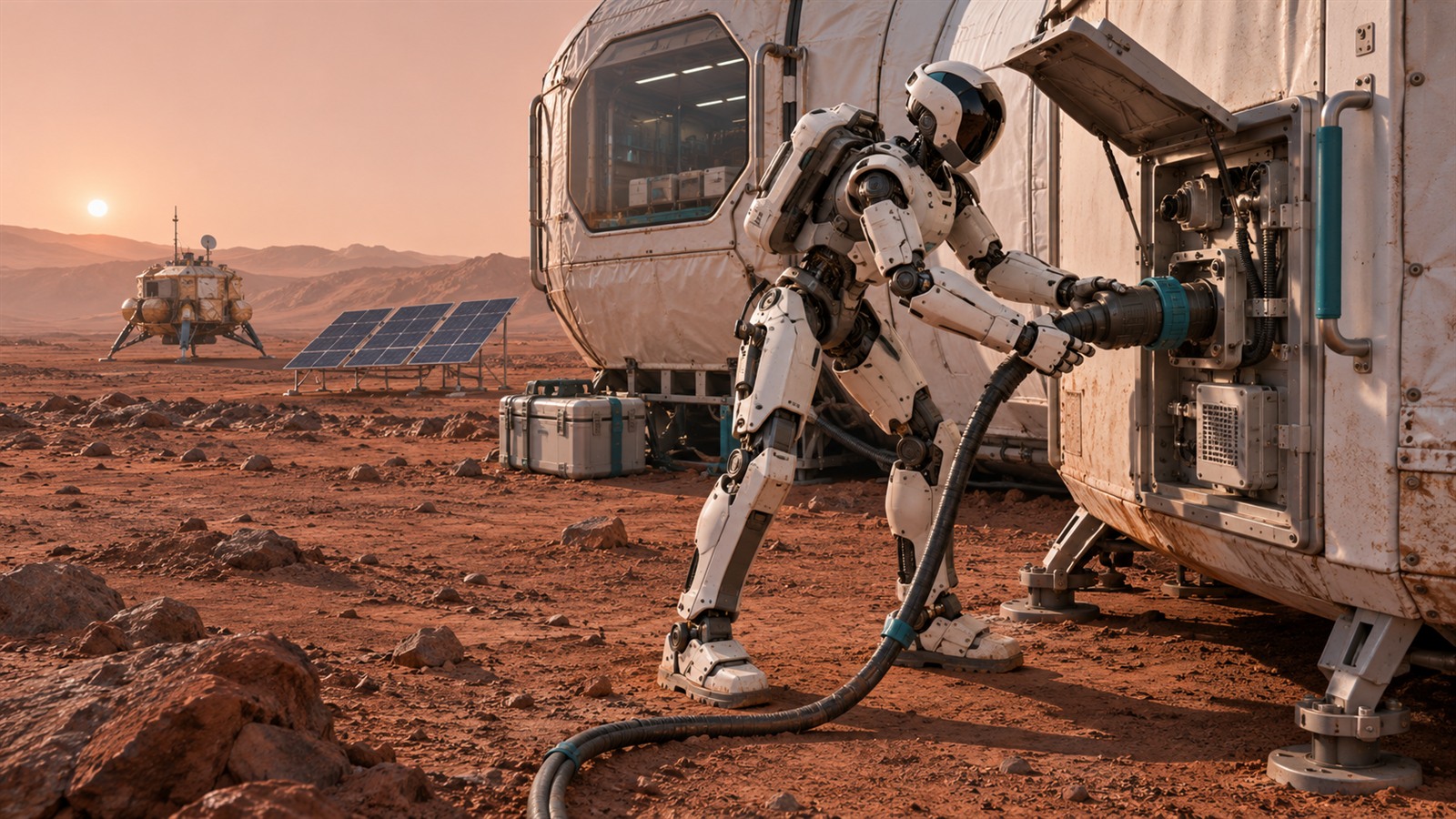
The first hands at a future Mars station could belong to a machine. A robot connects a power cable, checks a connector and tests whether a system works. Nobody has to put on a spacesuit. No breathing air is consumed. And if something goes wrong, no human life is immediately at stake.
That is the engineering appeal of sending humanoid robots to Mars. Machines with human-like arms, hands and perhaps legs could prepare infrastructure before astronauts arrive. They could monitor equipment, use tools and maintain a station between crewed expeditions.
But there is an enormous development gap between a robot that moves boxes on Earth and a reliable worker on Mars. Skill alone is not enough. The key factors are energy supply, resistance to harsh environments, autonomy, repairability and a transport system that brings the machine safely to the surface.
This analysis examines which foundations actually exist, which actors are working on them and where the reliable technology ends. The mission scenarios described are technical derivations from existing developments – not operational plans that have already been decided. All three images are specially created AI concept illustrations by Alpha Bionic and do not show real Mars missions.
In this article
Can humanoid robots fly to Mars today?
A humanoid robot could in principle be transported as the payload of a suitable spacecraft. The more difficult question is: Could it get out on its own after landing and do useful work for months?
The public sources evaluated here do not yet provide any evidence of such a complete chain of operations. Important sub-capabilities are documented: humanoid robotics on the International Space Station, mobile manipulation in terrestrial laboratories, remote control from orbit and long-term operation of specialized machines on Mars.
These differences determine whether an impressive announcement becomes a viable space project.
A humanoid robot can perform convincingly at a trade show without having been qualified for low atmospheric pressure. It can master a demonstrated task without reliably handling unfamiliar faults. And surviving spaceflight does not prove that it can subsequently work in Martian dust.
Transportability, workability and long-term operational capability are three different development goals.
However, it has already been proven that human-like robotics can be used in space: Robonaut 2 reached the ISS in 2011. This was an important step, but within a protected space station and not on an alien planetary surface. Source: NASA – Robonaut 2
Why let humanoid robots fly to Mars at all?
For humans, Mars is a location with an unusually high supply requirement. A crew needs a habitable environment, food, water purification, medical options, and protection from external threats. Added to this are the stresses caused by isolation, radiation and changes in gravity, which NASA is investigating as key risks of long-term space travel. Source: NASA – Risks of a Mars Mission
A robot also needs protection and support, but its requirements are fundamentally different: it needs no breathing air, meals or psychological support. An initial uncrewed mission could also be designed without returning the robot to Earth.
The potential advantage therefore arises at the level of the entire mission. A machine does not have to be better than a human at every single activity. It may be sufficient for it to carry out certain necessary tasks without the additional infrastructure of a manned expedition.
This capability would be particularly useful before a crew arrives. Landed equipment is not necessarily operational equipment. Connections need checking, components need unlocking, measurements need verification and faults may need correcting.
Using the same principle, a robot could continue to work after people leave. An expensive research station would then not have to be left completely unattended between two expeditions.
NASA describes exactly this prospect: Commercial humanoid systems could one day maintain facilities on the Moon or Mars while no humans are on site. This is an application idea with an institutional background, but not yet proof of its practical implementation. Source: NASA Spinoff – Humanoid Robots Assist Assembly Lines
The crucial difference: Why human-like?
Many arguments for robots on Mars also apply to rovers, gripper arms and automatic measuring stations. The fact that a machine doesn’t have to breathe oxygen doesn’t explain why it should have two arms or two legs.
The distinctive benefit of humanoid systems lies in their potential compatibility with human work environments.
A station designed for astronauts has human-sized controls, service ports, handles and tools. A robot with suitable reach and two dexterous arms could operate the same facilities.
Tasks that require holding and manipulating an object at the same time are particularly interesting. One arm steadies a cover while the other releases a fastener. One hand guides a plug while the other holds the cable. A single machine could thus perform maintenance tasks that would otherwise require several specialized devices.
However, it would be a mistake to simply set up a Mars base like an Earth workshop and then hope that a robot can handle it. A common design for people and machines would make more sense: easily accessible maintenance points, clear markings, standardized connectors and replaceable modules.
The human-like form would therefore be a means of sharing the infrastructure. It would not be an end in itself.
Two arms can be more important than two legs
The term “humanoid” does not necessarily have to describe a completely human-like biped. The German Aerospace Center uses Rollin’ Justin to examine a human-like upper body on a mobile wheel platform. The system is used for research into skillful, mobile manipulation and to support astronauts. Source: DLR – Rollin’ Justin
This combination could be attractive for a Mars station: arms for versatile work, wheels for suitable driving surfaces. Whether legs provide additional benefit would have to be shown by the specific tasks.
A machine on Mars gains nothing by making its silhouette look more human.
What the technology can already do: the most important players
NASA: Robonaut and Valkyrie as technical basis
Robonaut 2 was created through a collaboration between NASA and General Motors. The focus was on skillful manipulation: machines should take on tasks in human working environments and, in the future, work where people would be exposed to particular risks. Its deployment on the ISS provided experience with humanoid robotics in space. Source: NASA – Robonaut 2
Valkyrie represents a different part of the development. The two-legged research robot is used to investigate mobile, skillful manipulation. NASA described a collaboration with Woodside Energy in Australia to further develop capabilities to remotely maintain unmanned and remote energy facilities.
The connection with space travel is understandable: there, too, machines have to reach and operate technical facilities in difficult environments. Nevertheless, Valkyrie remains a research basis. Testing in an industrial environment is not a Mars qualification. Source: NASA – Valkyrie and Woodside
DLR and ESA: Division of labor between humans and machines
European research on supervised autonomy is particularly relevant. In METERON SUPVIS Justin, astronauts aboard the ISS issued work orders to a robot on Earth. Rollin’ Justin used its own onboard intelligence to carry out parts of those tasks.
The principle is essential: the person sets a goal instead of remotely controlling every single joint movement. The machine implements the order based on its perception and available capabilities.
The experiments took place in a simulated planetary working environment. They demonstrated possible collaboration between humans in orbit and robots on a surface. They did not prove full operation over the actual Earth-Mars connection. Source: DLR – METERON SUPVIS Justin
DLR and ESA also used Surface Avatar to investigate the control of a heterogeneous robot team. This direction is particularly plausible for Mars missions: different machines take on different tasks instead of cramming all capabilities into a single robot body. Source: DLR – Surface Avatar
Tesla and SpaceX: robots and means of transportation
Tesla describes Optimus as a development program for a universally applicable, autonomous biped. Challenges specifically mentioned include balance, navigation, perception and interaction with the physical environment. These skills would also be necessary for a Martian worker; However, the product description does not demonstrate suitability for the Martian environment. Source: Tesla – Robotics
Elon Musk announced in March 2025 that he wanted to send Optimus to Mars with Starship, and at the time named the end of 2026 as the target. Such statements document an intention, not a secure mission roadmap. In February 2026, Musk also declared a greater prioritization of the moon. Earlier Mars target dates should therefore not be presented as unchanged promises. Documented March announcement and Report on the changed priority.
The technical division of labor would be clear: SpaceX would have to enable transport and landing, and Tesla would have to provide a suitable work machine. The success of one of these systems would not automatically prove the readiness of the other.
Apptronik and industrial development
Apptronik shows how closely space research and commercial robotics are connected. NASA documents joint development work and the company’s technical roots in the Valkyrie environment. The Apollo robot is initially aimed at useful work in terrestrial industrial environments. Source: NASA Spinoff – Apptronik and NASA
This industrial route could be crucial for later Mars applications. Repeated work under real operating conditions provides experience on wear, maintenance and reliability. A research prototype shows that movement is possible. An industrially proven system shows how often this is successful and how much effort is required.
Transferring it to Mars would then require its own development and qualification.
The biggest technical hurdles
1. A Mars landing is not a package delivery
Before a robot can work, its transport system must safely set it down. NASA points out that landing technology for the large payloads of human Mars missions must go beyond the capabilities of previous robotic landing architectures.
Perseverance brought about a ton of rover mass to the surface. Large infrastructure packages represent a different order of magnitude. A single humanoid demonstrator would not necessarily have to land with a complete base; Its mission still requires a suitable landing unit, power supply and a safe route to the ground. Source: NASA – Challenges of Large Mars Payloads
This results in a slightly underestimated requirement: unloading is also part of the mission. A damaged ramp or an awkwardly positioned piece of cargo could prevent deployment before the first planned action is carried out.
2. Cold, dust and thin atmosphere
The Martian atmosphere is thin and temperatures can fluctuate widely. NASA cites a planet-wide range of approximately minus 153 to plus 20 degrees Celsius. These extreme values describe different conditions and locations; they are not a daily temperature profile for each landing site. Source: NASA – Mars Facts
For a work robot, the conditions at the specific place of use are particularly important. Batteries, lubricants, seals, cameras and joints must be designed for this.
The technical difficulty increases with the number of mobile interfaces. A skilled hand has many places where wear or contamination can impair function. In its overview of robotics needs, NASA lists, among other things, lubrication, extreme environments and the protection of sensitive components as areas of development. Source: NASA – Robotics Technology Needs
When it comes to mission design, this means that every additional capability must justify its protection and maintenance costs.
3. Energy is working time
A humanoid robot needs electricity for movement, perception, computing and communication. In cold environments, temperature control is added. Standstill can therefore also cost energy.
NASA explicitly describes the heating requirements of batteries and electronics for Mars missions. Dust and unfavorable environmental conditions also make solar supply more difficult. Source: NASA – Mars Power and Heating
A viable operating concept would have to answer how the machine reaches its charging station, how it behaves when energy reserves decrease and how it survives longer restrictions on electricity production.
Possible solutions would be protected charging areas, replaceable energy modules or a cable supply at fixed workstations. Which variant makes sense depends on the task. A robot that primarily maintains a system needs a different system than a machine that travels long distances.
The statement “Robots can work around the clock” would therefore be misleading. You don’t need sleep, but you do need charging time, maintenance and a resilient energy budget.
4. Remote control from Earth is not enough
The signal transit time between Earth and Mars is approximately three to 22 minutes in each direction, depending on the planetary constellation. Feedback can therefore only arrive many minutes after a command. Source: NASA – Mars Relay Network
This is too slow for a person at the control panel to catch a fall or immediately correct a jammed plug.
The decisive reactions must take place on site. The robot needs fast control, safe motion planning and the ability to abort an unsafe process. People can still make higher-level decisions.
NASA explicitly derives an increased need for autonomy for Mars missions from delays and communication interruptions. Source: NASA – Mars Communications Disruption and Delay
For humanoid systems, this means: A convincing voice interface would only be the beginning. What is crucial is whether a work order becomes a verifiable, safe action.
5. Less gravity does not automatically make movement easy
The gravity on Mars is approximately 38 percent of Earth’s. An object has less weight there, but retains its mass and therefore its inertia. Source: NASA – Mars at a Glance
This results in a mixed picture for robotics. Lifting can require lower weight forces, while accelerating and braking heavy components remains challenging. At the same time, the forces available for ground contact and traction change.
A gait trained on Earth would therefore have to be adapted and validated for the new environment. In addition, there is unknown ground: sand, stones, slopes and local unevenness.
Anyone who wants to fly humanoid robots to Mars will therefore have to demonstrate more than just walking upright on a hall floor.
Which work would actually be useful?
A plausible initial task profile can be derived from the existing research directions. It would be significantly narrower than the image of a universal construction worker.
An early Mars robot could open standardized maintenance hatches, position instruments, check connectors and handle small, replaceable modules. Work with clearly identifiable initial and target states would be particularly useful.
An example: An instrument reports an error. The robot travels to the system, photographs the connections, checks a defined connection and, after approval, replaces an accessible module. Every step can be monitored and documented.
The task of building a complete station out of any material would initially be less plausible. Such a task combines too many unproven skills: construction site logistics, large forces, complex assembly, fault diagnosis and long-term independence.
The first productive machine would therefore not have to be able to do everything. It would need to perform a few select tasks reliably enough to justify its transportation and operating costs.
Oxygen production: This is where robotic maintenance could become particularly valuable
One of the most important requirements for longer stays on Mars is the use of local resources. The MOXIE experiment actually harvested oxygen from the Martian atmosphere aboard Perseverance.
Across 16 experimental runs, MOXIE produced a total of 122 grams of oxygen. Its highest production rate was twelve grams per hour, with a purity of at least 98 percent. This was an important technology demonstration, not an industrial supply plant. Source: NASA – MOXIE Mission Completion
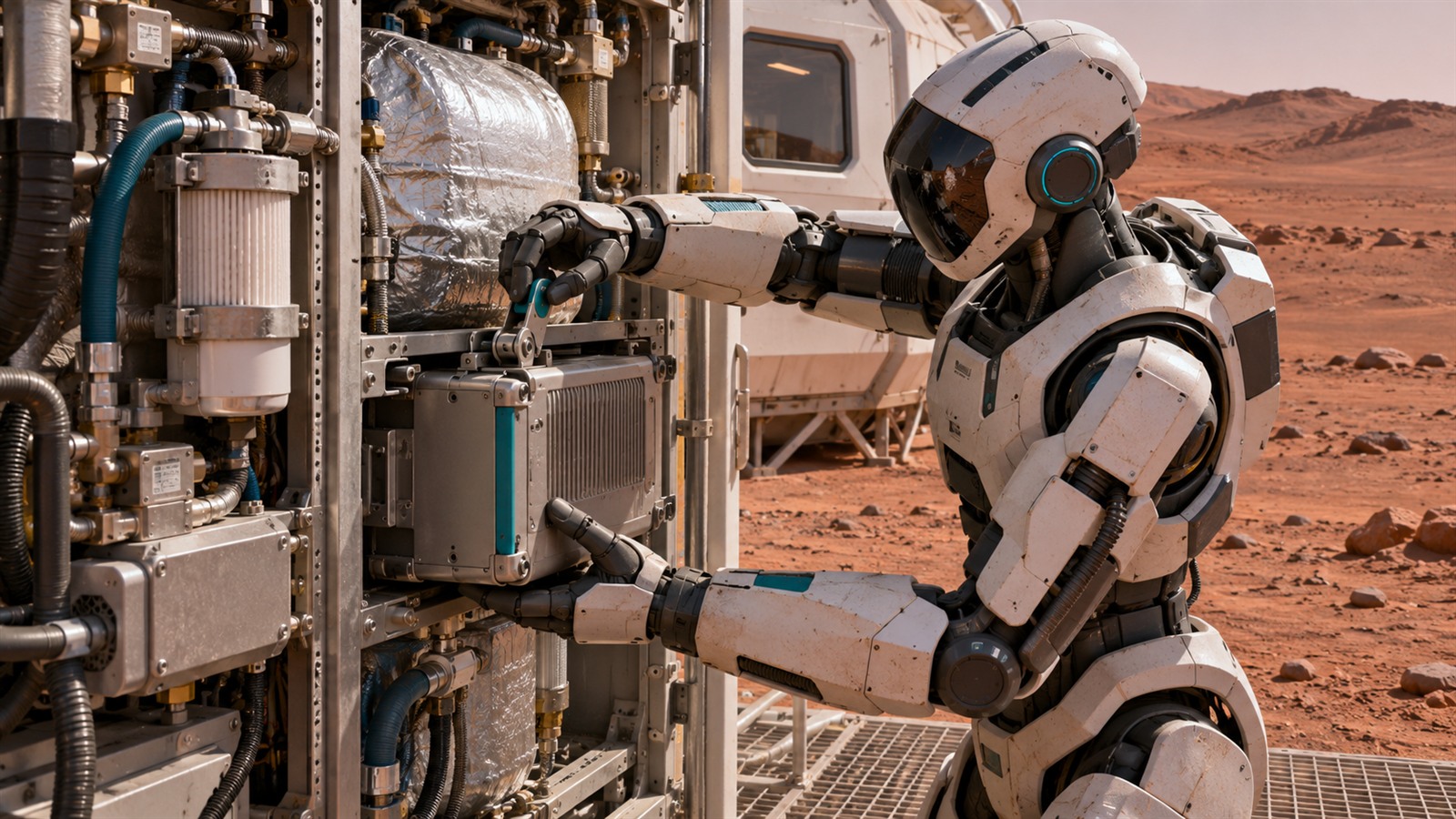
NASA calls the next development step a complete system that generates, liquefies and stores oxygen. The substance would be relevant both for respiratory supplies and as an oxidizer for rocket engines. Source: NASA – MOXIE and future systems
This is where a possible field of application for mobile maintenance robotics arises. A larger system network could have accessible filters, plug connections or replaceable components.
This is a technical perspective, not an already demonstrated skill. Their appeal lies in the fact that a versatile maintenance robot could look after several systems. The prerequisite would be that these are designed for robotic access from the start.
What advantages would humanoid robots have over humans?
The strongest advantage would be the use without immediate risk to life. A dangerous inspection could initially be assigned to a machine. Even a failure would have significant financial and scientific consequences, but no injured astronauts.
A second advantage would be the temporal decoupling. Robots could arrive before the crew and stay after they leave. This would allow infrastructure testing to be carried out before people become dependent on its functionality.
Third, a fleet combining specialized and humanoid systems could work in parallel. While one machine collects measurements, another could reposition an instrument. The actual benefit would depend on how much human support these operations require.
Fourth, robotic precursor missions could be planned without the return of the work machines. This opens up different risk profiles and mission architectures.
A general cost superiority cannot yet be derived from this. Development, space qualification, spare parts, energy supply and support can be expensive. The decisive factor would be the successful completion of the work over the entire duration of the mission.
| criterion | Human crew | Humanoid robot |
|---|---|---|
| supply | Requires habitable environment and biological support | Requires electricity, temperature control and technical maintenance |
| Dangerous outdoor use | Immediate risk to people | Risk to hardware and mission objectives |
| Unknown problems | High flexibility and ability to improvise | Depending on proven skills and autonomy |
| Stay without return | Particularly demanding for manned planning | Possible for suitable unmanned missions |
| Operation between expeditions | Requires people to be present at all times | Basically conceivable as unmanned support |
The comparison also shows the limit: a person remains an exceptionally versatile problem solver. Understanding, experience and improvisation can be crucial, especially in unexpected situations. Robotic advance work could make these human skills more targeted by reducing routine and exposure.
Why rovers and special machines remain indispensable
Good Mars architecture would not assign every task to a humanoid.
A low wheeled vehicle might be more useful for transporting heavy goods. For repeated work on the same system, a permanently mounted arm could be sufficient. For earth moving, a machine designed for this purpose would be obvious.
Humanoid robotics would be especially worth evaluating where shared infrastructure requires a range of different manual operations. Its advantage would have to come from versatility.
The technical conclusion from this is a mixed team: transport vehicles move loads, specialized machines process material, mobile manipulators carry out inspection and maintenance. Bipeds are an option where their ability to move has a demonstrable additional benefit.
The most attractive system might therefore be less human-like than the most popular images of the future.
What would be technically possible next?
A credible development program should be based on proven skills. A sensible path could be divided into four stages.
First, long-term work on Earth would have to be successful. Repeatable tasks, low frequency of intervention and comprehensible error handling would be crucial. A short demonstration does not answer these questions.
Environmental qualification tests would then have to follow. Low pressure, temperature changes, dust and radiation would have to be examined for the respective system. At the same time, communication delays lasting several minutes and longer connection failures would have to be incorporated into the operation.
A first planetary demonstration should have a narrow goal. For example, a robot could perform a standardized maintenance task and reliably return to its supply point. That alone would be significant progress.
Only then would it make sense to expand to several systems. With increasing experience, teams of robots could swap modules, diagnose each other’s faults and maintain infrastructure for longer periods of time.
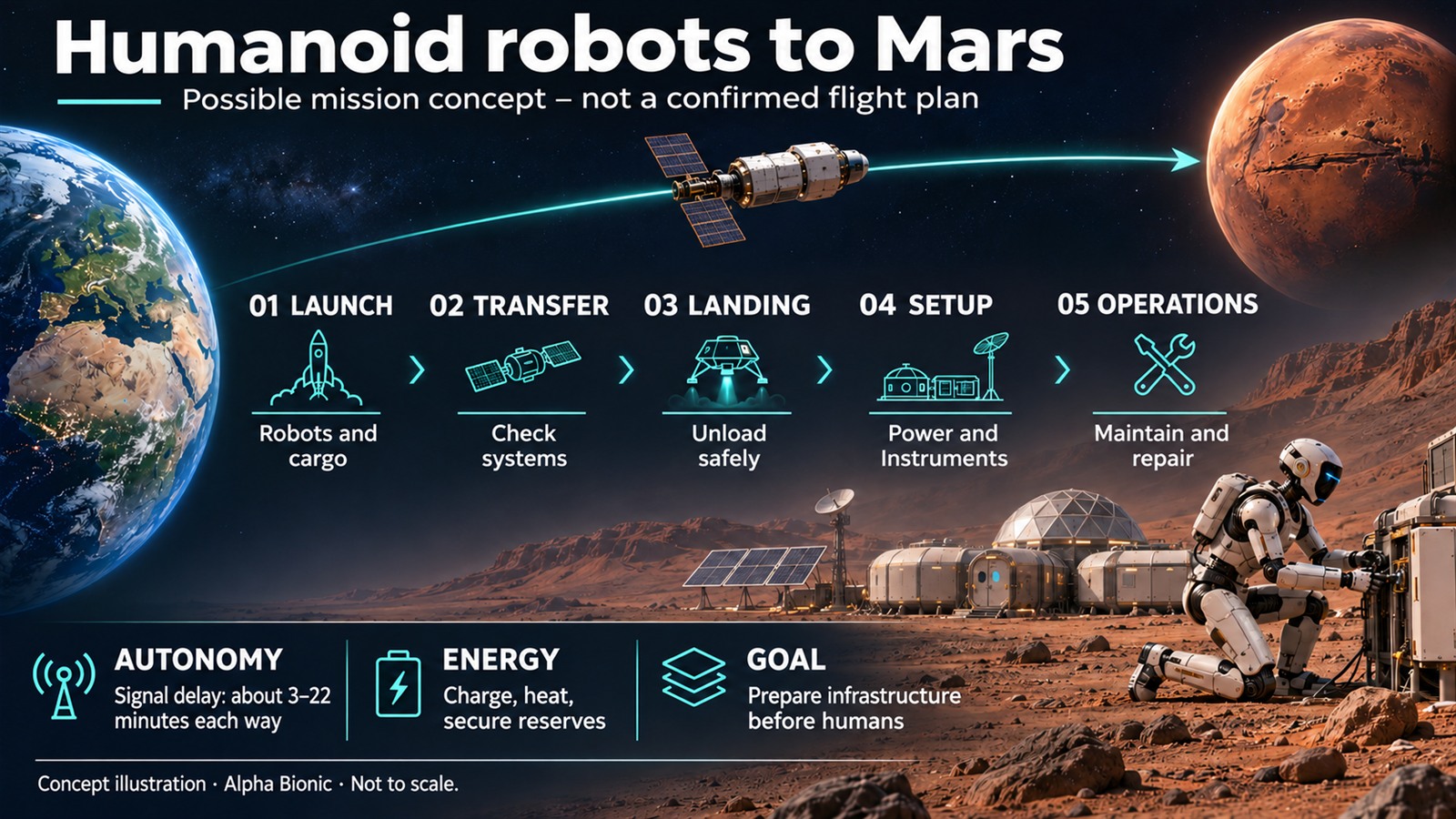
The infographic classifies the conceivable mission sequence from Earth to ongoing operations. It does not represent a booked mission or a binding schedule. Transport, safe landing, energy supply and local autonomy would have to work together before a demonstration machine becomes a reliable Mars worker.
A skill that is hardly noticeable in spectacular videos would be particularly valuable: the robot recognizes that it cannot continue working safely, protects the system and waits for a decision.
For a Mars mission, controlled inaction may be more valuable than a risky attempt.
What a serious Mars robot would have to be measured against
Whether humanoid robots should fly to Mars cannot be decided based on their running speed alone. These questions would be particularly relevant:
- Which specific tasks does the system handle repeatedly and under what conditions?
- How often do people need to intervene?
- Which environmental tests has the hardware passed?
- How high is the energy requirement per successfully completed task?
- Can the machine reach a safe state after an error?
- How are wearing parts replaced and failures bridged?
- What advantage does it offer over a rover or a fixed mechanism?
These criteria would turn a claim about the future into a verifiable development program. At the same time, they prevent progress from being downplayed: Even a limited, reliably carried out maintenance operation on Mars would be technologically remarkable.
The most important first step would be a working connection
Humanoid robots on Mars are a serious engineering prospect. Real research programs have created important foundations. What is still missing is reliable evidence that these capabilities grow together to form a permanently useful overall system under Martian conditions.
The most convincing application is in the preparation and support of infrastructure. Machines could create conditions under which people later work more safely and productively.
Whether two legs are necessary for this remains an open design question. Two skilled arms, robust technology and a reliable energy supply could be more important.
When humanoid robots fly to Mars, their most significant moment may look unremarkable: a connector clicks into place, a system starts, and a test confirms that it works. Back on Earth, a mission team knows that a future astronaut will have one fewer critical task to perform at risk to their life.

Author Nico Nuss has worked with mobile computing and automation software since 2001. His many years of experience and strong interest in emerging technologies shape his work on robotics and artificial intelligence.