
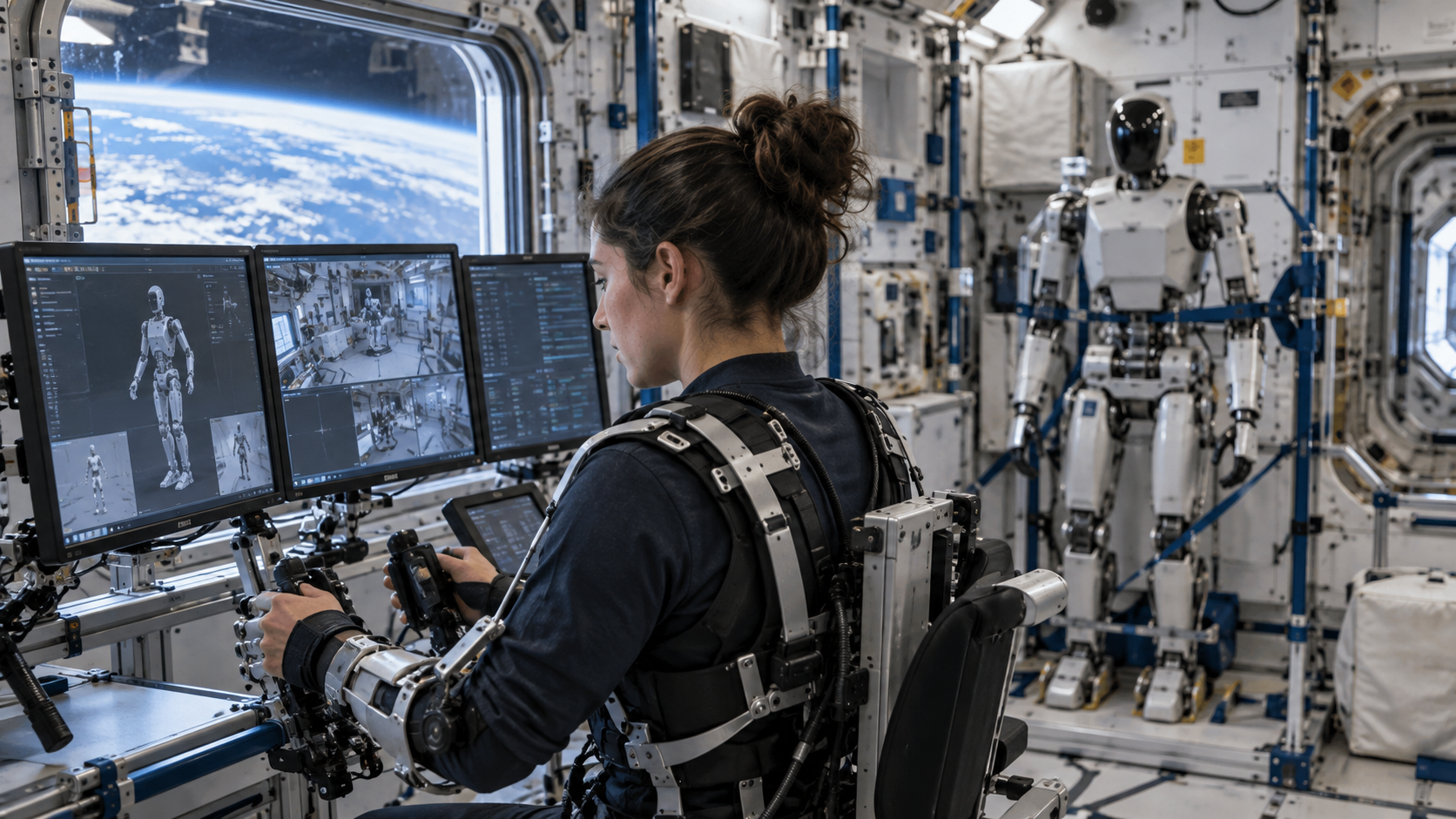
A new piece of humanoid-robotics hardware has reached the International Space Station, but the robot itself is not yet on board. Russia’s Progress MS-35 cargo spacecraft delivered the operator workstation, control equipment and an exoskeleton intended for the Teledroid experiment. The distinction matters: this is the infrastructure for a future teleoperated robot, not evidence that a humanoid has already begun working outside the station.
The shipment is nevertheless significant. It turns Teledroid from a laboratory programme into a staged orbital experiment with real hardware aboard the ISS. The project is designed to test whether a human operator can control a humanoid machine in an environment where every movement, delay and failure mode has consequences. If the later phases proceed as planned, the robot could eventually be evaluated inside the station and then during external work.
In this article
What arrived with Progress MS-35
Progress MS-35 docked with the ISS on 19 September 2026 after launching from the Baikonur Cosmodrome. According to information attributed to Roscosmos, its cargo included an operator station, control electronics and an exoskeleton associated with Teledroid. These components are meant to capture the operator’s movements and translate them into commands for a remote robot.
That hardware is central to the concept. A teleoperated humanoid is useful only if the operator can understand what the machine is sensing and can command its arms, hands and body without losing orientation. The workstation therefore does more than resemble a joystick console. It combines motion input, visual feedback and software that maps a human movement onto a robot whose joints, reach and speed differ from those of its operator.
What did not arrive is equally important. The Teledroid robot remains on Earth. Interfax, citing the Russian space agency, reported that the robot itself is planned for transport on Progress MS-36 in November. Spaceflight schedules can change, so that date should be treated as a plan rather than a completed milestone.
Why the wording in the headlines matters
Space and robotics announcements often compress several stages into one dramatic sentence. “Robot technology arrives at the ISS” can quickly become “humanoid arrives at the ISS,” even when the cargo contains only supporting equipment. In this case, the difference separates a verifiable event from a future ambition.
The current milestone is the arrival of the control layer. Engineers can install the station, test interfaces in orbit and assess how the system fits into ISS operations. They can study ergonomics, communication paths and procedures before the robot occupies precious cargo volume. That is sound engineering, but it is not yet a demonstration of robotic maintenance, inspection or an external spacewalk.
For readers following humanoid robotics, this distinction is more informative than the simplified headline. Commercial humanoid projects on Earth face the same sequence: first the control system and work cell, then supervised trials, and only later a claim of productive use. A named destination or a video does not, by itself, prove operational maturity.
How teleoperation could work in orbit
Teledroid is built around the idea of a human remaining in control while the robot performs physically demanding or hazardous actions. The operator wears or uses an exoskeleton-like interface. Sensors register movements, software converts them into target positions, and the robot follows within limits imposed by its joints and safety system. Cameras and other sensors return information to the operator.
This sounds intuitive, but orbit makes the problem harder. Even a small communication delay can make direct control feel unstable. A robot arm may continue moving after the operator has already reacted. Contact forces are difficult to judge from video alone. Microgravity changes the way loads pass through the body, while the robot must avoid pushing itself or nearby equipment into an uncontrolled motion.
Successful systems therefore mix human guidance with local autonomy. The operator may specify the intended movement, while the robot limits speed, avoids collisions and stabilises its posture. Force feedback can help the person feel resistance, but it must be filtered so that oscillations are not amplified. A reliable system needs graceful stops, clear recovery procedures and the ability to return to a safe configuration.
A three-stage experiment, not a single launch event
Public descriptions of the programme indicate a phased approach. The first phase uses a virtual model, allowing the operator interface and control logic to be evaluated without risking physical hardware. A later phase would place the robot inside the station. Only after those steps could external tasks become realistic.
Each phase answers a different question. A simulation can reveal mapping errors and train operators, but it cannot reproduce all mechanical friction, sensor noise or unexpected contact. An internal test adds real hardware while keeping the robot in a comparatively controlled environment. External operation introduces vacuum, radiation, thermal extremes and stricter constraints on mobility and communication.
This staged structure is the strongest reason not to portray the project as an accomplished robotic spacewalk. The experiment is valuable precisely because it has not skipped the difficult intermediate steps.
Why use a humanoid form at all?
Space stations are designed around human bodies. Handrails, tool interfaces and work areas assume human reach and manipulation. A humanoid robot can theoretically use some of that existing infrastructure without requiring every task to be redesigned for a specialised machine.
That does not mean a human-shaped robot is always the best solution. Conventional robotic arms already perform important work outside spacecraft, and a purpose-built inspection device can be lighter and simpler. Humanoid systems carry many joints, actuators and failure points. They must justify that complexity by handling varied tools and moving between tasks that would otherwise require several machines.
The most plausible near-term role is therefore not an autonomous “robot astronaut.” It is a supervised physical proxy: a machine that extends a trained operator’s reach into a dangerous location. The human provides judgement, while the robot absorbs some of the environmental risk.
What the next milestone must demonstrate
When the robot is delivered, the decisive evidence will not be its presence on the ISS. Observers should look for repeatable task completion, communication latency, operator workload, recovery after errors and the degree of local autonomy. The difference between a compelling demonstration and a useful system lies in how often it succeeds and how safely it fails.
Useful reporting should also separate an engineering test from productive deployment. Installing a control station is an announcement-backed milestone. Operating the robot inside the station would be a pilot. Completing external maintenance or inspection with measured performance would be a much stronger indication of practical value.
The Alpha Bionic view
Teledroid is interesting not because it confirms that humanoids are ready to replace astronauts, but because it exposes the architecture behind credible physical AI. The visible robot is only one layer. Interfaces, communication, safety limits, procedures and trained operators determine whether the machine can be trusted.
The arrival of the exoskeleton and workstation is therefore a real step, just a different one from the step suggested by some headlines. It prepares the control chain. The next claims should be judged against observable tests: robot delivery, installation, controlled movement, task performance and eventually operation in the harsher external environment.
Sources
- Space.com: Progress 96/MS-35 docks with the ISS, 19 September 2026
- Interfax: cargo and Teledroid control equipment, 16 September 2026
- Interfax: planned delivery of the robot on Progress MS-36, 16 September 2026
- Spaceflight Now: Progress cargo ship arrives at the ISS, 19 September 2026