
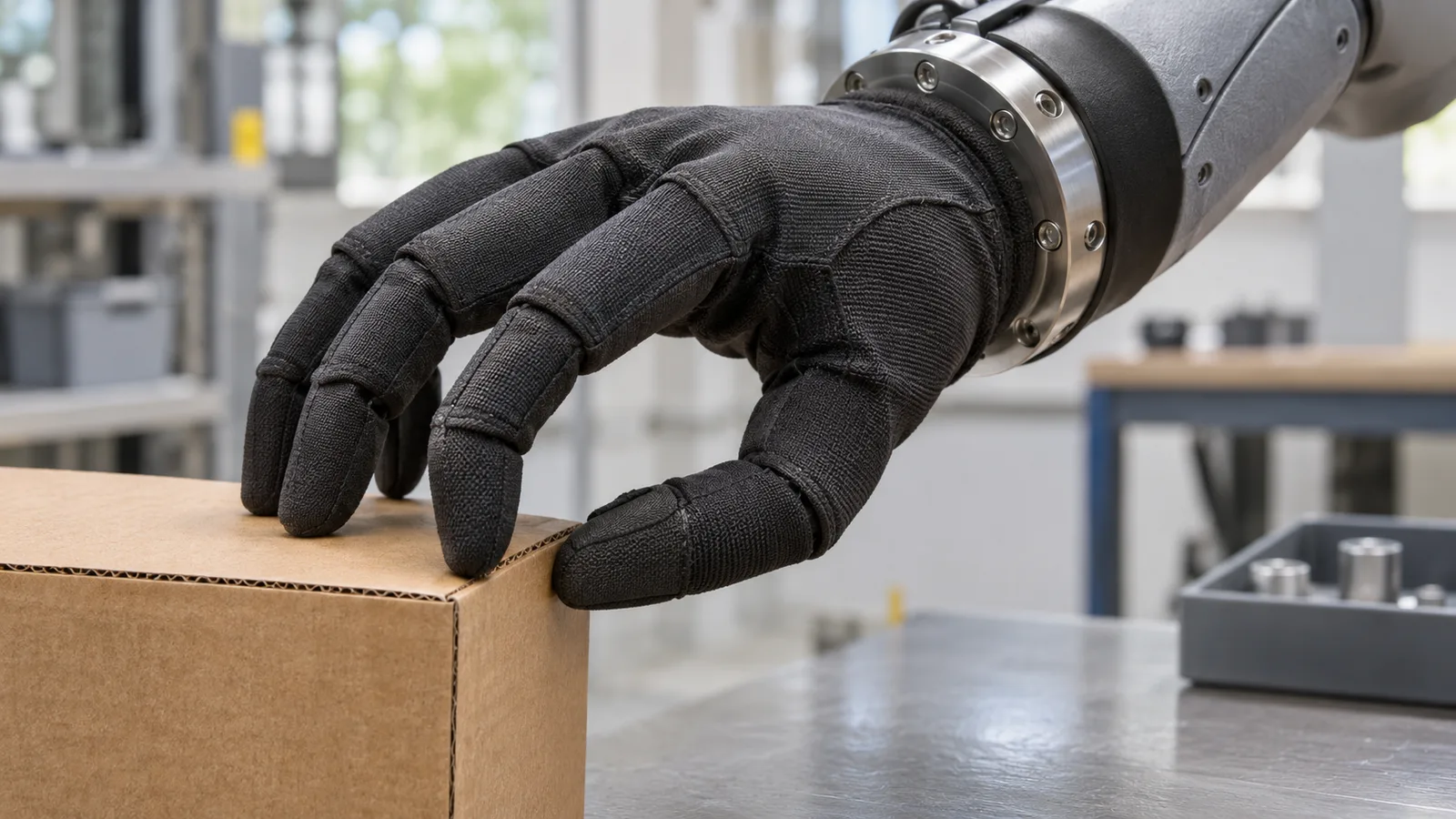
Genesis AI announced a $500 million funding round on November 17, 2026, at a reported post-money valuation of $3.5 billion. Premji Invest, Khosla Ventures and Eclipse co-led the Series A. The company intends to use the capital to expand its Eno robot platform and customer deployments. The industrial significance is straightforward: Genesis has more resources to turn a technical development into a dependable working system.
In this article
Funding is not proof of sustained operation
The two headline figures answer different questions. The $500 million is the announced financing; $3.5 billion is the company’s valuation after the round. Neither number measures revenue, delivered robots or autonomous working hours. Assessing the business significance therefore requires keeping financial backing separate from operational maturity.
Genesis identifies manufacturing, logistics and laboratories as initial markets. Its approach combines GENE robot AI, glove-based data collection, simulation and its own hardware. This is the manufacturer’s development strategy, not an independent performance assessment.
Dexterous hands rather than a human face
According to The Next Web, Eno has two arms on a rotating, wheeled base and no humanoid head. The report describes pilots, not extensively documented industrial operation. Publicly verifiable evidence covering long work sequences and the supervision they require remains an important gap in assessing the system.
The design draws attention to the task itself. At a packing station, looking human is not the central requirement. A robot needs to reach objects, grasp them safely, place them correctly and recover when something goes wrong. A mobile base can make several working positions accessible; it does not automatically improve hand precision or make an unreliable grasp dependable.
Alpha Bionic’s analysis: measure the finished order
Our assessment starts with the complete workflow. A successful grasp is only an intermediate result. Packing might require picking up an item, aligning it, placing it inside a box and closing the package. If the final step fails, several successful movements still do not add up to a completed order.
A simple calculation illustrates the difference. If ten independent steps each succeeded with a probability of 99 percent, the probability of ten consecutive successes would be approximately 90.4 percent. This is explicitly a hypothetical model, not a measured Genesis result. Failures in a real installation may also be correlated rather than independent. The underlying point remains: the success rate of individual movements must not be mistaken for the success rate of entire jobs.
Three measurements would make a pilot particularly informative:
- Jobs completed without assistance: How many tasks does the system finish across an entire shift?
- Interventions and recovery: How often must a person help, and how long does the workstation remain unavailable afterwards?
- Maintenance per productive hour: Which parts need replacement, how much time does that take and what does it cost?
What European operators should establish before a pilot
For German and European businesses, comparing the robot against their existing process would be more useful than judging how closely it resembles a person. For repetitive, predictable tasks, the first question is whether a fixed automation setup is sufficient. With changing objects, a flexible robot would instead need to demonstrate that reduced changeover work outweighs the additional supervision and maintenance it requires.
The size of the round can be placed alongside Agile Robots’ financing, covered in our German edition. Equal funding amounts do not make the technologies or deployment stages equivalent. In practical terms, an announced expansion remains distinct from a specifically described factory pilot, also covered in German.
The next significant Genesis development would therefore be more than a larger production count. More revealing would be a named customer reporting completed tasks, required interventions and maintenance across multiple shifts. That would allow operators to assess whether the new funding is translating into an economically viable workflow.
Sources
- Genesis AI: Series A funding announcement, November 17, 2026. Primary source for company statements.
- The Next Web: Funding, Eno and hardware limitations, November 17, 2026. Secondary coverage referencing interviews and demonstrations reported by other outlets.