
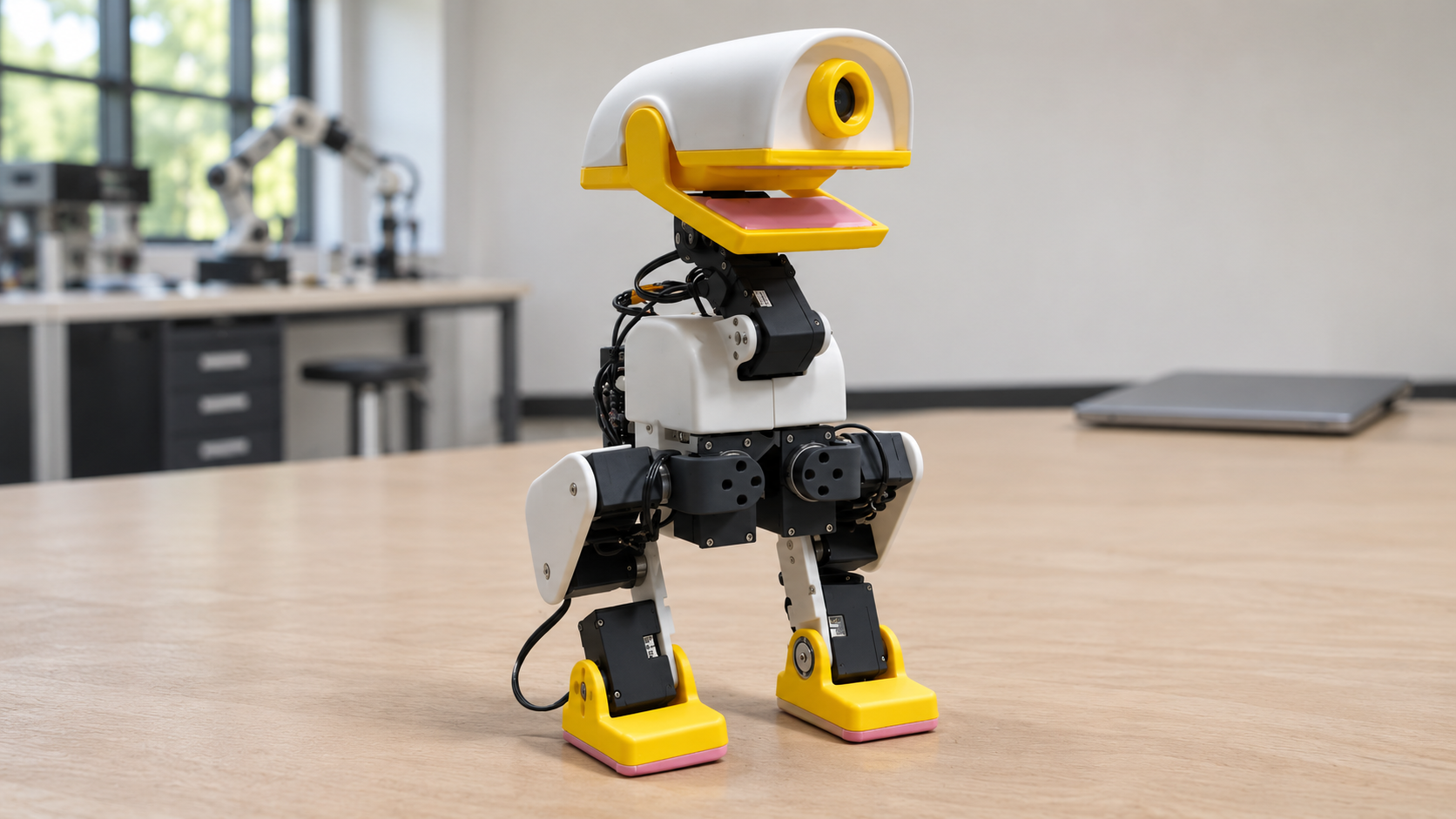
XGO-Duck walks using a trained neural controller and can be built from printed parts. Luwu Dynamics combines Arduino UNO Q, 15 servos and publicly available design files in a duck-shaped biped. The current audio/video electronics kit is listed at $396 in the manufacturer’s shop. The board and printed structures are additional purchases. Its appeal becomes clear when a step that worked on screen behaves differently on a real floor. You have a manageable machine on which to investigate the connection between software, sensing and mechanics. The current kit also gives builders more options for camera and voice projects than the earlier electronics package. Official hardware project · Current manufacturer offer
In this article
How 15 servos move the duck
Each leg has five powered joints. Four more move the neck and head, and one operates the beak. The current guide names Feetech HD1910M servos with magnetic position feedback and a rated torque of 12 kg·cm. That describes an actuator’s torque under specified conditions. Working out the robot’s carrying ability would require more information. The exposed mechanism is helpful for learning because even a different head position changes how the body balances. Alongside walking, the guide describes skating on passive wheels, driven by joint movement. Builders can study what the same mechanism does with a different contact surface. Manufacturer specifications
What Arduino UNO Q does
The Linux side of UNO Q runs the Python application and evaluates the motion models. Its STM32 microcontroller handles lower-level control tasks. The current documentation uses the 2 GB board and describes setup through Arduino App Lab. Day-to-day operation happens in a browser on the local network, making it easy to look between the machine and its controls during a lesson. Before changing software, keep a working version and save this robot’s calibration. Otherwise, a changed gait after an update can be hard to trace to a model, a setting or a mechanical fault. XGO Duck AI installation and runtime
From a simulated policy to a physical step
The training route uses mjlab, MuJoCo Warp and PPO. A simulated robot tries movements and receives scores for how well it performs the task. The resulting policy turns an estimate of state into commands for joints. Training your own model requires a separate supported Linux/CUDA computer with an appropriate NVIDIA GPU. UNO Q then runs the exported controller. I would begin with a supplied movement, repeat it on two surfaces and record the differences. Once that works, a new policy is easier to evaluate. Deployment depends on matching details including joint order and action scale, so keeping the experiment’s configuration is part of the work. Training and export guide · Our introduction to simulating a small robot duck
Printing, assembly and calibration
Luwu’s hardware repository includes mechanical models, PCB material, a bill of materials and assembly instructions. The current audio/video guide uses V5 printed structures and a V1.1 expansion board. The build includes numbering and configuring each servo before wiring and calibration. Owning a printer gives you a way to make replacement parts and explore different shells, while materials, tools and build time remain part of the budget. For a first build, I would follow a documented combination of structures, electronics and software and record any changes. Check the licence and attribution accompanying the particular files you use. Design files and assembly resources · Current structural version
Camera, voice and distance sensing
The audio/video kit adds a camera, microphone input, dual speakers, fill light and a VL53L5CX ToF sensor with an 8 × 8 measurement grid. The browser can show the camera view, providing a starting point for connecting perception to motion. The runtime documentation says cloud voice requires account binding and internet access. For a lesson, identify which parts of the exercise need only the local network and which use an external service. A distance reading in front of the duck also answers a narrower question than room navigation. Give a first sensing experiment a specific goal so you can repeat it and see what triggers the movement. Audio/video electronics kit · Voice and runtime requirements
What the XGO-Duck kit costs
The shop lists the audio/video electronics kit at $396 against $450 and says it ships within twelve days of payment. UNO Q and the printed structural parts are excluded. Add the board, printing materials or a print service, tools, applicable shipping and taxes to reach a complete build budget. The older $352 figure refers to a different electronics offer. Compare completed setups that can run your first experiment rather than kit prices alone. The current documentation gives no single measured runtime for the complete configuration. Movement, audio/video load and battery condition affect how long a session lasts. Price, contents and dispatch estimate · Runtime notes
Who should build an XGO-Duck?
XGO-Duck suits builders who want to assemble a machine, calibrate it and change how it moves. The connection from printable joint to trained motion model gives the project room to grow. Microduck, Open Duck Mini and WonderDuck have their own approaches to packaging and public documentation, covered in our comparison. With XGO-Duck, my first target would be a short repeatable walk with a clean start and stop. Then I would add sensing or explore a new motion. That gives each change a result you can observe, while keeping the work manageable enough to finish. Microduck alternatives compared · Our WonderDuck overview

Author Nico Nuss has worked with mobile computing and automation software since 2001. His many years of experience and strong interest in emerging technologies shape his work on robotics and artificial intelligence.