
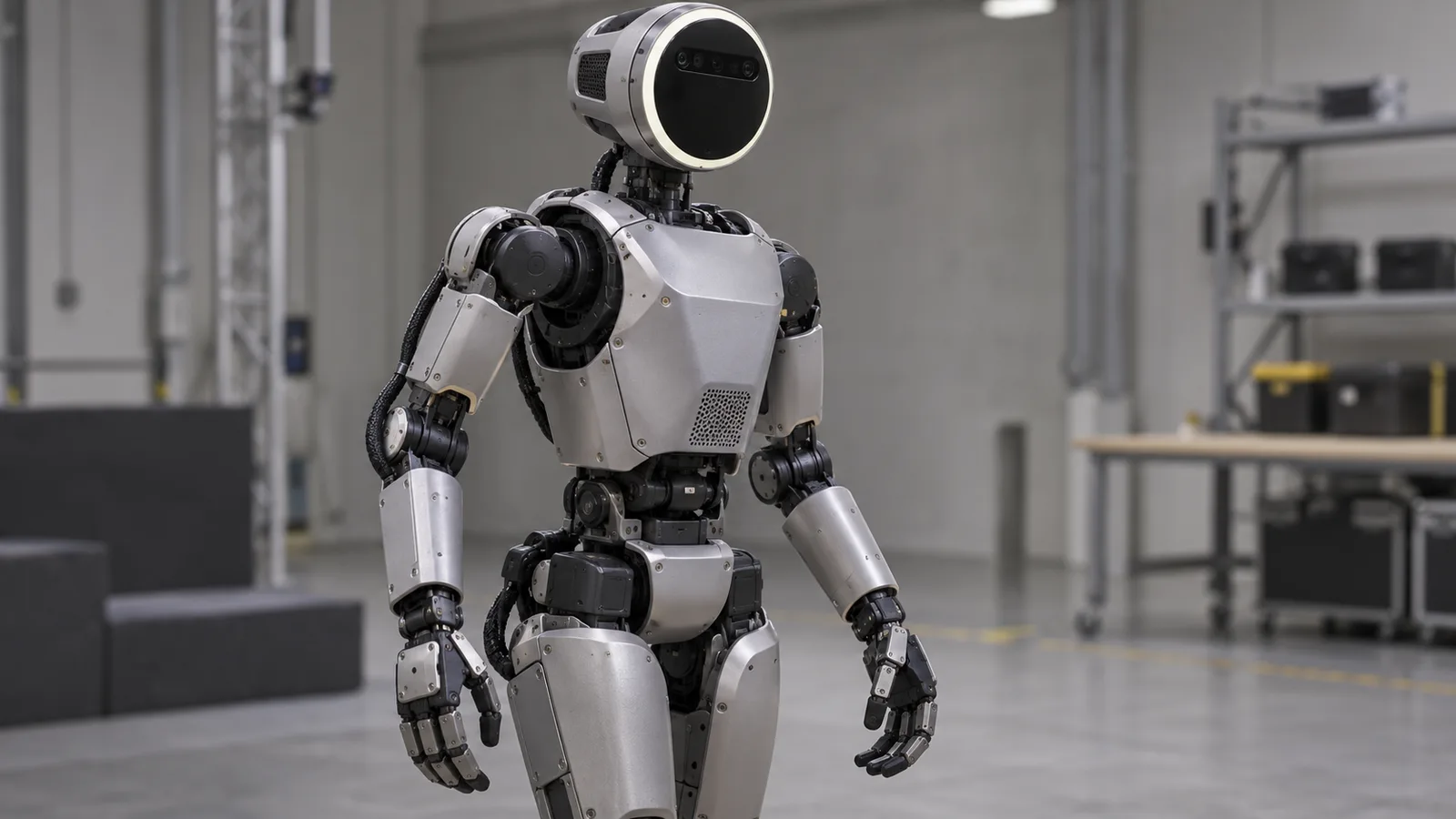
GlobalFoundries plans to begin on-site trials of the Atlas humanoid robot in early 2027. The chip manufacturer and Boston Dynamics announced the expanded collaboration on November 17. Atlas now has a named trial partner outside the automotive industry. This is not yet evidence of productive humanoid operation in a chip factory.
In this article
What is actually planned for Atlas
The initial work covers possible use cases, operational readiness and integration requirements. A skills-development workshop, early testing and task-specific training are intended to support the programme. GlobalFoundries is described as the first Atlas early adopter outside the automotive sector.
The announcement does not identify a specific Atlas task, unit numbers or measured performance. The precise trial sites also remain unspecified. In particular, it does not confirm an Atlas deployment in Dresden: Dresden appears in the expansion of the Spot programme.
The 90,000 inspections belong to Spot
The partners are also expanding use of Spot, their four-legged inspection robot, across Malta in New York, Burlington in Vermont, Dresden and Singapore. GlobalFoundries says it has worked with Spot in Burlington for more than four years.
For two Spot robots in Singapore, the companies report almost 900 kilometres travelled, more than 90,000 inspections and a 99% mission success rate since April. These are figures from the participants, not independently published test results. They describe Spot and cannot be used as evidence of Atlas performance.
The metric also needs careful interpretation. Completing a mission successfully does not mean that 99% of all possible equipment faults were detected. Without a definition of missions, fault classes and human interventions, detection accuracy cannot be calculated. The described inspections concern technical utility areas known as sub-fab spaces; they do not establish qualification for every cleanroom task.
From inspecting to physically manipulating
Alpha Bionic’s analysis focuses on the difference between the two robot roles. An inspection robot can collect readings and images along a route. A humanoid is intended to interact with objects and workstations. Grasping, positioning, contact forces, recovery and safe collaboration must therefore work across a complete process.
A proven inspection route provides useful operational experience, but it cannot replace validation of a manipulation task. For European operators, that distinction matters: existing robotics infrastructure may ease adoption, without removing the need to qualify the new system.
Three tests that would make the pilot meaningful
First, a defined task and a baseline. What should Atlas do, and how do people, fixed automation or a mobile manipulator perform that job today? Without a baseline, even an impressive demonstration is difficult to assess economically.
Second, the complete cycle rather than a single success. Useful measures would include cycle time, completed cycles, quality deviations and required interventions. Recovery matters too: can the robot continue after a failed grasp, or does someone need to help?
Third, the total operating effort. Hardware is only one element. Setup, training, maintenance, supervision and recovery after faults also count. A high success rate does not establish profitability if infrequent failures cause lengthy downtime.
The announcement is a concrete step towards customer testing, not proof of humanoids already manufacturing chips. The next decisive development would be a named Atlas task with transparent results from the planned trials.
Further reading in German: Atlas overview and Spot inspection platform.
Sources
- GlobalFoundries: Boston Dynamics and GlobalFoundries Expand Robotics Collaboration (17.11.2026).
- Boston Dynamics: GlobalFoundries collaboration (17.11.2026).
- Yonhap: Report on the expanded collaboration (18.11.2026).