
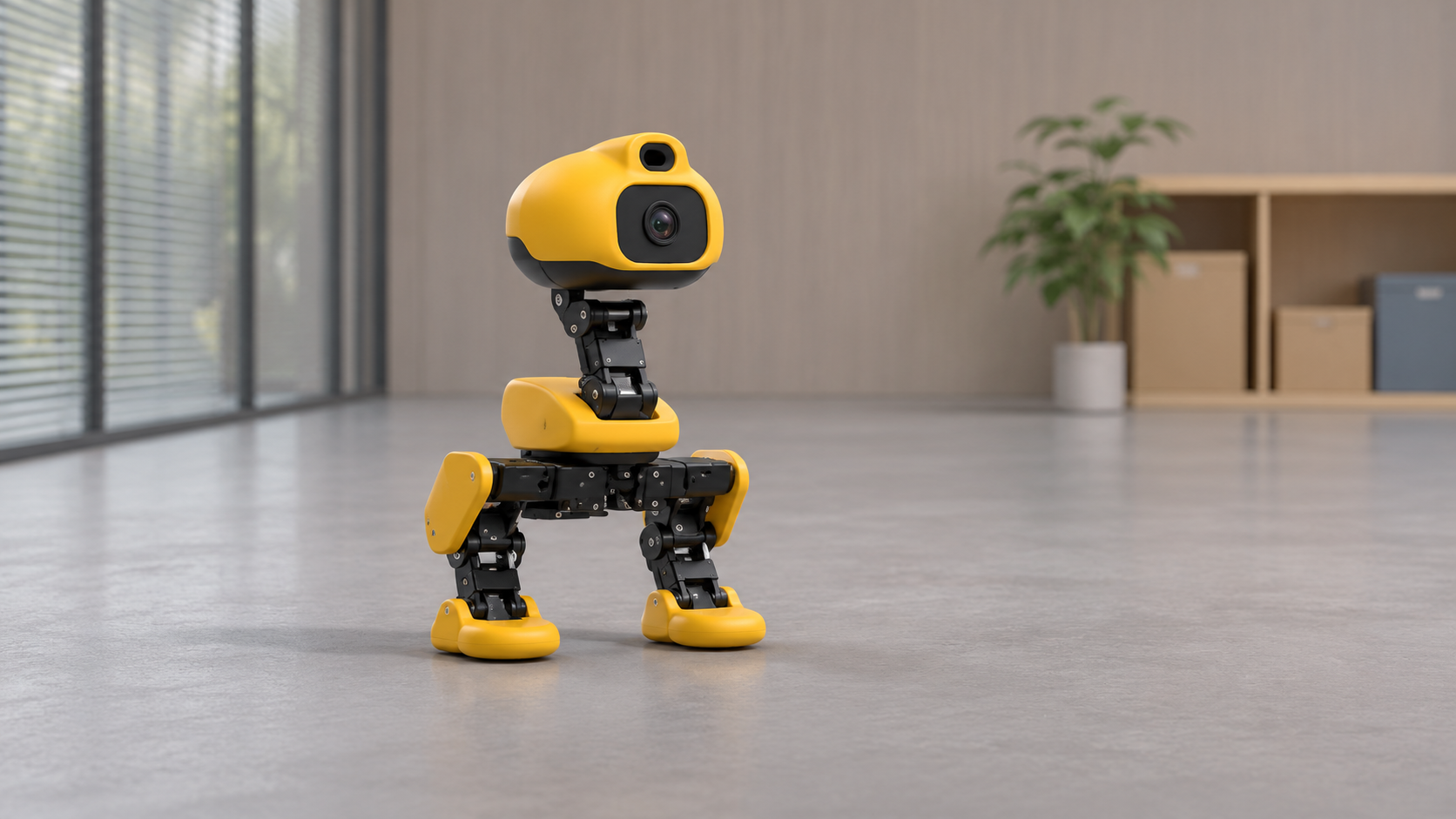
WonderDuck is a small two-legged robot from Shenzhen-based Hiwonder. The company says it trains the walking controller in simulation and runs it on the physical duck. It also describes the hardware design, runtime code and training projects as open. The files will determine whether other people can build a WonderDuck and reproduce its walk.
The first experiment I would try is simple. Give the duck a direction, ask it to stop and repeat the same walk on a different floor. A seam between two tiles can reveal how much a controller assumes about the ground. A small biped gives students and hobbyists a way to see those assumptions play out in front of them.
In this article
WonderDuck specs and features
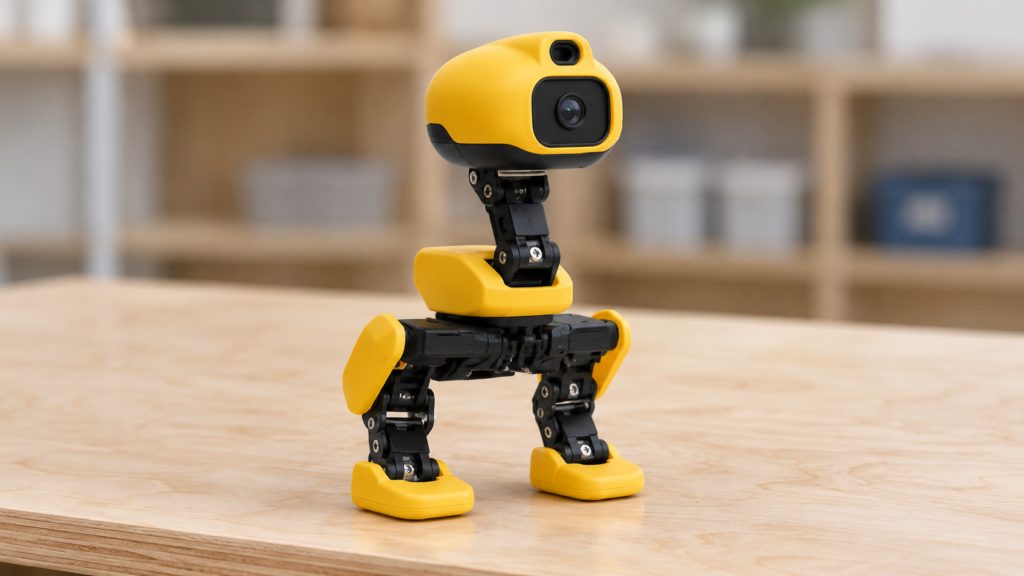
Hiwonder shows a yellow and black biped with a compact head, narrow neck and short articulated legs. It mentions four colour options and describes a workflow from simulation training to running a trained controller on the physical machine. Its public presentation shows a prototype walking. Performance comparisons would need details about the surface, the duration and any operator intervention. Hiwonder’s announcement
| Feature | What the public material establishes |
|---|---|
| Maker | Hiwonder, based in Shenzhen, China |
| Design | Compact robot with two articulated legs |
| Colours | Four options announced. A complete list of names is unverified. |
| Walking controller | Hiwonder describes simulation training and deployment to physical hardware. |
| App | Hiwonder lists WonderDuck with Android and iOS entries. Features and regional availability are unverified. |
| Hardware and code | Hiwonder describes the hardware, runtime and training projects as open. A complete public set of files and licences could not be verified. |
| Dimensions and weight | No verified manufacturer figures |
| Motors, degrees of freedom and processor | No verified models or counts |
| Sensors and connectivity | No verified camera, ranging or wireless specifications |
| Battery, runtime and speed | No verified figures |
| Price, contents and release | No confirmed public offer found |
The app listing gives WonderDuck its own entry in Hiwonder’s software catalogue. It does not spell out which movements it can trigger or what interfaces a developer can access. The head has a dark front panel in the manufacturer’s material. That visual detail leaves practical questions such as camera resolution and access to raw data open. Hiwonder app catalogue
How WonderDuck learns to walk
In a sim-to-real workflow, a physics model represents the robot’s mass, joints and contact with the ground. During training, the system can try many movements and score outcomes such as staying upright and following a requested direction. The result is a policy, a controller that turns an estimate of the robot’s state into commands for the next movement. Hiwonder describes that workflow for WonderDuck. Its announcement leaves the training settings and computer requirements unspecified. Hiwonder’s description of the training workflow
The real floor is where an experiment gets interesting. The same feet can grip carpet and slide on a polished surface. A small difference in joint calibration can change the weight shift just before a step. To repeat a result, a new builder needs to know which hardware revision, policy and runtime went into it. The distinction between running a trained policy and training a new one is easy to explore on a comparable platform. Alpha Bionic’s guide to the Microduck simulator
I would measure three things separately across several runs: deviation from a marked line, the number of falls and the time it takes to restart. A duck that stays on course can still need help every time it falls. Which result matters most depends on the experiment.
What open hardware would let a builder do
A set of mechanical files helps a builder print or modify a shell. A bill of materials helps them order compatible motors and electronics. Wiring instructions and calibration steps help them make the assembled duck move. The licence determines how they can share their changes. For training, the equivalent pieces are the simulation model, the training configuration, a sample policy and the runtime it targets. I could not verify a complete public WonderDuck release containing those parts and their licences in Hiwonder’s public project listings. Hiwonder’s public GitHub profile
For a classroom, I would start with one supplied movement. Have students repeat it on two surfaces and record where the robot loses balance. Let them change one setting and rerun the same test. That exercise would give them a specific effect to look for while keeping the rest of the setup the same. The start-up and calibration guide will tell educators how much preparation an exercise like that requires.
WonderDuck vs Microduck and Open Duck Mini
Pollen Robotics lists Microduck for preorder at US$399 before tax and shipping. Its press kit gives a height of 25 cm and 15 motors. Pollen publishes the SDK, simulation and training stack. It excludes the mechanical and electronic designs from that release. Those figures describe Microduck only. Pollen Robotics’ Microduck press kit
Open Duck Mini v2 takes the do-it-yourself route, with printable parts, build documentation and a parts list in its project repository. Luwu Dynamics also publishes mechanical models, PCB material and an assembly guide for XGO-Duck. These are useful reference points when evaluating how much of a WonderDuck build someone outside Hiwonder could reproduce. Open Duck Mini v2 repository · XGO-Duck hardware repository · Alpha Bionic’s comparison of Microduck alternatives
WonderDuck price and release date
The manufacturer pages I checked gave no confirmed WonderDuck price or delivery date. A buyer needs the box contents, regional shipping terms and a way to obtain spare parts. For builders, the next useful release would be a set of versioned files with a bill of materials and licences. Hiwonder product catalogue
Frequently asked questions
Who makes WonderDuck?
Shenzhen-based Hiwonder develops the small bipedal robot.
How much does WonderDuck cost?
A confirmed public sale price could not be verified in Hiwonder’s product information.
Is there a WonderDuck app?
Hiwonder has a dedicated WonderDuck entry with Android and iOS labels. Its feature list and regional availability remain open.
Can I build my own WonderDuck?
Hiwonder describes the hardware as open. A reproducible build still needs verified design files, a parts list and a licence.
Are WonderDuck and Microduck the same robot?
They are separate projects. Hiwonder makes WonderDuck. Pollen Robotics, part of Hugging Face, makes Microduck.

Author Nico Nuss has worked with mobile computing and automation software since 2001. His many years of experience and strong interest in emerging technologies shape his work on robotics and artificial intelligence.