
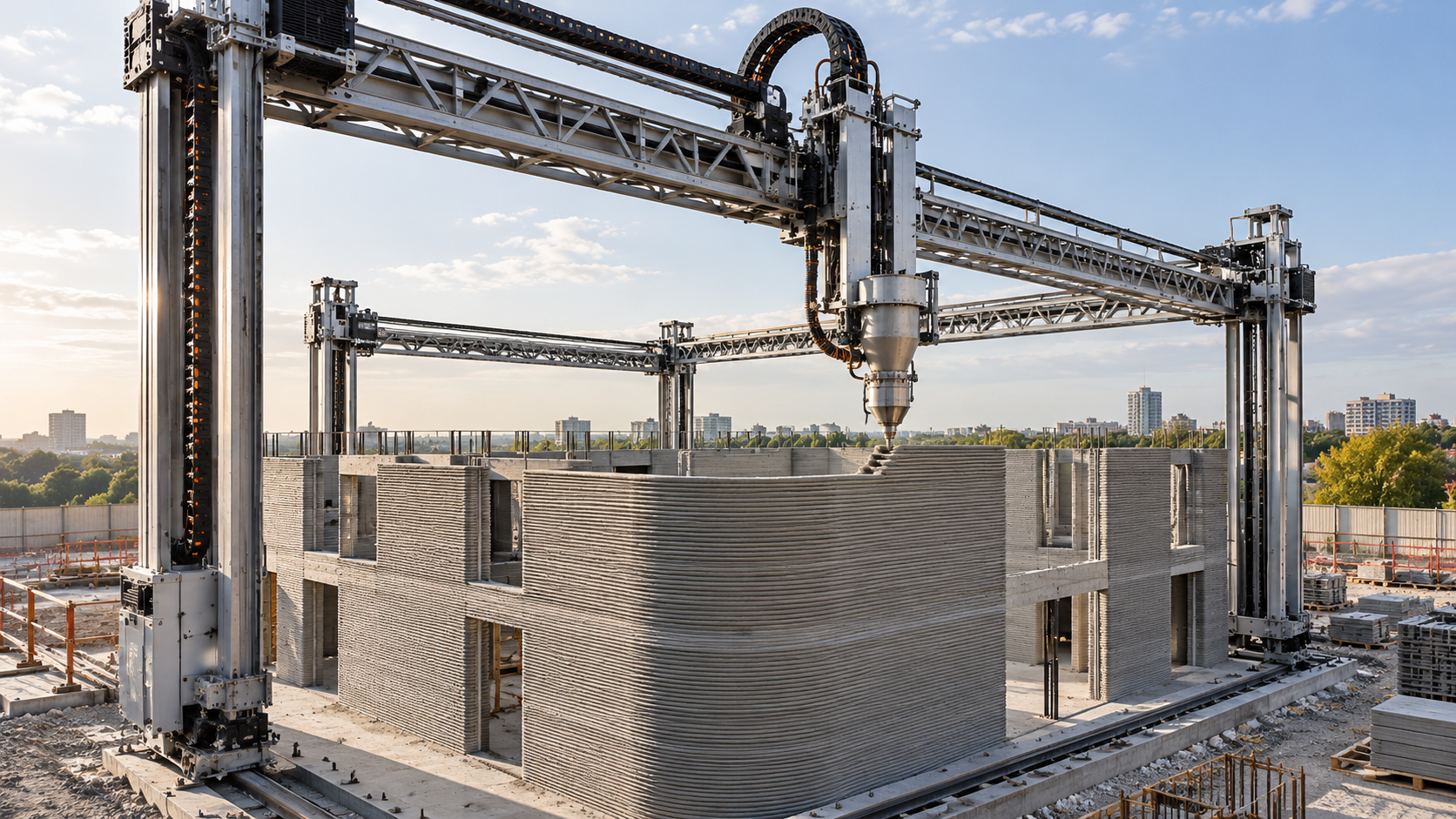
ICON announced a $200 million Series D financing round on October 13, 2026. The Austin-based company says the capital will help manufacture and deploy Titan, its multi-story robotic construction system, while expanding development and operations. The financing is a concrete step toward a larger fleet. It is not, by itself, proof that a given number of machines have been built, delivered or shown to lower the total cost of completed buildings.
In this article
What is new, and what was already announced?
ICON says the round was co-led by Baillie Gifford and funds managed by BlackRock. The company plans to use the money for Titan manufacturing and deployment, a larger research and development site in Austin, further work on its technology and expansion into more markets. Titan’s commercial rollout was announced in March. The October development is therefore about financing a broader manufacturing and deployment effort, not the first introduction of the machine.
Titan is a specialized construction robot. A large positioning structure moves a nozzle along programmed paths, depositing building material layer by layer to form wall sections. It is not a general-purpose robot that completes every trade on a building site. Foundations, structural elements, floors, roofs, services, windows, interiors and inspection still have to be addressed. A fast wall-printing demonstration therefore should never be presented as the time required to finish a house.
Funding is different from a verified building-cost result
ICON has made claims about speed and cost advantages. Those company figures deserve examination, but they are not independent averages across all types of project. A useful comparison must state what is included: materials, transporting and setting up the printer, crew time, finishing work, downtime, maintenance and regulatory compliance. Savings in one wall-building step might be offset elsewhere in the project. Equally, a sufficiently standardized pipeline of buildings could spread setup costs across many jobs. The outcome depends on the entire process.
The $200 million can give ICON resources to build more systems and pursue more sites. It does not establish how many Titan machines are already in service or how they perform under different building codes. Manufacturing capacity, actual production, delivery to a customer and productive site use are separate milestones. Each should be reported separately. Otherwise a funding announcement risks sounding like evidence of deployment that it cannot provide.
Where a construction robot could earn its place
Repeatable wall geometries and predictable material supply are plausible strengths. The more similar the projects, the more often planning and setup work can be reused. Small one-off builds, unusual layouts, variable weather or inconsistent material can weaken that advantage. Local permitting and inspection requirements also affect whether a printed structure is practical. None of these conditions disappears simply because the machine becomes available.
For European builders, transferability is a major open question. US construction costs, labor markets and approval procedures differ from those in Germany and other European countries. A headline comparison between a “printed house” and a conventional house is meaningful only if both include the same degree of completion and comparable designs. Alpha Bionic would ask for cost per approved, finished wall and per completed building, not only the price of the printer or the time its nozzle is active.
Which figures would show genuine scale?
The strongest evidence would be a series of completed projects with a clearly defined scope: printed wall area, machine hours, number of operators, defects, rework and total cost against an appropriate alternative. For a manufacturing ramp, it also matters how rapidly new machines are delivered and commissioned, and how many sites each serves annually. A large machine can be expensive to own if it spends long periods in transit or awaiting permits.
Independent customer projects would add another test. Technology can perform well when its developer controls the building design, site preparation and support team. A contractor using the system without that close involvement may face different training and service requirements. Reporting should distinguish ICON-led jobs from external customers and explain exactly which components were printed rather than conventionally built. That would make claims about a scalable product much easier to assess.
This financing round is a clear signal of ambition to move construction robotics beyond isolated projects. The next decisive evidence will be delivered machines, completed buildings and comparable project-level economics. Until then, the effect on the cost and pace of construction remains an expectation to test, not a demonstrated market-wide result.
Sources
- ICON’s Series D announcement, October 13, 2026.
- Austin Business Journal on the round and expansion plans, October 13, 2026.
- Axios on the construction-technology funding round, October 13, 2026.
- ICON’s earlier Titan commercial rollout, March 11, 2026.