
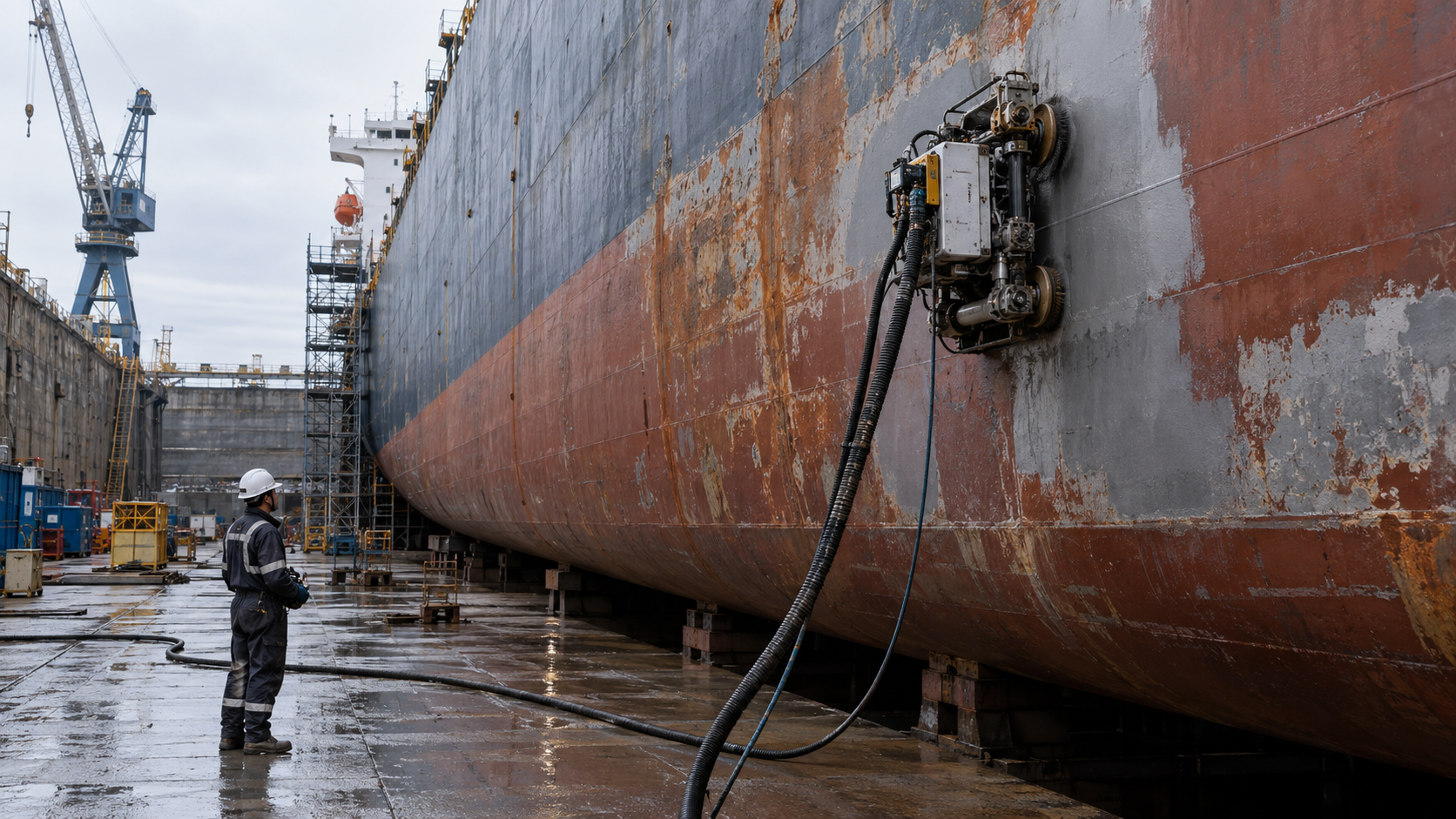
RobotPlusPlus has closed a Series C round worth what it describes as hundreds of millions of renminbi, or tens of millions of US dollars. The Beijing company is not promising a general-purpose humanoid. It builds specialist machines for ship hulls, tanks, wind assets and building façades—places where the work is repetitive, dirty and often performed at height.
Qianggang Capital Fund led the round, joined by three new investors and existing backer Fosun RZ Capital. RobotPlusPlus says the capital will fund international sales and service, scaled manufacturing, industry standards, recruitment and an “embodied AI” platform for difficult industrial environments.
That combination makes the news more interesting than a conventional funding story. Much of today’s robotics debate asks when a single mobile machine will learn many human jobs. RobotPlusPlus is pursuing the opposite route: constrain the environment, engineer the machine around one hazardous surface task and accumulate operating data there. If its deployment figures withstand scrutiny, the company offers a useful case study in how robots can create value before general-purpose autonomy is ready.
In this article
A funding round built around a concrete job
Removing rust and old coatings from a cargo ship is a vast maintenance operation. Workers may need scaffolding, suspended access or other systems to reach large vertical surfaces. The job creates noise, debris and exposure to high-pressure cleaning or abrasive processes. A crawler that remains attached to the hull can move the work head while the operator supervises from a less exposed position.
RobotPlusPlus reports that its hull-derusting systems have worked on more than 10,000 cargo vessels at over 100 shipyards. It also claims more than two million operating hours, activity in 18 countries and a market share above 70 percent. Those company-provided figures are not yet accompanied by a public methodology or an independent fleet audit.
An older company report offers a partial historical reference point. RobotPlusPlus said it delivered another 24 hull and cargo-cleaning robots to COSCO Shipping and had supplied more than 100 machines to over 20 shipyards, covering more than 500,000 square metres of derusting work. The new release implies significant growth since then, but it does not publish a year-by-year deployment table, customer utilisation data or the definition used for a vessel “worked on.”
Why specialist robots can scale earlier
A specialist robot does not need to understand an entire shipyard. It needs to maintain adhesion, carry or guide a tool, follow a surface, cope with cables and hoses, and recover predictably when conditions change. Its task can be described through measurable variables: surface coverage, preparation quality, operating speed, consumable use, intervention frequency and downtime.
This narrower problem can still be difficult. A ship hull is curved, weathered and interrupted by seams, openings and changes in coating. Service lines add drag. Water, abrasive material or removed paint must be managed. The system also needs a safe response if adhesion, power or communication is lost. A machine that performs well on a clean test plate may behave differently on an ageing hull in a humid dock.
Specialisation helps because engineers can design the chassis, work head and control logic around those conditions instead of preserving a human shape. The robot can keep its centre of mass close to the steel, distribute load across the surface and integrate the process equipment it actually needs. That does not make the system simple; it makes the engineering problem bounded enough to test repeatedly.
Safety is more than removing a person from a scaffold
The clearest potential benefit is reduced exposure. Moving a blasting or cleaning head by robot can keep workers away from part of the hazardous zone. Yet the risk does not disappear. Technicians still prepare the equipment, connect utilities, manage exclusion areas, inspect results and respond to faults. Heavy service hoses, high-pressure equipment and falling material require their own controls.
A credible safety case therefore needs more than a promotional comparison with manual work. Operators need documented limits for surface geometry, weather, coating condition and tool settings. They also need procedures for securing the machine, recovering it after a fault and preventing work below an active unit. Training and maintenance matter because degraded seals, wheels, magnets or cables can change the risk profile long before a complete failure.
The economic case is similarly application-specific. RobotPlusPlus says its systems can improve efficiency five to six times and reduce total costs by 30 to 50 percent versus manual methods. These are attractive figures, but the release does not disclose test conditions or whether scaffolding, preparation, operators, consumables, rework and downtime are included. Shipyards considering the technology should ask for comparable job records rather than a single headline percentage.
What “embodied AI” could add
The company plans to use the new capital to develop vertical models and move from individual machines toward more complete industrial systems. In this context, embodied AI should not be interpreted as a robot suddenly reasoning like a human. The practical opportunity is narrower: use operating data to improve path planning, surface recognition, tool control, fault detection and the hand-off between autonomous movement and operator intervention.
For example, a system might classify a surface region, adjust its cleaning path or flag an area that requires another pass. It could learn which combinations of curvature, coating and tool parameters tend to produce poor results. A fleet layer could schedule work and compare performance across sites. Each feature would still need validation because an incorrect decision affects a physical process, not only a screen.
The data advantage claimed by RobotPlusPlus is therefore plausible but not self-proving. Two million operating hours are valuable only if events are recorded consistently, linked to process outcomes and usable across hardware generations. Customers will also want to know who owns the telemetry, what leaves the site and how models are updated when equipment operates in critical infrastructure.
The evidence investors and customers should request
The strongest next step would be verified operating data from named customers. Useful measures include productive hours per shift, square metres completed, preparation quality, operator interventions, recovery events, maintenance time and total cost per finished area. Reporting a distribution across sites would be more informative than a best-case demonstration.
Funding should also be separated from commercial performance. A Series C round confirms that investors see growth potential; it does not independently validate the reported market share or savings. The announced amount is a range rather than an exact figure, and the company has not published valuation or revenue in the release. That uncertainty belongs in any assessment of scale.
For European users, service coverage may become the decisive issue. A shipyard cannot wait days for a specialist technician or replacement part while a vessel occupies a dock. Expansion therefore requires local training, spares, remote diagnostics and clear responsibility between the robot supplier and process-equipment partners. RobotPlusPlus explicitly names international sales and service as a funding priority, which suggests the company recognises that constraint.
A useful counterpoint to the humanoid race
RobotPlusPlus is compelling because it connects robotics funding to an unpleasant task with an observable output. A cleaned or prepared hull can be inspected, measured and priced. That is a different proposition from a broadly capable robot whose final workplace is still undefined.
The company still has to substantiate its largest claims with independently verifiable data. But the underlying strategy is credible: start with a dangerous, expensive process; design a robot around its physical constraints; then add intelligence where it improves repeatability and supervision. The decisive question is no longer whether the robot can climb a hull in a demonstration. It is whether the new capital can turn reported deployments into transparent, repeatable performance across many sites.
Sources
- RobotPlusPlus: Series C announcement and company-reported operating figures, September 16, 2026
- Zip Robotic: funding and deployment summary, September 17, 2026
- RobotPlusPlus: earlier COSCO delivery and historical deployment figures