
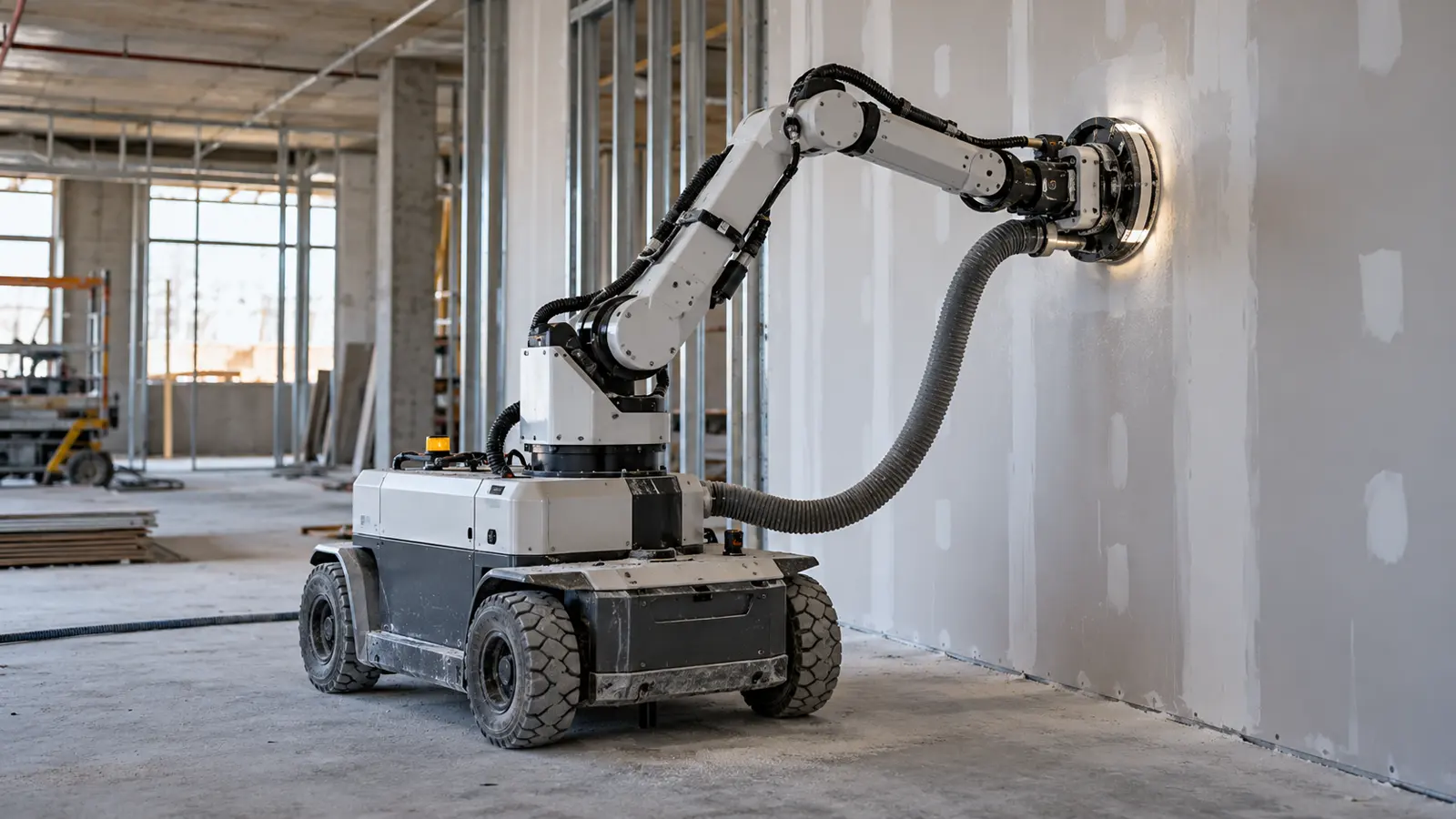
Origin says its OG-1 construction robot is already working on unfinished walls at New York job sites. Announcing the machine on October 15, 2026, the US company described a mobile platform that applies joint compound, sands and primes drywall. It also disclosed $20 million in total funding. Pilots in Germany, Sweden and France are planned, but a planned European trial is not an established commercial deployment.
The important change is the setting. A robot seen on a live construction site faces dust, changing access routes, imperfect geometry and other trades working nearby. That is a more demanding claim than a controlled exhibition demo. Yet Origin’s public statements do not by themselves establish that OG-1 can deliver consistent quality and attractive economics across many projects. Its claim of working three times faster than humans remains a company claim.
In this article
A practical task, not a general construction worker
OG-1 has a mobile base and a tool-carrying arm. The currently described application covers wall finishing: applying compound, sanding and priming. Combining several steps on one platform could reduce handovers and make a contractor’s schedule easier to manage. But the platform’s stated ability to expand into other interior trades is a roadmap, not evidence that it can currently install drywall, drill conduit routes or do every job its makers envision.
Job-site autonomy is also narrower than the phrase can suggest. Human staff still need to map or prepare the work area, supply materials, handle some tool and maintenance needs, and check the result. A machine may be autonomous during an individual finishing pass without running the entire workflow alone. For a contractor, the useful measure is output per full shift after setup, relocations, refilling, cleanup and rework—not only the speed of the sanding head while it is moving.
What the three-times-faster claim would need to show
In a Forbes interview, Origin’s chief executive said the reported throughput advantage includes human setup, tool changes, material replacement and end-of-day maintenance. That clarification is useful because promotional clips often omit support work. It is not the same as an independent, reproducible comparison. No public test protocol identifies matched wall areas, finishing standard, operating hours, failure rate and total labour input under the same conditions.
An informative customer case would state how much acceptable finished surface OG-1 delivers per shift; how often people intervene; whether corners, ceilings and damaged surfaces are included; and how much rework is needed after inspection. Results should be compared with a crew performing the same finish to the same specification. Without that, a threefold speed figure might be true for a defined internal trial yet not transferable to another contractor’s site.
Why the proposed German pilots matter
A German pilot could test a different mix of building methods, trade coordination and service requirements. Contractors would need to know whether OG-1 fits normal access routes and handles the wall systems and quality levels they buy. Service availability, training, spare parts and responsibility for inspection would all affect adoption. A pilot announcement alone provides none of these outcomes.
The strongest potential use case is a large project with repeatable wall areas and a shortage of finishing labour. On smaller or fragmented sites, relocation and setup may consume more of the shift. Both scenarios are plausible. Publishing a real comparison would show where the boundary lies and make the European pilots editorially valuable beyond another launch announcement.
Funding and deployment are separate milestones
Origin’s wording describes $20 million in total funding. Some headlines present that as a new $20 million round. Unless the company provides a breakdown, the entire amount should not be treated as newly raised cash. The money is intended to expand the fleet and support further customer pilots. Origin’s ambition to deploy 150 robots by the end of 2027 is likewise a target rather than a current fleet count.
OG-1 therefore deserves attention as a reported move from demonstration toward job-site work. The decisive next evidence is a named contractor publishing sustained output, finishing quality, intervention time and cost over a meaningful project. That would tell readers whether wall-finishing autonomy is solving a construction bottleneck or merely showing technical promise.
Image note: The AI-generated hero is a symbolic illustration. It does not show Origin’s OG-1 or a documented worksite.
Sources
- Origin announcement, October 15, 2026
- Forbes interview with Origin, October 15, 2026
- Robot Harbour analysis, October 16, 2026